Water weight and the scale
Losing Inches But Not Weight: What's Going On
Losing inches but not weight usually means water and density, not a stalled result. See the math, and what to track instead of the scale.
Guides
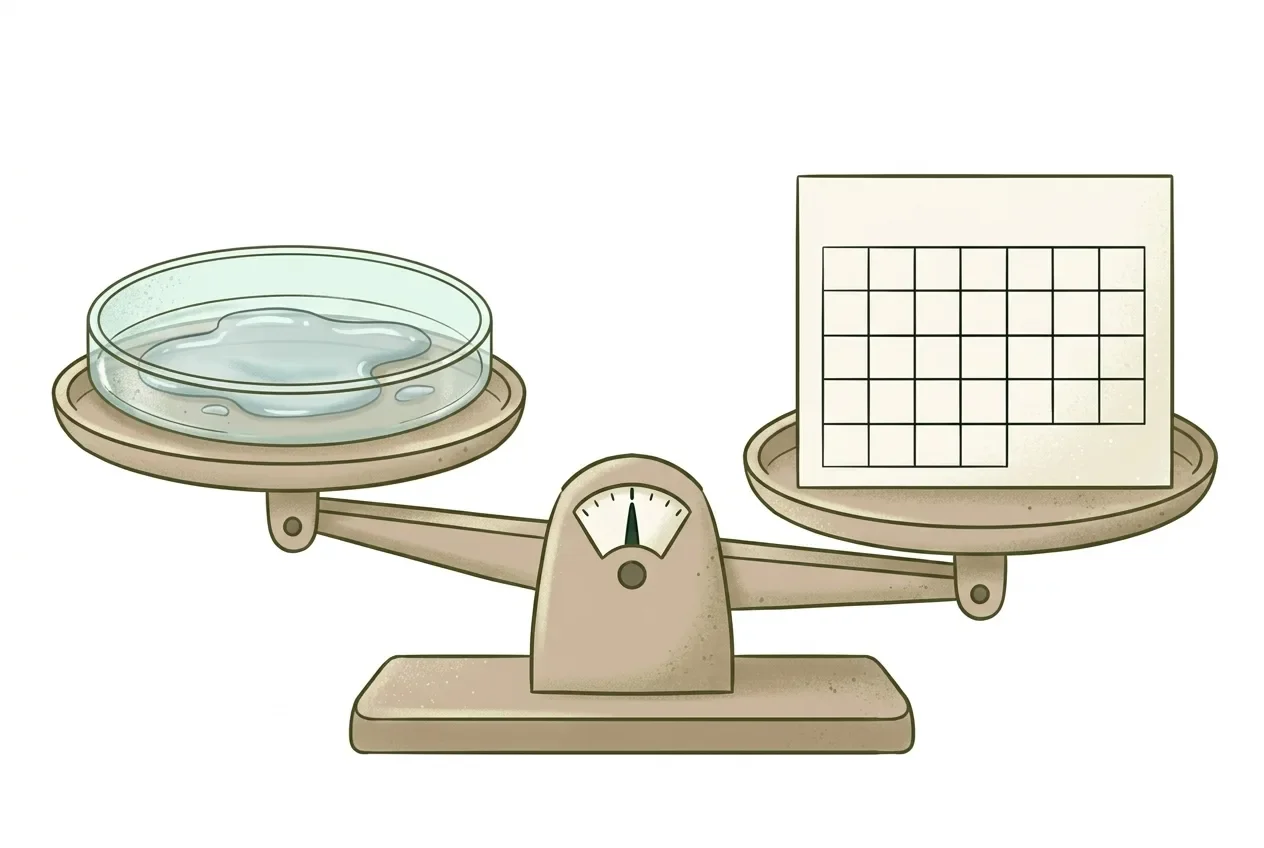
A 2023 study found participants gained about half a kilogram before their period, and it was fluid, not fat. Researchers measured weight during menstruation running about 0.450 kg higher than during the first week of the cycle, in the same women. The difference was almost entirely extracellular water. A separate year-long diary cohort found fluid retention rising through the late luteal phase and peaking on day one of the period.
If your scale jumped 1.5 kg in three days right before your period, that is bigger than either study's average. The next section explains why comparing this cycle day to last week gives the wrong number.
The obvious move is to compare today's weight to last week's. That comparison assumes your body holds a steady baseline all month. It doesn't.
Kanellakis and colleagues measured extracellular water 0.474 kg higher during menstruation than in the first week of the cycle, in the same women. Fat mass and muscle mass showed no significant change. The finding comes from Kanellakis et al., American Journal of Human Biology 2023. The shift is fluid moving in and out of tissue, not tissue itself changing.
White's diary cohort followed 62 women through 765 cycles for a year. It scored fluid retention on a 0 to 4 daily scale. The score reached its lowest point in the mid-follicular phase, then rose from about 0.22 five days before ovulation to about 0.50 five days after, climbing further to a peak of about 0.9 on day one of the period (White et al., Obstetrics and Gynecology International 2011).
Comparing this week to last week catches you mid-rise. You are weighing the trough against the peak of a curve that repeats every month, not against a stable number.
The late luteal phase is the week or so before bleeding starts. It brings a shift in progesterone and estrogen.
That hormonal change affects how the kidneys handle sodium, and sodium retention pulls water with it. Extracellular fluid rises for a few days and then falls again once bleeding begins. That timing lines up with the day-one peak both studies point to.
The NHS lists bloating as a common premenstrual symptom in the weeks before a period, alongside cramping (NHS, "Premenstrual syndrome (PMS)"). It's named as normal, not something to treat with the scale as your guide.
None of this is a hidden fat gain. Per Kanellakis et al., fat mass showed no significant change across the cycle in their cohort. The scale is reporting extracellular water, not a change in body composition.
Possibly a small part of it. Research on the menstrual cycle's effect on energy balance found a pattern worth naming. Energy intake and cravings for carbohydrate and fat rich foods tend to rise in the luteal phase compared with the follicular phase, in that study's cohort (Davidsen, Vistisen and Astrup, International Journal of Obesity 2007). That paper's precise numbers weren't available to check directly, so treat this as a qualitative pattern from one study, not a specific figure.
Neither cited study measured whether higher intake itself adds detectable weight before digestion, so this article does not attribute any part of the swing to that. What a food log can tell you is simpler: whether your own logged intake rose in the days before your period, so you know which weeks to compare in the first place. Weighing the food itself is the part how to count calories accurately walks through. A comparison across weeks is only as good as what went into each week's log.
If a craving that week means cooking something from scratch, the recipe calorie calculator can help. It turns a homemade dish's total calories into calories per serving or per 100 g, so that meal still lands in the same log you are comparing month to month.
The fix is simple: match the calendar, not the clock. Instead of asking how today compares to seven days ago, ask how today compares to the same day of the cycle last month.
To do that you need two things logged: your weight, and roughly where you are in your cycle. If you weigh in daily, you can line up day 26 of this cycle against day 26 of last cycle instead of against last Tuesday.
That comparison removes the fluid curve from the picture. You are comparing two points at the same phase, not two points at different phases. What's left is closer to your actual trend.
Avocalo's 30-day statistics view is built for exactly that kind of comparison: log weight and meals in the app to build the history, then hold this cycle day up against the equivalent day last month.
The starting weight and the days chosen are illustrative, invented to show the arithmetic. The 0.450 kg and 0.9-of-4 figures are the sourced ones from the two studies above.
| Comparison point | Weight | What it tells you |
|---|---|---|
| Cycle day 8 (illustrative baseline) | 62.0 kg | Roughly mid-follicular, the phase White et al. found had the lowest fluid retention scores of the cycle |
| Cycle day 26, day before period (illustrative, +1.5 kg logged) | 63.5 kg | Late luteal phase, fluid retention score climbing toward its day-one peak per White et al. |
| Same cycle, day 3 after bleeding starts (illustrative) | 62.1 kg | Fluid retention score has passed its peak and is falling |
| Last month, day 26 of that cycle (illustrative) | 62.3 kg | The real same-day comparison |
Reading day 26 against day 8 shows a 1.5 kg rise. That comparison spans two different points on the fluid retention curve White et al. described. It doesn't compare two points at rest, so the size of the gap tells you more about timing than about what changed in the body.
Reading day 26 against day 26 of last month tells a different story. The gap is 1.2 kg (63.5 minus 62.3). Per the two cited studies, extracellular water rising toward its day-one peak explains this kind of gap far better than fat does. Reading day 3 after bleeding shows the number nearly back to the earlier baseline. That's the shape White's cohort describes: a rise into day one, then a fall.
Avocalo can't tell you which part of a scale change is cycle-related fluid and which part is trend. It can make the same-day-last-month comparison possible to see.
Photograph a meal and the app's AI vision model estimates calories and macros from the image. You review and edit the result before saving it. You can also search its food database and log manually. Weight entries build into the 30-day statistics view mentioned above.
That view turns "the scale went up" into "here's what day 26 looked like last month too." Download Avocalo to start building that log. It won't tell you the fluid is normal, but it will show whether this month's pattern matches last month's.
It can. Cleveland Clinic, a health authority, names 5 lb, about 2.27 kg, as their threshold for when a period-linked weight change is worth discussing with a provider. The two studies cited in this article found smaller averages in their own cohorts: about 0.45 kg measured directly, and a diary score that peaks around day one without converting to a specific kilogram figure.
Neither study in this article measured water intake directly, so this article won't invent a number for it. The fluid retention described here is driven by how the kidneys handle sodium in the late luteal phase, not simply by how much you drink.
White's cohort tracked 765 cycles across 62 women and found fluid retention scores differed strongly between women, but not significantly from one cycle to the next within the same woman. That means your own pattern is likely to repeat fairly consistently month to month, so a big swing from your personal norm is more worth noticing than comparing yourself to someone else's average.
Yes. The scale measures total body weight, while bloating is a subjective sense of fullness or tightness, and the two don't necessarily move together. NHS lists bloating as a common, separate PMS symptom alongside the general pattern of fluid retention.
Cleveland Clinic names 5 lb, about 2.27 kg, as their suggested point for talking to a provider. A swing near or past that size is worth raising with a doctor. So is one that doesn't resolve within a few days after bleeding starts, or one that comes with other symptoms that concern you.
This article was written by the Avocalo Editorial Team for Petros IT Solutions SRL, following the editorial policy. Spotted an error? Write to [email protected].