Water weight and the scale
How Long Does Cheat Day Weight Last?
How long does cheat day weight last? Usually 2 to 4 days: it's glycogen water and food weight, not fat, and a worked example shows the split.
Guides
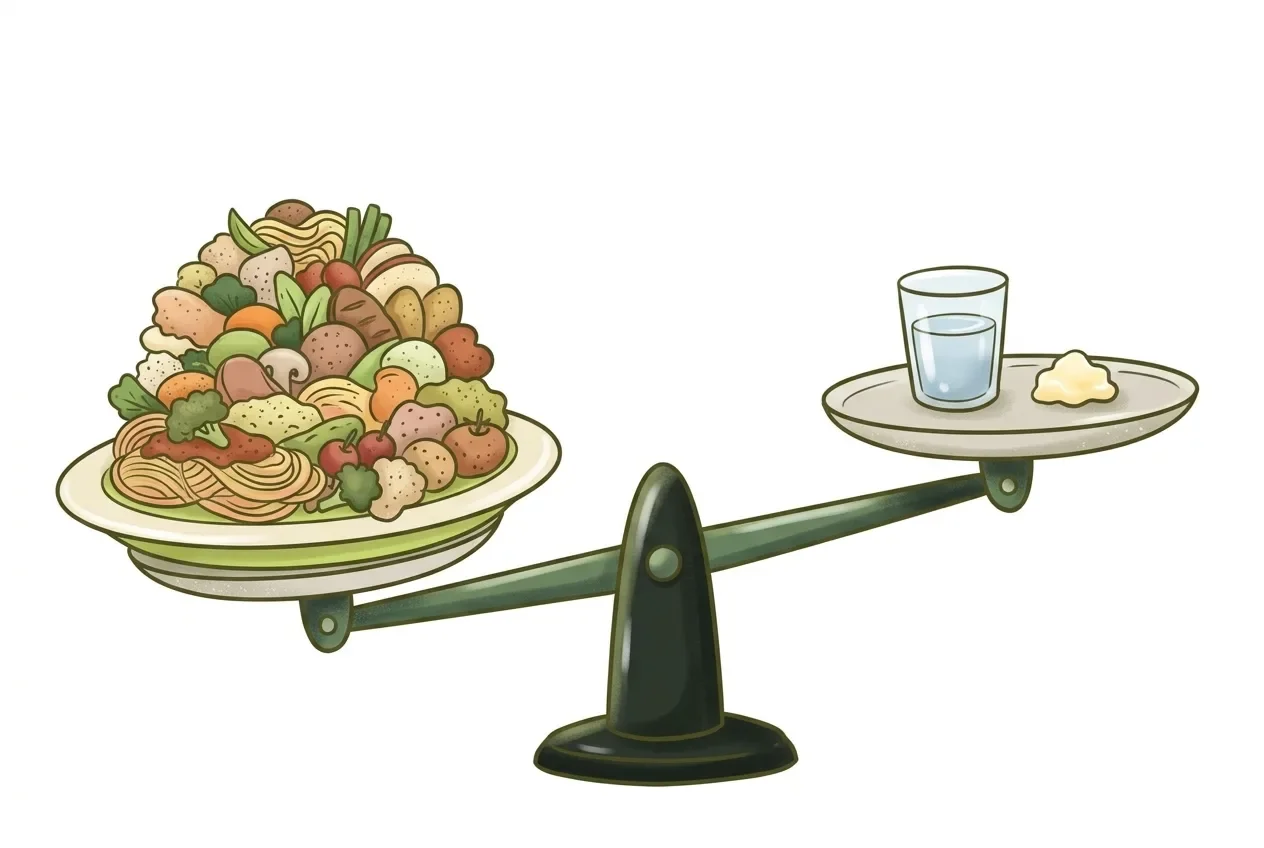
One day of overeating will not ruin your progress. A 1,000 kcal surplus adds only about 0.1 to 0.2 kg of actual body fat. Body fat tissue is fat plus water and cells. It holds roughly 5,100 to 8,000 kcal per kilogram (Martin et al. 1994).
The 1 to 2 kg you might see on tomorrow's scale is mostly water. It comes from the extra glycogen your body just stored, plus food still moving through your digestive system. It leaves within a few days if you eat normally.
The obvious method is to divide 1,000 kcal by 3,500 kcal per pound, the traditional rule of thumb. That gives roughly 0.13 kg of fat gained, inside the range the fat-tissue figures allow.
The problem is comparing that number to what the scale actually shows the next morning. That can be 1 to 2 kg higher. Those two numbers are not measuring the same thing.
The scale weighs water, food still in your gut and glycogen, along with any fat. Hall's 2008 paper on energy deficits per unit of weight loss notes the 3,500 kcal rule itself overstates real fat change in leaner people. So even the fat estimate is a ceiling, not a floor. The extra kilograms on the scale are a separate story, explained by what your body does with the carbohydrate in that meal.
Your body's first move after a big meal is not to make fat. It refills glycogen, the stored form of carbohydrate kept in muscle and liver.
Glycogen does not sit dry. Olsson and Saltin's 1970 study on total body water found the body stores about 3 to 4 g of water for every 1 g of glycogen (Olsson & Saltin, 1970). A modest glycogen refill of a few hundred grams can pull in over a kilogram of water on its own. That happens before any food weight is even counted.
Acheson et al. (1988) showed the body's glycogen storage capacity is about 15 g per kilogram of body weight. That is roughly 500 g of glycogen capacity for most adults. Filling that tank uses up glycogen-water long before de novo lipogenesis, the process of turning carbohydrate directly into fat, becomes meaningful. That process only ramps up after sustained intake above about 475 g of carbohydrate a day, far more than one dinner supplies.
No. Skipping a meal or cutting hard the next day does not target the fat you actually gained. Most of tomorrow's higher number on the scale is water and food weight, not fat, and it is already on its way out.
Eating normally lets glycogen and gut contents settle back down over the following days. Restricting further only adds hunger on top of a number that was going to correct itself anyway. If you would rather count the day carefully than guess at it, how to count calories accurately covers the method for the days that follow.
Glycogen-linked water tends to clear within days once intake returns to normal. That follows the same replenish-and-deplete pattern the glycogen storage research describes (Acheson et al., 1988).
Food still in the digestive tract clears on its own separate schedule, generally within a day or two as digestion runs its course. That transit time is not the same mechanism as glycogen turnover, and no fixed hour is named in the cited research for either process.
Body fat tissue holds roughly 5,100 to 8,000 kcal per kg, while pure triglyceride holds about 9,440. Using the leanest tissue figure, 5,100, gives the most cautious estimate of how much fat one overage day could add.
| Energy density used | Source | Fat gained from 1,000 kcal |
|---|---|---|
| ≈5,100 kcal/kg (leanest body fat tissue, includes water and cells) | Martin et al., 1994 | ≈0.196 kg |
| ≈9,440 kcal/kg (pure triglyceride) | Hall, 2008 | ≈0.106 kg |
Both are well under half a kilogram. Neither accounts for the fact that digesting extra food itself burns some of those calories. That effect would push the true figure even lower.
Compare that to a typical 1 to 2 kg scale jump the next morning. Most of that jump is the 3 to 4 g of water held per gram of newly stored glycogen (Olsson & Saltin, 1970). The gap between roughly 0.1 to 0.2 kg of fat and 1 to 2 kg on the scale is the water, not a miscalculation.
Carbohydrate is the main driver of the glycogen-water effect described above, since glycogen is built from carbohydrate specifically. A dinner heavy in refined carbs and sides is more likely to trigger a bigger glycogen refill than the same calories from fat or protein.
Alcohol calories were not part of the glycogen research this article draws on, so nothing here is measured for alcohol specifically. As this article's own inference, extending the same mechanism described above: since glycogen is built from carbohydrate, alcohol calories would not be expected to refill glycogen or carry its water-binding effect, but that extrapolation was not tested in the cited sources.
Log the meal as it was and leave it there. There is nothing to fix by memory or by skipping the next meal.
If you want a rough read on your own number, you can check what an overnight jump on your own scale is likely to be. Use the site's fat or water calculator, which weighs your specific change against the same energy-density figures used above.
For the ongoing picture, you can log the day in Avocalo and move on. Use the app at Avocalo's download page to keep the entry honest and watch the weight trend over the following days.
Not on its own. A single 1,000 kcal surplus adds at most about 0.1 to 0.2 kg of fat by the sourced energy-density figures above, a small amount compared to the thousands of kcal a sustained weekly deficit totals, so one day rarely undoes sustained progress.
No, this article is about one higher-than-usual day, not a clinical pattern. The mechanism described here, glycogen refill and water retention, applies to any single day of extra eating regardless of the reason.
That is a different question worth attention, separate from the arithmetic of one day. If eating well above your usual amount is a frequent pattern rather than an occasional dinner, it may be worth discussing with a professional who can look at the whole picture.
That specific comparison was not measured in the sources this article draws on. As this article's own inference from the mechanism above, alcohol calories are not stored as glycogen the way carbohydrate is, so they would not be expected to pull in the same 3 to 4 g of water per gram that glycogen storage does (Olsson & Saltin, 1970), though this extrapolation is not itself a tested result.
This article draws on primary research measuring how fat tissue, glycogen and body water actually respond to a calorie surplus.
See the editorial policy for how figures on this site are checked. This article is published by Petros IT Solutions SRL under the byline Avocalo Editorial Team. Report a correction to [email protected].