Water weight and the scale
Why Am I Gaining Weight in a Calorie Deficit?
Why am I gaining weight in a calorie deficit? Water, glycogen and salt shift by a kilo fast; true fat loss is far smaller and slower.
Guides
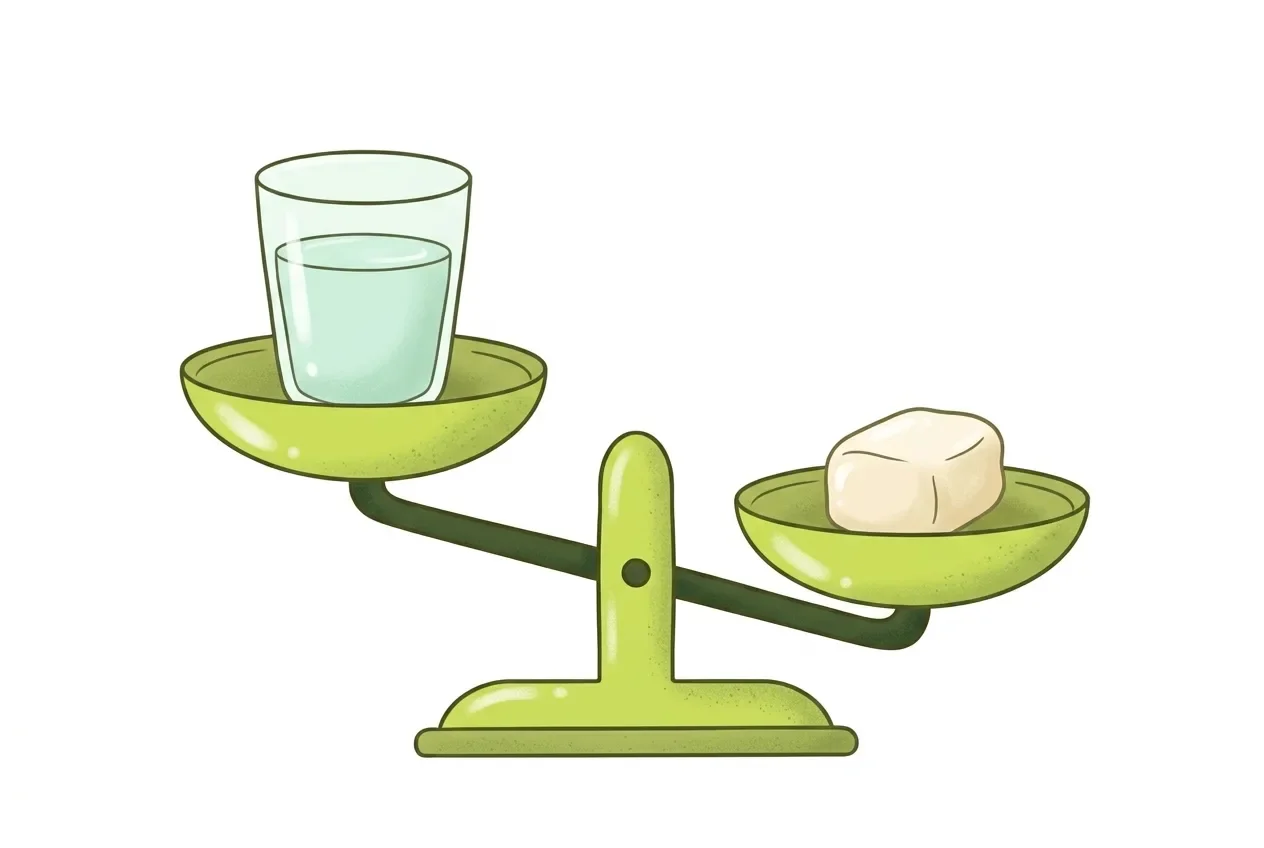
A 2kg jump on the scale overnight is water, not fat. Body weight can swing by a kilogram or two from one day to the next because of salt, carbohydrates, hormones and digestion, none of which involve storing fat. Fat gain works on a much slower, much larger scale, and the arithmetic below shows why one meal cannot produce it.
Pure fat holds about 9,440 kcal per kg, but body fat tissue also contains water and cells, so it holds less: measurements by Martin et al. (1994) put it at roughly 5,100 to 8,000 kcal per kg. The popular rule of 7,700 kcal per kg, derived from Wishnofsky's 1958 calculation, is a rule of thumb that sits inside that range, not a measured figure.
To show that 2kg of actual fat could not appear overnight, we can use the leanest figure, about 5,100 kcal per kg, which makes the case hardest to argue. Even then, you would need to eat roughly 10,200 kcal above what your body burns, in a single day.
That is illustrative math, not a target: 10,200 kcal in one day is the sourced number to check against, and it is far beyond what a single sitting or a single day of meals could realistically supply. So if the scale jumped 2kg overnight, fat is not the explanation. Something else moved, and it moved fast.
Two mechanisms explain most of the swing, and they work on different substances.
Neither mechanism adds fat. Both add water, which weighs the same as any other water: one liter is one kilogram on the scale.
This kind of gain is temporary. Glycogen and its bound water get used up as you move and eat normally over the following one to three days, and sodium-linked fluid shifts tend to settle out on a similar timeline.
Fat, by contrast, accumulates slowly across weeks of sustained surplus, roughly one kilogram of fat tissue for every 5,100 to 8,000 kcal above what you burn. Water moves in days, fat moves in weeks. If a 2kg jump is still there after a week of normal eating, look at the weekly trend instead of any one morning.
Ignore the single reading and watch the pattern instead. A weekly average smooths out water swings and shows whether your calorie intake, not your hydration, is actually changing. Logging a meal with a worked example, as in how to count calories in homemade food, makes that weekly trend easier to build. Photographing meals in Avocalo turns that weekly check into a habit instead of a one-off calculation.
Yes, sometimes. Exercise depletes glycogen, and refilling it afterward pulls water back into your muscles as described above. This can show up as a temporary weight increase in the days after a hard workout, even though nothing about your fat stores has changed.
You do not need to stop, but expect the number to be noisy. A single large or salty meal can shift water weight for a day or two, so treat that morning's reading as an outlier rather than a trend.
Sodium, carbohydrate intake, and hormonal fluctuations vary day to day even at a stable calorie total. Water retention responds to what you ate and how your body is cycling fluids, not directly to your calorie count.
This article is published by Petros IT Solutions SRL. Spotted an error? Write to [email protected].