Water weight and the scale
How Long Does Cheat Day Weight Last?
How long does cheat day weight last? Usually 2 to 4 days: it's glycogen water and food weight, not fat, and a worked example shows the split.
Guides
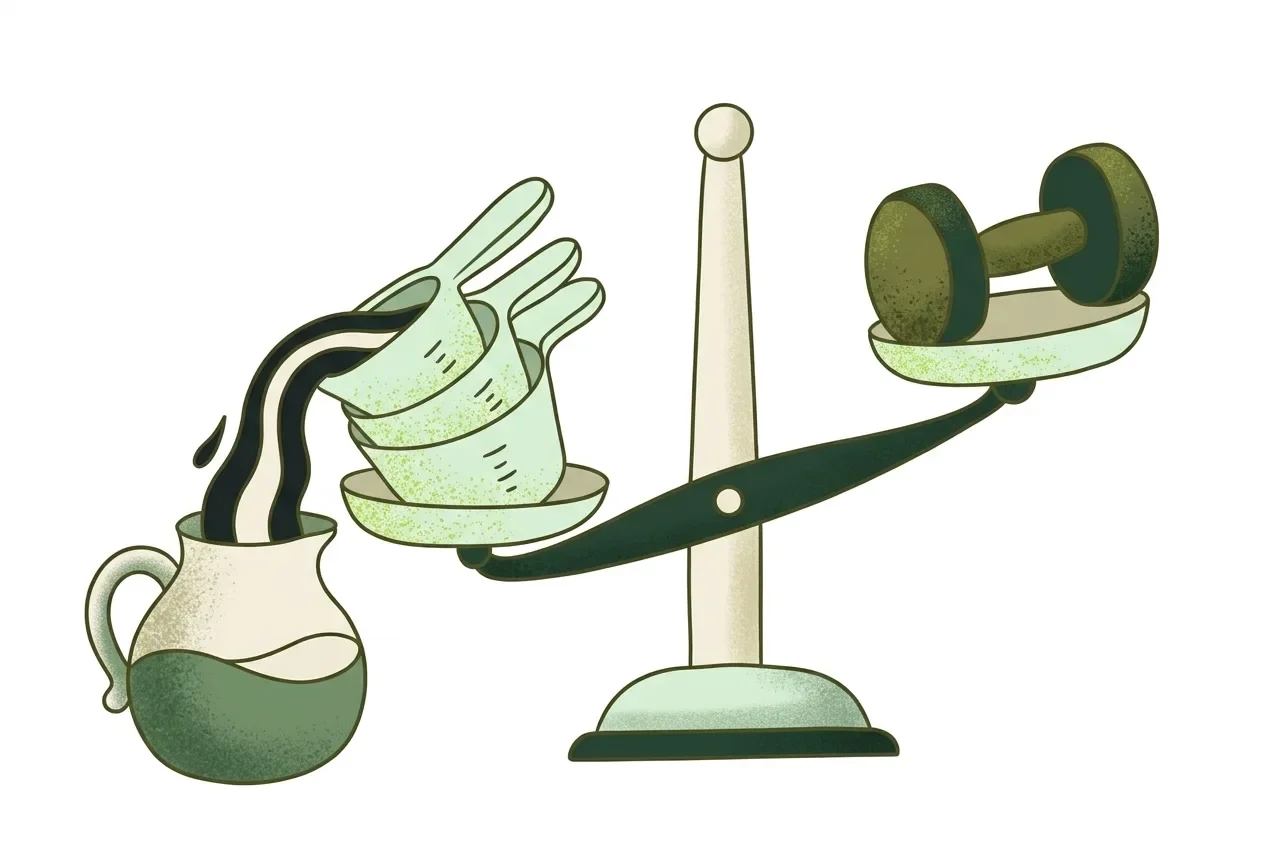
Trying to tell water weight vs fat apart? A jump of 1 to 2 kg in a day or two is almost never fat, it's water weight. Fat gain needs a large, sustained calorie surplus. A change that fast is food still in your gut, extra glycogen, or water your body is holding onto. If the number holds for two to three weeks, that's the one worth taking seriously.
The scale only reports total mass. It cannot tell you what that mass is made of.
Fat, food, glycogen and water all weigh something, and they can all shift the same amount overnight. A 1.5 kg rise after a salty, carb-heavy weekend looks identical on the scale to 1.5 kg of fat.
The difference is speed. Fat accumulates slowly because building it costs a large amount of energy. Water and food mass move fast because nothing has to be built, they just have to be absorbed or retained. Once you know the energy ceiling on fat gain, a same-day jump stops being a mystery.
Very little. Research tracking body composition during dieting found that a kilogram of adipose tissue holds a large amount of energy. It's roughly 6,041 kcal once weight change stabilises past the first six weeks. That figure comes from Heymsfield and colleagues' analysis of DXA-measured fat and fat-free mass changes (Metabolism, 2012).
That figure is for adipose tissue as a whole, not pure fat. Real fat tissue is 54% to 85% lipid alongside water and structural material (Martin et al., International Journal of Obesity, 1994).
Either way, gaining even half a kilogram of actual fat in a single day would take a lot of surplus energy. It would need thousands of kilocalories beyond what your body burns, in that one day alone. That's a ceiling, not a target: it shows what's arithmetically implausible, never a number to eat under.
Carbohydrate is stored with water attached. When muscles replenish glycogen, each gram is stored with roughly 3 to 4 grams of water. That ratio comes from classic research by Olsson and Saltin, cited in a 2022 review in Nutrients (Shiose, Takahashi & Yamada). The review notes the ratio can range more widely, from 1:3 up to 1:17, depending on how much fluid is consumed during recovery.
A weekend of pasta, bread and rice after a lighter week can refill glycogen stores significantly. The water that comes with it is real weight on the scale, and it is not fat.
Sodium works differently: it pulls water with it and holds it in the body. Action on Salt is part of Queen Mary University of London's Wolfson Institute of Population Health. It states that a high-salt intake can cause the body to retain around 1.5 litres of fluid, and that this retention continues for as long as the higher salt intake is kept up (Action on Salt).
That 1.5 litres alone accounts for roughly 1.5 kg on the scale. That's on top of anything from glycogen or food still being digested. The source doesn't give a day-count for how fast it reverses, only that it keeps building as long as the higher intake continues, which implies it eases once intake drops back to normal.
You don't need to wait weeks to get a first read. Run this over three days:
If most of the gain has reversed by day three, it was water and food mass. Day-to-day water fluctuation can mask small shifts either way, so if the number hasn't moved at all, watch it over the following one to two weeks rather than concluding fat gain right away.
The intake numbers below are illustrative, meant to show the arithmetic, not a measured case. Suppose someone's weight rises by 1.8 kg after a weekend with extra pasta, bread, and a couple of salty restaurant meals.
| Contributor | Illustrative amount | Basis |
|---|---|---|
| Food and fluid still in the gut | ~0.5 kg | Illustrative: undigested meal mass |
| Glycogen-bound water | ~0.7 kg | 200 g extra glycogen × 3.5 g water/g, a mid-range figure within the 3 to 4 g/g ratio (Shiose et al., 2022) |
| Salt-driven fluid retention | 1.5 L (1.5 kg) | Action on Salt, sourced figure |
| Actual fat gained | negligible | Would need thousands of kcal surplus in two days (Heymsfield et al., 2012) |
Add the glycogen-water and salt-driven water together and the total already exceeds the 1.8 kg example. That's exactly the point: separate mechanisms overlap. They don't need to add up perfectly to explain a jump this size. None of it requires new fat tissue.
Avocalo lets you log meals by photo and log your weight in the same app. Photo logging estimates the foods, portions, calories and macros in a picture, which you can review and edit before saving. That gives you the first half of the three-day test: what you actually ate over the weekend in question.
Logging your weight alongside it gives you the second half. You can see whether the number came back down as the days pass. The app cannot tell you whether a specific jump is water or fat. It only gives you the inputs to run the test yourself. You can log today's meals and weight in Avocalo.
Not directly for salt-driven retention, since that eases once salt intake drops, not once you drink more. Adequate hydration supports normal fluid balance. No source here quantifies drinking water as a fix for retention. Reducing the driver, excess salt or carbohydrate, is what the cited mechanisms actually reverse.
Yes, in a specific way: intense exercise depletes muscle glycogen, and replenishing it afterward pulls water back in at the same 3 to 4 g of water per gram of glycogen ratio described above. That refill can show up as a temporary rise on the scale in the days after a hard workout or a return to training.
Day-to-day fluctuation from food mass, hydration and glycogen is normal and can move the scale by a kilogram or more without any change in fat. A single morning's reading rarely means anything on its own, a multi-day trend is the more reliable signal.
A first-week drop often includes glycogen and its bound water being used up, alongside any actual change, which is why early losses can look larger than later weeks. This article doesn't source a specific size for that effect, but the same glycogen-water mechanism described above runs in reverse when carbohydrate intake drops.
You can also check the calculation against your own overnight jump with the fat-or-water calculator, or confirm your own trend with a weight-trend calculator once your three days are up.
This article was written by the Avocalo Editorial Team for Avocalo, published by Petros IT Solutions SRL. See our editorial policy for how we source and check figures. Spot an error? Write to [email protected].