Photo calorie estimates
Are AI Calorie Counting Apps Accurate?
Are AI calorie counting apps accurate? Studies show photo estimates run from close to a lab value to hundreds of calories off.
Guides
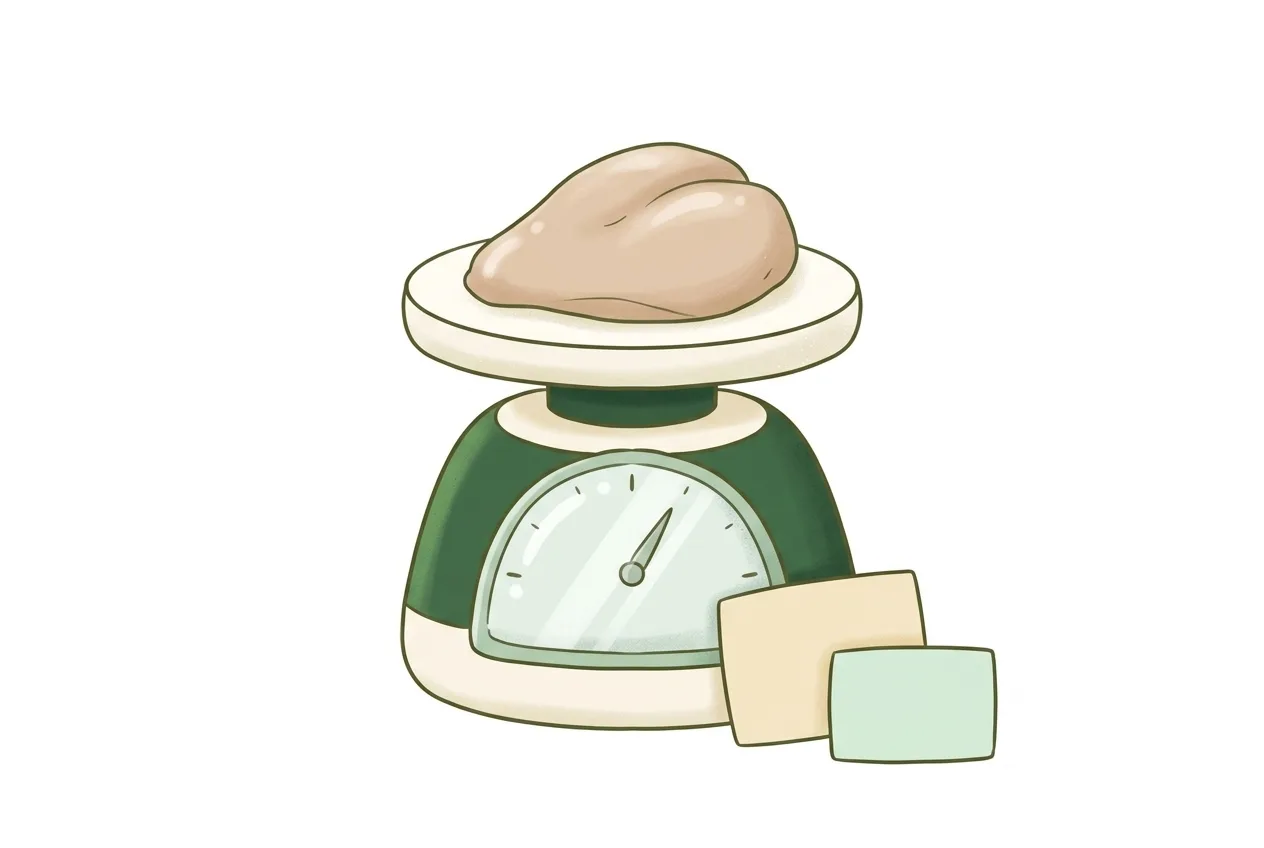
Accurate calorie counting means weighing food on a scale, matching it to a primary data source, and accounting for what cooking does to weight. That is the whole method. You weigh the raw or cooked ingredient. You look up its energy value in a source you can check. Then you multiply by the actual weight eaten, not an estimated portion. Skipping any one of those three steps is where most of the error creeps in, whether the food is homemade, packaged, or ordered at a restaurant.
The rest of this guide walks through each part of that method. It shows how much error appears when a step is skipped, and it works through one meal from raw ingredients to a per-serving number.
Accurate counting has four moving parts. Each one is a place where a number can drift from reality.
Each of the following sections answers one of these in enough detail to act on immediately. One links out to a full worked guide, since the homemade-recipe question has enough mechanism to earn its own page. As this site's cluster on raw-versus-cooked weighing grows, this section will link to that guide too.
Two honest numbers can disagree because nutrition labels are allowed to. Under United States food law, calories fall under a rule that caps how far a lab-tested product can run over its declared value. A food is misbranded if its measured calories exceed the declared label figure by more than 20%, but the same rule sets no minimum floor for calories at all (21 CFR 101.9(g)(5)).
A separate part of the same regulation covers a different group of nutrients, such as protein and fiber. Those do require a measured value of at least 80% of what is declared, but calories are not in that group. In practice this means a label is only guaranteed not to understate calories by too much. It offers no legal guarantee against overstating how few calories a food actually has.
Databases add a second source of drift. A food database entry is somebody's measurement of a specific sample. Different samples, suppliers, or copies of the same government record kept on other sites can show slightly different figures. A record can also change over time, as measurement methods improve or a new sample is tested, so the same food item can carry a slightly different number in two snapshots of the same database.
That is not an argument against tracking. It is a reason to prefer the primary source over a summary of it. Prefer the actual regulator's rule or the actual database record. Expect single-digit percentage disagreements between reputable sources as normal, not a sign that one of them is wrong.
Weigh and log a food in the same state you have data for it, and match your weight to that state consistently.
Cooking changes weight because water and sometimes fat leave the food. This concentrates the remaining nutrients per 100 g, even though the total calories in the piece barely change. A raw-food database entry paired with a cooked weight, or the reverse, produces a number that is wrong before any other error is added.
The fix is a matching rule, not a preference for raw or cooked. If your data source lists the food raw, weigh it raw, before it goes in the pan. If your source lists it cooked, weigh the finished piece. Writing down which state you weighed, raw or cooked, next to each entry removes the guesswork the next time you log the same dish.
Cooking concentrates protein per 100 g without changing the total grams by much. This effect is documented for one common cut in how cooking method changes protein content in chicken, which shows the same raw-versus-cooked mechanism applied to a real USDA record.
Labels are accurate within a legal tolerance, not to the calorie. In the United States, a food is misbranded if its measured calories exceed the declared label value by more than 20%, but the same rule sets no required minimum for how low the true value can run under the label (21 CFR 101.9(g)(5)). That means the printed number is a ceiling with real teeth on overstatement, and no equivalent floor stopping a product from containing meaningfully fewer calories than advertised.
This matters most when a food is eaten in large multiples of its labeled serving. A small percentage gap on one serving is trivial. The same gap repeats across four or five servings of a staple food. Think of a protein powder or a sauce used daily. It adds up to a real number over a week, even though no single label broke any rule.
The practical response is not to distrust labels. Treat the printed calorie figure as a regulated estimate with an asymmetric legal tolerance, not a guarantee in either direction. Expect it to be closer to the truth for whole, simple foods than for complex packaged ones with more ingredients to measure.
For a homemade dish, add up the calories of every raw ingredient before cooking. Weigh the finished cooked dish once it is done. Divide the ingredient total by the number of servings you cut it into, or by the cooked weight to get a per-100g figure.
The order matters. Cooking removes water weight but not calories, so the total energy in the pot stays close to the sum of the raw ingredients, while the weight of the pot goes down. Logging a recipe by weighing only the cooked result against a raw-ingredient calorie count, without doing the addition first, is a common source of error. This mistake is easy to make because the cooked dish looks like a single food once it is plated, even though it started as a list of separately weighed ingredients.
A full worked sum, ingredient by ingredient, with the addition and the division shown, is worked through in a full worked example for a homemade recipe. Once you have a recipe's total calories from that method, use the free recipe-portion calculator. It turns that total into calories per serving, per 100 g of the cooked dish, or for a specific portion you weigh out, without redoing the arithmetic by hand each time.
Without a scale, error can be large. A 1982 clinical study asked dieting patients with obesity to estimate quantities and calories for ten common foods by eye. Quantity estimates were off by an average of 63.9%, and calorie estimates were off by an average of 53.4% (Lansky and Brownell, American Journal of Clinical Nutrition, 1982).
That sample was small and specific: dieting adults with obesity, not a general population. The exact percentages should not be read as a universal error rate for everyone who estimates portions by eye. But the direction is instructive for this narrow, studied group. Their unweighed portion estimates were wrong by roughly half, not by a rounding error.
A kitchen scale removes the biggest single source of that kind of error. It replaces a guess about volume or size with a measured weight. The label or database error discussed above still applies after that, but it operates on a single-digit percentage scale, not a fifty-percent one.
Restaurant meals are the hardest case because you cannot weigh the ingredients or watch them being cooked. Portion sizes vary by kitchen. Hidden fats like cooking oil or butter used in preparation are usually invisible on the plate.
The closest you can get without weighing is to use the restaurant's own published nutrition information where it exists. Large chains are the ones most likely to publish it. Treat any number for a dish made in an unfamiliar kitchen as an estimate with a wider margin than a home-weighed meal.
When no published figure exists, comparing the dish to the closest homemade version you have already weighed gives a reference point, even though it will not match exactly. This uncertainty is a real limit of eating out, not a flaw in the counting method itself. A photo-based estimate, like the kind Avocalo produces from a picture of a plate, faces this same limit: it cannot see hidden oil or measure the actual portion either.
Here is one ingredient carried through the method above, using a real USDA record, to show how a small data gap compounds.
USDA FoodData Central record 171077 lists raw, skinless, boneless chicken breast at 120 kcal per 100 g (FoodData Central). While researching this article on 2026-09-26, one commonly used data mirror was observed showing 114 kcal per 100 g for this same cut, a 6 kcal per 100 g gap against the primary record at that time.
Mirrors can lag behind, or diverge from, the primary database, so a figure copied from one is not guaranteed to match the source it was copied from. Neither number here is fabricated, but only one of them is the primary source.
| Data source | kcal per 100 g | kcal in 400 g raw | Gap vs primary |
|---|---|---|---|
| USDA FoodData Central, record 171077 (primary) | 120 | 480 | n/a |
| Data mirror observed 2026-09-26 | 114 | 456 | 24 kcal |
Across 400 g of raw chicken, roughly a family-sized portion of breast meat, the 6 kcal per 100 g gap observed at that time becomes a 24 kcal difference in the recipe total. This happens before the dish is even cooked, split into servings, or affected by any label tolerance.
This is where the earlier sections connect. You would weigh the chicken raw, matching the raw-listed database entry, per the raw-versus-cooked section. You would use the primary FoodData Central record rather than a mirror, per the section on why sources disagree. Once the full recipe total is known, dividing by servings uses the same method described in the homemade-recipe section, or the free recipe-portion calculator if you would rather not do the division by hand.
Avocalo is a mobile app that estimates calories and macros from a photo of a meal. The user photographs the plate or picks a photo from their gallery, and an AI vision model reads the image to estimate the foods, portions, calories, protein, carbohydrates and fat. The user reviews and edits the result before saving it.
A photo estimate comes from the model reading the image, not from weighing the food or matching it against a nutrition database. It cannot see hidden oil, sauces, or exact portion weight the way a kitchen scale and a label can.
For a reader who wants the weighed, label-checked precision this guide describes, Avocalo also supports manual logging from a food database built from Open Food Facts, USDA FoodData Central, and national food-composition tables. Readers who want to try either approach can download Avocalo.
No, weighing matters most for foods eaten often or in large amounts, where a portion-size error repeats and compounds. Occasional meals, especially restaurant food, tolerate a rougher estimate without meaningfully changing a week's totals.
A photo estimate and a weighed, label-based estimate rest on different information. Weighing measures the actual food in front of you, while a photo estimate is the AI model's reading of an image, without a scale or a database match, so it cannot see hidden oil or exact portion size.
Restaurant kitchens vary portion sizes and use cooking fats you cannot see on the plate, and you cannot weigh the dish yourself. Even a careful home-weighing habit meets a harder problem the moment the meal was cooked somewhere else.
Yes, a small per-serving gap allowed under label tolerance rules multiplies with each serving eaten. One serving's rounding is trivial. Five servings of the same food in a week can add up to a noticeable total.
Published by Petros IT Solutions SRL. Spotted an error? Write to [email protected].