Raw vs cooked weight
Does Cooking Change Protein Content in Chicken?
Does cooking method change chicken's protein? Roasting and stewing barely change protein grams, USDA data show, only how concentrated it looks per 100g.
Guides
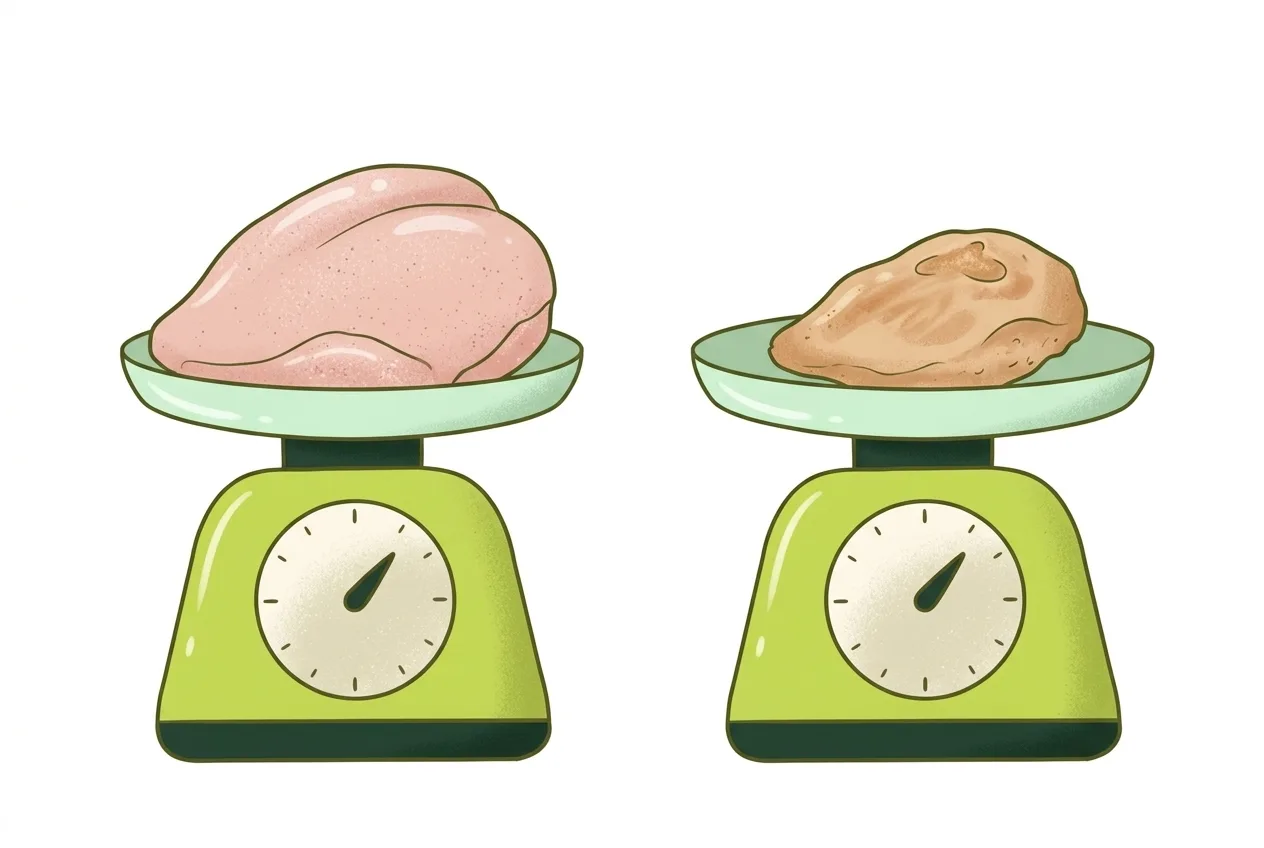
Weigh food in whatever state matches the database entry you're logging. If you picked "chicken breast, raw" from a food database, weigh it raw. If you picked "chicken breast, cooked," weigh it after cooking. The two entries hold different numbers per 100 g, because cooking drives water out or lets it in. Matching the wrong weight to the wrong entry is the tracking error this guide prevents.
That's the rule. The rest of this guide shows why it works, with arithmetic instead of a percentage to memorize.
Most of what leaves a raw cut of meat during cooking is water, not substance. Raw chicken breast is about 74 g water per 100 g. Roasted chicken breast is about 65 g water per 100 g, per USDA FoodData Central records for the raw and roasted cuts. That water evaporates or drips away as the meat heats, so it weighs less once cooked, even though almost none of its protein is gone.
Rice runs the opposite direction. Raw rice holds about 12 g water per 100 g. Once boiled, it holds about 68 g per 100 g, per USDA's raw and cooked rice records. The grain absorbs water as it cooks, so it weighs more.
A scale only reports total mass. It can't tell you whether that mass is protein, fat, carbohydrate or water, so the same food shows two different numbers depending on when you weigh it.
Either works, as long as it matches your database entry. The two numbers aren't interchangeable: 100 g raw beef and 100 g cooked beef are different amounts of meat, with different calorie and protein counts.
Weighing raw is often simpler, since it takes one weighing, before the food touches heat. For a raw beef steak, USDA regulation 9 CFR 317.309 sets "as packaged" (raw) as the default nutrient-declaration basis for meat, with single-ingredient raw cuts that are not ground or chopped permitted to instead declare values "as consumed" (cooked). Poultry follows a similar structure under 9 CFR 381.445, which lets packagers choose either raw or cooked as the labelling basis, provided the cooking method is disclosed when cooked values are used, without meat's raw-first default.
If you're logging a dish someone else cooked, weighing cooked is the only option. Look for a cooked-state entry rather than applying a raw entry to a cooked weight. Mixing states, weighing raw then logging a cooked entry, or the reverse, gives the wrong number, since the two entries simply hold different figures per 100 g.
You can work this out from USDA figures instead of trusting a flat percentage. Protein survives cooking largely intact, so the protein mass in a raw piece of chicken should roughly equal the protein mass in the cooked piece, once you correct for weight loss.
Raw chicken breast has 22.5 g protein per 100 g. Roasted chicken breast has 31.0 g protein per 100 g, per the same raw and roasted FDC records. If 100 g of raw chicken becomes fully cooked and none of that 22.5 g protein is lost, the cooked weight is wherever 22.5 g of protein equals 31.0 g per 100 g.
That's 22.5 divided by 31.0, times 100, which equals 72.6 g. So 100 g of raw chicken breast should weigh about 73 g once roasted, a loss of roughly 27%. That figure is derived here from the two FDC records above, then checked against the calorie count in the next section. A sibling guide covers how cooking method changes the protein number on chicken in more depth, looking at the raw-to-cooked protein concentration mechanism itself.
Here's the same math applied to three foods, each derived from two matched USDA FoodData Central records rather than an assumed percentage. The predicted-weight column comes from protein or carbohydrate conservation. The final column is not a separate USDA measurement: it's that predicted weight multiplied by USDA's cooked per-100 g calorie figure, calculated here to check the prediction.
| Food | Raw (100 g) | Cooked weight predicted | Cooked calories predicted | Cooked calories, derived from USDA per-100g figure |
|---|---|---|---|---|
| Chicken breast, roasted | 120 kcal, 22.5 g protein | 72.6 g | 119.8 kcal | 119.8 kcal (72.6 g × 165 kcal/100 g) |
| White rice, boiled | 365 kcal, 80.0 g carbohydrate | 283.7 g | 368.8 kcal | 368.8 kcal (283.7 g × 130 kcal/100 g) |
| Ground beef 85/15, pan-broiled | 215 kcal, 18.6 g protein | 75.6 g | 175.4 kcal | 175.4 kcal (75.6 g × 232 kcal/100 g) |
Chicken and rice use protein and carbohydrate as the conserved anchor. For rice: 80.0 g carbohydrate raw, divided by 28.2 g carbohydrate per 100 g cooked from the cooked rice record, times 100, equals 283.7 g predicted cooked weight.
Multiply that by the cooked food's calories per gram: 283.7 g times 1.30 kcal per g equals 368.8 kcal, close to the 365 kcal the raw portion started with. That gap is about 1%, and part of it is simply rounding: FDC lists whole-number calories per 100 g, not the more precise figure behind them, so the raw and cooked values each carry their own small rounding before you ever divide them. Calories in equal calories out, within that rounding, because only water moved.
Ground beef breaks the pattern. Raw 85/15 beef holds 18.6 g protein per 100 g, per the raw record. Using protein conservation: 18.6 divided by 24.6, the pan-broiled patty's protein per 100 g, times 100, equals 75.6 g predicted cooked weight, and 75.6 g times 2.32 kcal per g equals 175.4 kcal, well under the 215 kcal raw. The missing 39.6 kcal is fat that rendered into the pan, not a property of ground beef as a food.
When you didn't weigh the raw ingredients yourself, cooked weight is the only honest option. Look for a cooked-state entry, a restaurant meal, cooked chicken breast or cooked rice, rather than forcing a raw entry onto a finished dish's weight.
If you know a recipe's total calories and either its serving count or total cooked weight, you can work out calories per portion. Avocalo's free recipe-portion calculator takes a known total calorie count plus a serving count or portion weight, and returns calories per serving, per 100 g, or for your portion. It doesn't add up ingredients or convert raw weight to cooked weight, only divides a total you already know.
Log whichever state matches your database entry, every time, for every ingredient. Consistency between the state you weigh and the state you log matters more than picking raw or cooked as a universal rule.
A few things quietly break the result:
Avocalo's manual logging lets you search a food database, built from Open Food Facts, USDA FoodData Central and national food-composition tables, so you can pick the raw or cooked entry matching your scale.
For a meal you never weighed, you can instead photograph the plate. In Avocalo's photo logging, an AI vision model reads the image and estimates the foods, portions, calories and macros directly from the picture, with no scale or database lookup involved. You review and edit the estimate before saving. It's approximate, since the model can't see hidden oil or sauce, but it sidesteps the raw-versus-cooked question entirely. Photograph the plate instead of weighing it with the Avocalo app.
Yes, because each method removes a different amount of water. The chicken ratio above, about 27% loss, applies to roasting specifically, derived from two matched FDC records. A different method, like boiling or pan-frying, needs its own two FDC records to derive its own figure rather than borrowing roasting's number.
This guide has not derived vegetable-specific figures, so no percentage is claimed here. The same water-migration mechanism, boiling adding water and roasting removing it, plausibly applies, but confirming that for a given vegetable needs its own matched raw and cooked FDC records.
Then weigh the food cooked, and log it against a cooked-state entry. Under EU Regulation 1169/2011, Article 31, packaged food nutrition values default to "as sold," with "as prepared" values allowed only alongside detailed preparation instructions.
It can, because marinade adds weight and sometimes calories before the meat touches heat. Weigh meat before marinating if your database entry is for plain raw meat, since the marinade may need logging separately.
This guide's chicken figures come from USDA FoodData Central's raw chicken breast and roasted chicken breast records. The rice figures come from FoodData Central's raw and cooked white rice records, and the ground beef figures from the raw and pan-broiled 85/15 records.
The US meat labelling default, illustrated here with beef, is set out in 9 CFR 317.309, with the related poultry rule in 9 CFR 381.445; the EU default in Regulation 1169/2011, Article 31. See Avocalo's editorial policy for how figures in this guide were checked.
Published by Petros IT Solutions SRL. Spot an error? Write to [email protected].