How to Count Calories in Homemade Food: A Worked Example
Add ingredient calories, weigh the cooked recipe, and calculate your portion. A practical worked example with raw and cooked weights, oils, and leftovers.
Guides
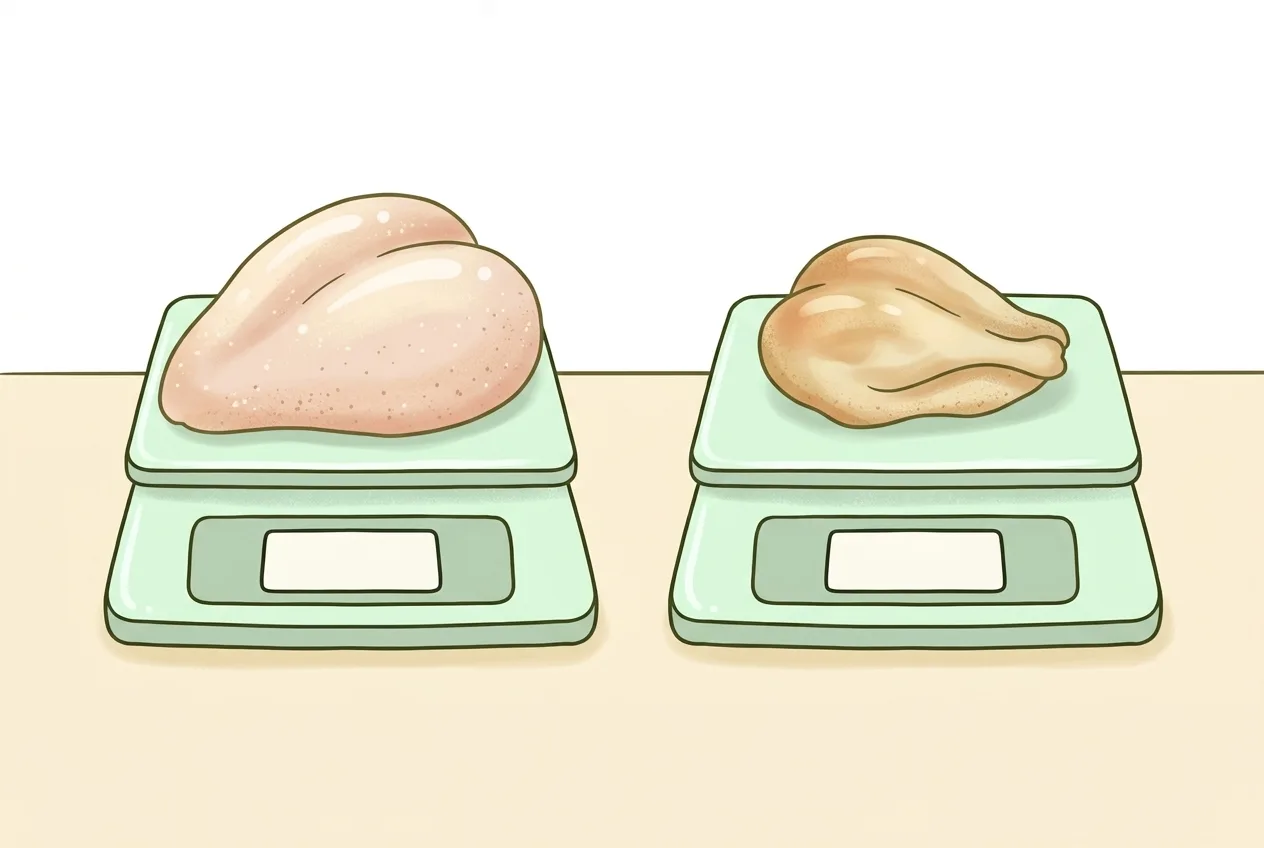
Cooking does not create or destroy protein in a chicken breast. The grams of protein in the piece stay essentially the same from raw to cooked; only the water leaves, so the same meat weighs less afterward and packs more protein into every 100 grams. That is why a food database lists two different numbers for the same chicken: USDA FoodData Central puts raw chicken breast at about 22.5g of protein per 100g, and roasted breast at about 31g per 100g. Nothing was added. The chicken simply lost water weight, concentrating what was already there, and that concentration is what a calorie log has to match to the weight actually on the scale.
The instinct is to treat protein as a fixed property of the food, the way its name is fixed, so surely 100g of chicken has the same protein whether it's raw or cooked. That reasoning is right about the total mass of protein in the piece and wrong about the per-100g figure. Weight and protein don't fall at the same rate when chicken cooks: water evaporates and drips away, but almost all the protein stays where it was. So a 100g portion measured after cooking represents a smaller slice of the original raw piece than a 100g portion measured before cooking, meaning the same 100 grams carries more protein once it's cooked. Log a weighed, cooked piece of chicken against a database entry meant for raw chicken, and both the calories and the protein come out too low, not because the entry is wrong, but because it answers a question about a different weight than the one on the scale. The worked example below shows by how much.
Before you weigh anything, check what the entry you're about to use is actually describing. In USDA FoodData Central, the food name says it directly: 'Chicken, broilers or fryers, breast, meat only, raw' is a different entry from 'Chicken, broilers or fryers, breast, meat only, cooked, roasted', and the two carry different values for every nutrient because they describe the same cut of meat at two different points in its water content. Most consumer food databases, including the one behind a photo-logging app, keep this same split even when the interface doesn't show it prominently. Search for the word raw or cooked, or a specific method like roasted, grilled, or boiled, before accepting a match. If a search returns a single generic chicken breast entry with no cooking state named, treat it as unverified rather than assuming it's raw, since some databases default to the cooked figure because that's what's more often weighed at the table. This one check, reading the entry's full name instead of scanning past it, is what keeps the rest of the calculation from starting on the wrong foot.
Weigh it at whichever stage matches the entry you plan to log against, and let that decision come first. If you're logging what's actually on the plate, that means putting the cooked piece on the scale after it comes off the heat and pairing that weight with a cooked entry. This is the more common case for anyone photographing a finished meal, since a cooked, weighed piece is the physical thing in front of them. If instead you're planning a recipe or batch-cooking ahead, it's often easier to weigh the raw chicken before it goes anywhere near heat, portion it there, and log against the raw entry, converting to a cooked-weight figure later only if a specific meal calls for it. What doesn't work is weighing at one stage and logging against an entry written for the other. Two habits cause this in practice: weighing after cooking out of convenience while defaulting to whatever entry came up first in search, or weighing before cooking and forgetting that the meat will lose water before it reaches the plate. Both push the final numbers off, in predictable directions, once you know which entry assumes which state.
Sometimes the only entry available is raw, but the chicken in front of you is cooked, or the other way round. The fix is a conversion, not a guess, and it can be built from the same two entries already in a database like USDA FoodData Central rather than a separate table: divide the raw protein density by the cooked protein density (22.5 divided by 31, worked through in full below) to get that cut's approximate cooking yield, the fraction of raw weight that survives as cooked weight for a given cut and cooking method. Multiply a known raw weight by that yield to estimate the cooked weight before the chicken even goes in the oven, or divide a known cooked weight by the yield to find its raw equivalent. This only holds within the same cut and cooking method: a grilled thigh and a roasted breast don't share a yield, because they don't lose water or render fat at the same rate. Avocalo's recipe-portion calculator runs this kind of raw-to-cooked scaling automatically when a recipe lists raw ingredient weights but the portion being logged is cooked, the same arithmetic done for you rather than by hand.
The chicken breast weight below, 200g raw, is illustrative, chosen only because it divides cleanly; the protein, calorie, and fat figures are USDA FoodData Central's published values for raw and roasted, skinless, boneless chicken breast, per 100g.
| Metric | Raw (per 100g) | Roasted (per 100g) |
|---|---|---|
| Energy | 120 kcal | 165 kcal |
| Protein | 22.5 g | 31 g |
| Fat | 2.6 g | 3.6 g |
Start with a 200g raw breast. Multiply each raw figure by 2: 240 kcal, 45g protein, 5.2g fat. That piece then goes into the oven. Protein isn't lost to heat in any meaningful amount, so the cooked piece still holds 45g of protein, just packed into less mass. To find that mass, divide the protein by the cooked density: 45g divided by 31g per 100g equals 145g cooked, rounded down from 145.2g. Check the other two figures against that same 145g: 145 times 1.65 kcal per gram is about 239 kcal, and 145 times 0.036 is about 5.2g fat, both close to the raw totals, which is what you'd expect if nothing left the pan except water and a small amount of rendered fat.
Now the mismatch: log that same 145g cooked piece against the raw entry instead of the roasted one, and the arithmetic runs 145 times 1.2 kcal per gram, which is 174 kcal, and 145 times 0.225, which is 32.6g protein, about 66 kcal and 12g of protein short of what's actually on the plate. Same scale, same chicken, wrong entry.
A photo of a cooked chicken breast on a plate is exactly the kind of thing Avocalo is built to estimate from: it reads the meal as it actually looks, which means as cooked, not as a raw ingredient list. The app's food database keeps raw and cooked entries separate for the same reason USDA's does, so a photographed, cooked piece is matched against cooked reference values by default rather than raw ones. What it can't do is weigh the food for you or confirm the exact cooking method from a photo with certainty; portion size from an image is always an estimate, refined by whatever detail you add. For a first look at how the app works, start at Avocalo.
This article was published by Petros IT Solutions SRL. Read Avocalo's editorial policy for how corrections are handled, and send any correction to [email protected].