Counting calories
How to Count Calories Accurately
Learn how to count calories accurately: weigh food, trust primary data, handle cooked meals, and see how much error each step removes.
Guides
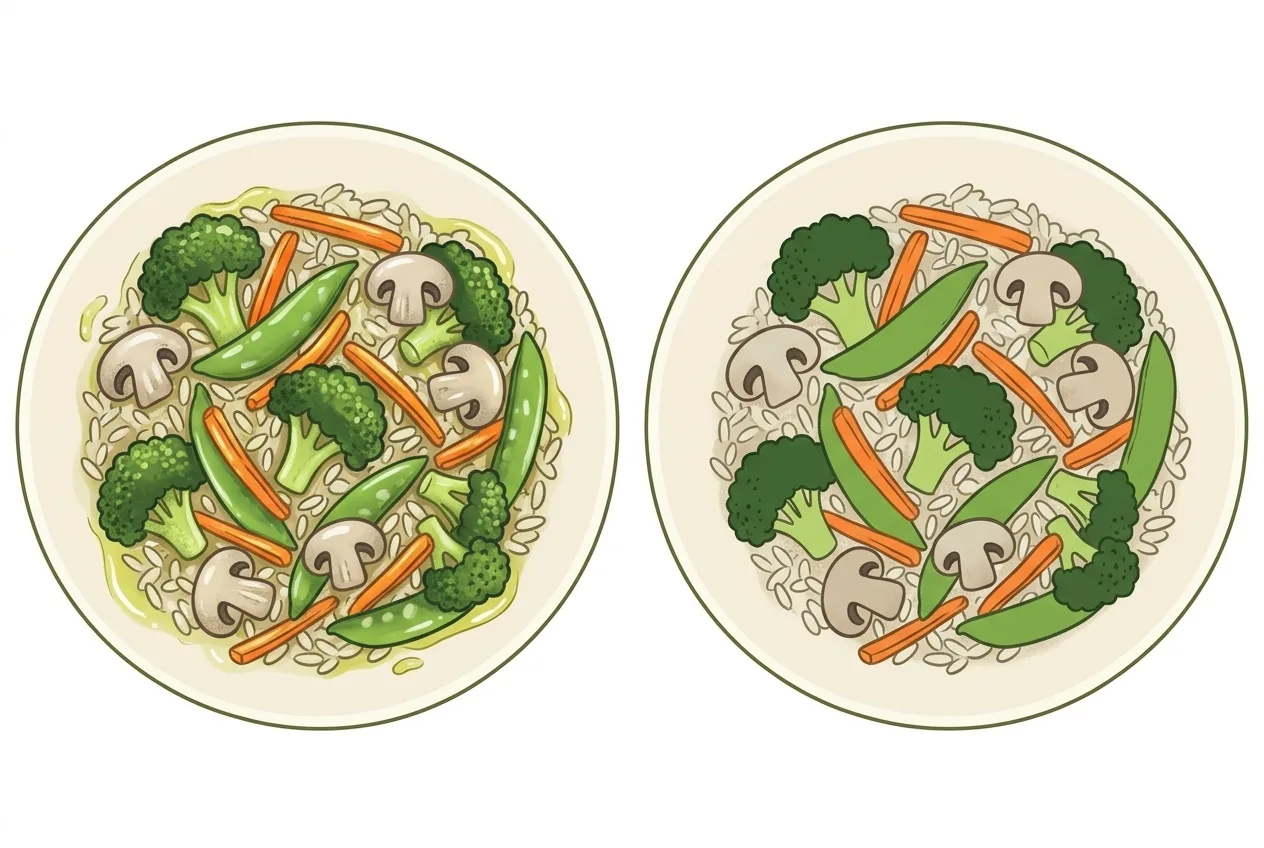
Are AI calorie counting apps accurate? Not with certainty: they estimate, and published studies show that estimate can be close or hundreds of calories off. The direction of the error is not random. Apps tend to underestimate total calories and overestimate fat, because a picture cannot show density, weight or hidden oil. That mechanism, not app quality alone, explains most of the gap.
A photo is a flat image of light bouncing off a plate. It shows shape, color and rough size. It does not show density, weight or what's mixed into a sauce.
Two bowls of rice can look identical and weigh differently if one is packed tighter. A stir-fry glossy with oil looks almost the same as one cooked with a spray. As an illustrative figure, two tablespoons of oil adds roughly 240 calories, and none of it is visible in a photo.
This is why better photos alone don't fix the problem. A camera captures what light does, not what a scale would say. Any estimate from a single image has to guess the parts the image can't show.
An AI vision model looks at the image and identifies which foods are present. It then estimates portion sizes from visual cues in the photo, things like plate size, food height and comparison to typical serving shapes.
From the identified foods and estimated portions, the model produces calorie and macro numbers directly. This differs from a barcode scan or a database search. There is no lookup against a table of measured values at this stage.
The person then reviews what the model produced. They can edit the identified food, the portion size or the numbers before saving anything. That review step is where a photo estimate turns into a logged entry, rather than staying a guess.
This sequence, identify, estimate, review, is the first step toward knowing where the estimate can go wrong and where a person's own edit can catch it.
A 2026 study in Nutrients compared AI models against registered dietitians using standardized hospital meal photos. Energy and carbohydrate estimates from the strongest models, ChatGPT-4o and Gemini 1.5 Pro, correlated above 0.8 with the dietitians' figures, often within about 10 percent (Nutrients, DOI 10.3390/nu18060966). Every model in that study showed a mean bias of over 20 percent overestimation for fat. Protein was also less accurate than energy.
The reason tracks back to what a camera can see. Carbohydrate-heavy foods like rice have a fairly predictable volume-to-calorie relationship. Fat is often invisible, folded into a sauce or pooled under other ingredients. A model guessing fat from appearance alone tends to overcorrect.
Two further studies put numbers on the total calorie gap, not just fat. A preliminary finding presented at NUTRITION 2026 tested four commercial apps, MyFitnessPal, LoseIt!, CalAI and Appediet, against an initial set of 102 metabolic-kitchen meals with ingredients measured to 0.1 gram, then more than 200 additional meals reviewed afterward. The apps underestimated calories by about 250 to 345 kcal per meal, and by about 30 g of fat (EurekAlert, NIH/NIDDK). This result is preliminary and has not yet been peer reviewed.
A peer-reviewed study in npj Digital Medicine compared an AI app called SNAQ against doubly labelled water, a gold-standard measure of energy intake, in women with obesity. The app underestimated daily intake by 817 kcal on average, a 25 percent bias, against a measured mean of 3,004 kcal a day. Repeat-measurement agreement was essentially zero, an ICC of 0.00 (PMC, npj Digital Medicine).
| Study | Condition | Comparison | Result |
|---|---|---|---|
| NIH/NIDDK (preliminary, NUTRITION 2026) | 102 weighed metabolic-kitchen meals, plus 200+ reviewed afterward | 4 commercial apps vs. measured ingredients | Underestimated by 250-345 kcal, about 30 g fat |
| npj Digital Medicine | Free-living, women with obesity | 1 AI app (SNAQ) vs. doubly labelled water | Underestimated by 817 kcal a day, 25 percent |
| Nutrients | Standardized hospital meal photos | AI models vs. registered dietitians | Energy within about 10 percent; fat overestimated 20 percent or more |
The pattern: controlled, single-plate photos produce the closest estimates. Free-living, multi-item meals produce the largest gaps.
A printed label sounds like solid ground next to a photo guess, but the rule behind it works in a specific direction.
Under FDA rule 21 CFR 101.9(g), calories, total fat, saturated fat, trans fat, cholesterol and sodium are Class I nutrients. These may not exceed 120 percent of the declared label value. The regulation sets no floor against understating them.
A label's calorie count can legally run up to 20 percent higher than the true lab value, and nothing in the rule stops it from running lower. Protein, vitamins, minerals and dietary fiber are Class II nutrients instead: they must be at least 80 percent of the declared value, with no ceiling.
This isn't a claim that labels are unreliable. It's context: even a lab-tested, regulated calorie figure carries a built-in ceiling, not a guarantee of exactness. A photo estimate and a printed label are both approximations, with different sources of error.
Neither method is error-free. Manual logging, searching a food database and entering a portion, depends on the person choosing the right entry and estimating their own portion size correctly.
Photo logging shifts that work to the model. The model faces the same core problem: it cannot weigh food or see inside a dish.
A study of a marker-based research app called goFOOD Lite found that of 468 photo recordings, 60, or 12.8 percent, had to be discarded due to capture errors. The reasons included a missing reference marker or the plate not fully visible (JMIR mHealth and uHealth, DOI 10.2196/24467). That's a separate error source from the AI model itself, in a system built specifically to reduce capture mistakes.
Neither method eliminates guesswork. The difference is where the guess happens, in a person's portion estimate, or in a model's read of an image.
Treat a photo estimate as a fast first pass, not a final number. For a single, simple plate, estimates land closer to a trained observer's judgment, per the Nutrients hospital study. For a mixed home-cooked meal with sauce or oil, the gap tends to widen, per the NIH/NIDDK and npj Digital Medicine findings.
Several things quietly break the result:
A reader who wants a tighter number for a homemade dish can build it ingredient by ingredient instead, following counting calories in a homemade dish ingredient by ingredient. Once that total is known, the free recipe-portion calorie calculator splits it into servings, without needing a photo estimate for a shared dish.
Avocalo's photo logging works the way this article describes. Photograph a meal or pick one from your gallery, and an AI vision model identifies the foods and estimates portions, calories, protein, carbs and fat from the image.
That estimate is not looked up against a nutrition database. The app does not weigh food or see hidden oil, sauce, or exact portion sizes. You review and edit the result before saving it.
For foods you'd rather look up directly, Avocalo also offers manual logging: search a food database built from Open Food Facts, USDA FoodData Central and national food-composition tables, and reuse recent or frequent items. Used together, the two methods cover more of a day's eating than either alone. Visit Avocalo to find the app on the App Store or Google Play.
The studies here tested app performance at a single point in time, not learning over repeated use. None of the cited research measured whether accuracy improves with longer use. A claim about an app learning a person's habits over time would need its own study to verify.
The cited studies don't test this specific practice, so no sourced answer exists here. What the research does show is that portion and ingredient visibility, not timing, drive most of the error. A clear photo with the full plate visible addresses the capture-error problem the goFOOD Lite study identified.
Different apps use different AI models, and the Nutrients study found real variation between models on the same standardized photos. ChatGPT-4o and Gemini 1.5 Pro correlated above 0.8 with dietitian values, but not identically, and all models overestimated fat by different margins.
Not always. Manual logging removes the AI's guesswork but depends on the person choosing the right database entry and estimating portion size themselves. Both methods carry error, and the npj Digital Medicine study found even a purpose-built AI app had wide limits of agreement in free-living use.
Published by Petros IT Solutions SRL. Spotted an error? Write to [email protected].