Hunger and cravings
Why Am I So Tired in a Calorie Deficit?
Why am I so tired in a calorie deficit? See the CALERIE and sleep-hormone numbers, then a log checklist to find the specific cause.
Guides
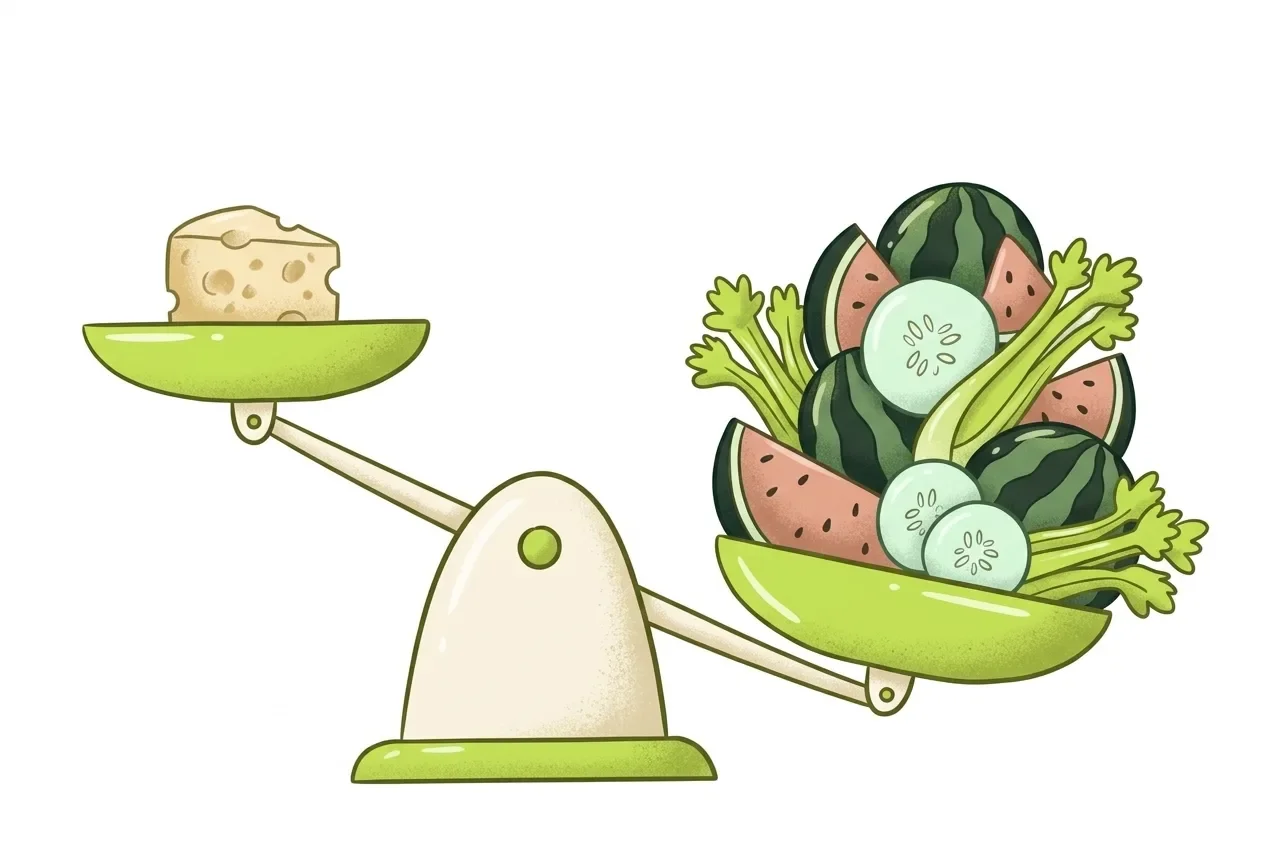
High volume low calorie foods pack a lot of grams for relatively few calories. A plate can look and feel full without carrying a big energy load. The clearest way to compare them is calories per 100 g, taken from a single database rather than scattered blog estimates.
USDA FoodData Central lists iceberg lettuce and raw celery at 14 kcal per 100 g. That is among the lowest of any commonly eaten food. A food earns a spot on this kind of list by being mostly water. Fibre also adds bulk without adding much energy, and some foods do both at once.
In short
- Iceberg lettuce and raw celery tie for the lowest calorie density in this table, both 14 kcal per 100 g according to USDA FoodData Central.
- Egg whites carry 10.9 g of protein per 100 g at just 52 kcal, the highest protein-to-calorie return among the foods with fewer than 100 kcal per 100 g in this table.
- Farmed Atlantic salmon, cooked, is the densest food in the table at 206 kcal per 100 g, more than 14 times the calorie density of iceberg lettuce, both figures from USDA FoodData Central.
Volume eating is the practice of choosing lower calorie density foods. The goal is a meal that takes up more space on the plate and in the stomach for the same energy total. Medical News Today discusses the idea as a legitimate approach in a medically reviewed explainer. It lays out high, moderate and low volume food categories. It does not give specific calorie figures for any of them.
This article fills that gap with a single ranked table. Every figure is sourced record by record to USDA FoodData Central, for 28 real foods as they are actually eaten. Foods appear raw where raw is normal, and cooked where cooking is normal. A reader deciding whether to weigh one of these foods before or after cooking can check should you weigh food raw or cooked, which works through the USDA math behind that choice.
Lettuces, cucumber, zucchini, radishes and tomatoes hold the lowest places in this table, each under 20 kcal per 100 g. Iceberg lettuce and raw celery tie for the lowest figure at 14 kcal per 100 g. Cucumber with peel and green leaf lettuce follow at 15 kcal, and radishes reach 16 kcal, all according to USDA FoodData Central. Every value below is per 100 g of the food exactly as the USDA record describes it, whether raw or cooked.
Foods with high water content and low calorie density tend to sit toward the top of the table for a simple reason. Water itself carries no calories. A food that is 90 percent or more water by weight has very little room left for energy-dense fat or sugar. Iceberg lettuce, celery, cucumber and green leaf lettuce, the four lowest rows, are each 95 percent water or more, according to the same USDA records.
Few foods in this table are genuinely high in both protein and volume for their calories. Egg whites deliver 10.9 g of protein per 100 g at 52 kcal, and plain nonfat Greek yogurt delivers 10.2 g at 59 kcal, both from USDA FoodData Central.
Cod, at 105 kcal and 22.8 g of protein per 100 g, sits further down the table. It still returns more protein per calorie than chicken breast or salmon do. Lentils, boiled, land in between at 114 kcal with 9.02 g of protein and 7.9 g of fibre per 100 g. That fibre figure is the highest of any food in this table.
Chicken breast and salmon sit near the bottom of this ranking. In this table, that is not because they are poor food choices, but because they carry far less water. Roasted chicken breast is 65.3 percent water per USDA FoodData Central, against 95.6 percent for iceberg lettuce. That gap alone accounts for most of the difference in calories per 100 g between these two rows.
Salmon adds fat on top. Farmed Atlantic salmon, cooked dry heat, carries 12.4 g of fat per 100 g. That is more than triple the fat in chicken breast's 3.57 g, and it pushes salmon's energy to 206 kcal per 100 g. Ranking by kcal per 100 g rewards water content in these rows, not protein content. That is why a food high in protein can still rank low on this particular measure.
Cooking can move a food's rank. In this table, boiled zucchini sits at 15 kcal per 100 g, close to the raw values of the other watery vegetables ranked near it.
Boiled broccoli, at 35 kcal per 100 g, sits close to raw broccoli at 34 kcal. That one-point gap is small enough to make little practical difference between these two rows. Potatoes boiled in their skin land at 87 kcal per 100 g, both figures drawn from USDA FoodData Central. A reader who wants the fuller arithmetic behind counting a home-cooked dish can see how to count calories in homemade food, worked through with a real example.
This table ranks 28 foods by kilocalories per 100 g. Each figure uses the specific USDA FoodData Central record for that food exactly as described, cooked or raw. Cooked entries were used where the food is normally eaten cooked, such as boiled zucchini or roasted chicken breast, because a raw calorie figure would misrepresent how the food is usually served.
Ranking by kcal per 100 g shows calorie density directly. It does not show how protein-dense a food is for its calories, which the protein column partly addresses instead. The list leaves out nutrient quality entirely. It says nothing about vitamins, minerals or how a food fits an overall diet, only how many calories it packs per gram.
This table is a reference for comparing foods, not an instruction to eat to any number. A reader building a meal from several of these foods can use the free recipe portion calculator. It adds ingredients from a fixed list of 147 common foods and shows calories per serving once the dish is weighed.
Someone buying a packaged version of one of these foods, such as bagged spinach or canned tomatoes, can scale the label to the amount actually eaten with the nutrition label calculator.
For logging a meal built from foods like these as it is actually eaten, the Avocalo app lets a reader log it by photographing the plate. The website's tools stay in the browser and do not log meals themselves. Anyone wanting a different browser tool can see all the free calorie and weight tools.
Volume eating does not guarantee weight loss on its own; it is a way of choosing foods within whatever a person already eats. The table above shows which foods carry fewer calories per gram, but weight change depends on total energy intake over time, not on any single food choice.
Among the vegetables in this table, iceberg lettuce and raw celery are lowest, both at 14 kcal per 100 g per USDA FoodData Central. Cucumber with peel and green leaf lettuce follow closely at 15 kcal per 100 g, with radishes at 16 kcal.
Calorie density is the number of calories a food carries per unit of weight, most often expressed as kcal per 100 g. This table measures it using USDA FoodData Central records, which report energy alongside protein, fat, carbohydrate and water content for each food as prepared.
No, calorie density and nutrient density measure different things. This table ranks foods only by calories per 100 g; it says nothing about vitamin, mineral or fibre content per calorie, so a low calorie density food is not automatically more nutrient dense.
Yes, cooking can shift a food's rank because water loss or water absorption during cooking changes its calorie concentration per 100 g. Boiled broccoli, at 35 kcal per 100 g, sits close to raw broccoli at 34 kcal in this table, a small but real difference from USDA FoodData Central.
Every value in the table above comes from USDA FoodData Central, linked at the record level for each food in the table itself and named once here as the FoodData Central database. The medically reviewed explainer from Medical News Today on volume eating is cited for confirming that the volume eating concept is a legitimate, widely discussed approach, not for any calorie figure.
This article was published by Petros IT Solutions SRL. Report a correction to [email protected].