Hunger and cravings
Why Am I So Hungry at Night?
Why you're so hungry at night: the science behind the evening hunger peak, its 17% swing, and how a light day feeds into it by dinnertime.
Guides
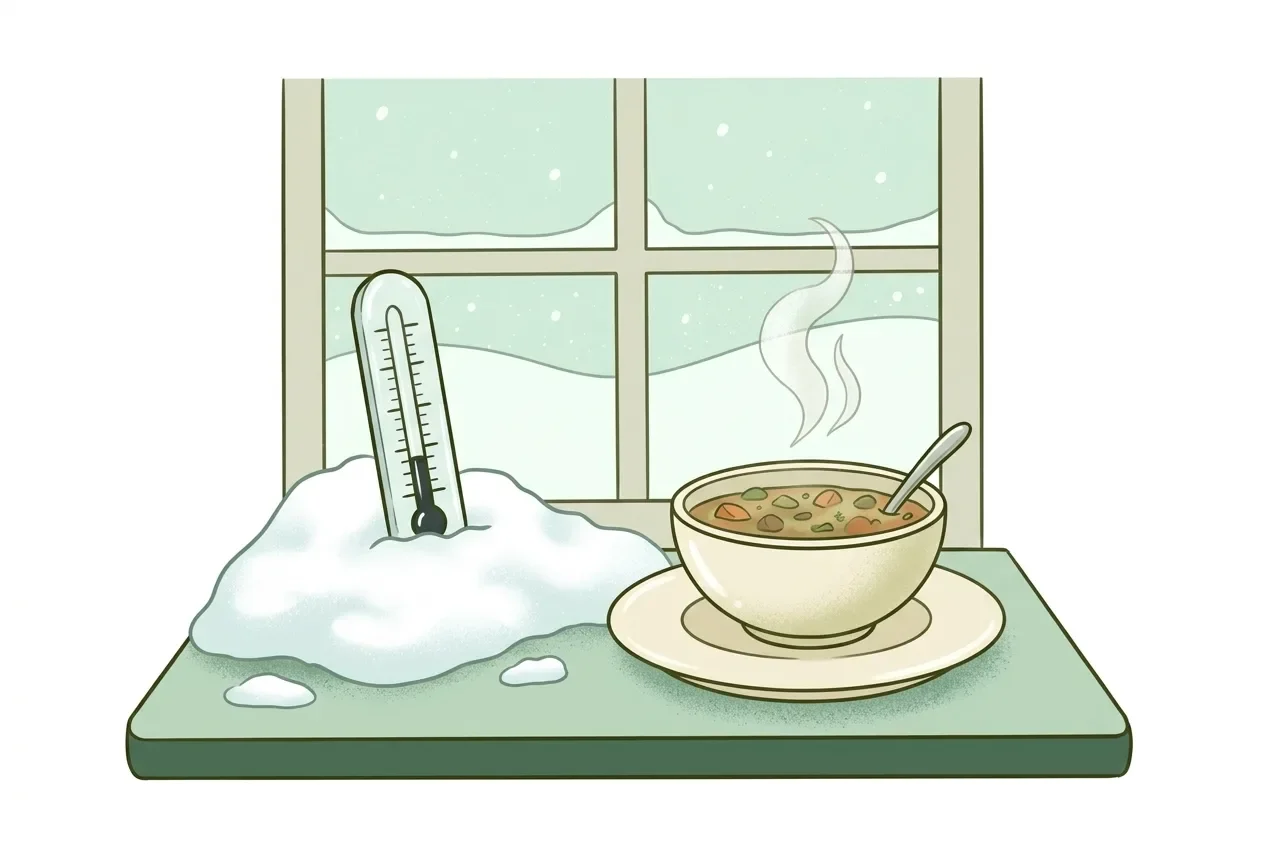
Cold weather makes you hungry only a little, and only when the cold reaches your skin. Trials that expose people to cold, at rest or during exercise, find on average a small rise in later intake. A pooled analysis of 11 such studies found a mean increase of about 179 kcal (750 kJ) compared with warm or neutral conditions (Nutrients, 2021).
That is a real, measured effect. It is small next to a full meal. It also depends heavily on how the cold was experienced.
Cold makes the body spend more energy staying warm, through shivering and other heat-producing processes. Within that same pooled analysis, the subgroup of 8 studies that used cold exposure during exercise found a larger rise, about 251 kcal (1051 kJ) (Nutrients, 2021).
In one trial, 11 men cycled for 45 minutes in 20°C water or 33°C water. Energy burned during the ride was similar either way, about 517 kcal in cold water versus 505 kcal in warm. Afterward, the cold-water group ate 877 kcal at a buffet. The warm-water group ate 608 kcal, a 44% difference (White et al., 2005; University of Florida release).
A separate trial had 16 overweight adults walk on a treadmill for 45 minutes at 8°C or 20°C. The cold walk raised acylated ghrelin, the hormone that signals hunger. That rise lined up with higher intake at a buffet 45 minutes later (Crabtree & Blannin, 2015).
Mostly, yes, if you are just sitting still. A trial put 10 healthy adults in a room at 18°C or 24°C for two and a half hours, with no exercise involved.
The cooler room did raise resting energy expenditure, the extra fuel the body burns just to hold its temperature. Hunger ratings and actual food intake did not differ significantly between the two temperatures (Langeveld et al., 2016).
That gap matters. The exercise-in-cold trials show a real appetite bump. This resting trial shows sitting in a mildly cool room, the kind a heated home mostly avoids, does not reliably do the same. Walking to the car in November is not the same exposure as a cold outdoor workout.
A cohort of adults was tracked across the year. Daily intake was about 86 kcal higher in fall than in spring. Activity was lowest in winter, and body weight varied by roughly 0.5 kg across the year, peaking around February (Ma et al., 2006).
A separate diary study followed 315 adults. It found total intake, especially carbohydrate, and meal size rose in fall. People rated themselves hungrier at the end of fall meals, even though they had eaten more (de Castro, 1991).
Neither study isolates temperature from shorter days or lower activity. Ma et al.'s cohort shows intake and weight lowest in spring, after peaking in fall and winter. That pattern is consistent with the rise not persisting year-round, rather than steady winter weight gain.
The trials point to cold itself when the exposure is real and active: outdoor exercise, a cold commute, standing outside for a while. The cohort data points to a broader seasonal shift when you are mostly indoors and just moving less.
One way to separate the two is to look at your own record side by side. If activity dropped along with the extra eating, that lines up with the cohort pattern more than a cold-exposure effect. Logging meals next to why hunger returns fast after a carb-heavy meal can also show whether denser winter meals wear off faster than expected.
The free weight trend and plateau check shows whether your weight has actually moved this winter, against the roughly half-kilo seasonal swing the cohort data found. Logging meals and activity side by side in the Avocalo app can show whether a cold week changed what you ate, or just how much you moved. A photo of a meal there gets an estimate of its calories and macros for you to review.
The data suggests it does. Ma et al. found the seasonal cohort's intake and weight are lowest in spring, after peaking in fall and winter, consistent with the rise not persisting year-round (Ma et al., 2006).
A little. A trial found resting energy expenditure rose in a cooler room (18°C) versus a warmer one (24°C). This did not translate into more hunger or eating in that trial (Langeveld et al., 2016).
Not necessarily. The diary study found people rated themselves hungrier at the end of fall meals despite eating more, suggesting a shift in satisfaction or meal pattern, not just a calorie shortfall (de Castro, 1991).
Sources: White LJ et al., Int J Sport Nutr Exerc Metab, 2005, PubMed 15902988; the University of Florida press release describing it; Crabtree DR & Blannin AK, Med Sci Sports Exerc, 2015, PubMed 24870575; Langeveld M et al., Endocrine Connections, 2016, record page; de Castro JM, Physiology & Behavior, 1991, PubMed 1946724; Ma Y et al., Eur J Clin Nutr, 2006, PMC1428793; Nutrients, 2021, PMC8538265. Published by Petros IT Solutions SRL. Spotted an error? Write to [email protected].