Hunger and cravings
Cravings in a Calorie Deficit: Why They Fade
Cravings in a calorie deficit aren't hunger. See the trial data showing they fall over weeks, sweets falling most of all.
Guides
Yes, it is normal to be hungry in a calorie deficit, because eating less than you burn shifts appetite hormones within weeks, raising the ones that drive hunger and lowering the ones that signal fullness. That shift explains the background feeling. How strong it feels depends more on what and when you eat than on the size of the deficit itself. Protein, food volume and sleep move measurably in trials, and your own meal log shows which of your meals actually held you.
Hunger is not a meter of anything. It cannot tell you whether fat loss is happening faster, slower, or at all.
What researchers have measured is a hormonal shift that shows up after weight loss and does not fully reverse. In a study of 50 overweight or obese adults, researchers measured nine appetite-related hormones, including ghrelin, leptin, PYY and CCK, at the start of a 10-week weight-loss program, right after it, and again a year later (Sumithran et al., NEJM 2011, DOI 10.1056/NEJMoa1105816). The changes favoring hunger and regain, seen at 10 weeks, were still largely present at 62 weeks, even though participants had regained some weight.
That means the hunger you feel is a real, measurable shift, not proof your deficit is either working or failing. It is background noise your body generates while adapting, not a signal about outcome.
The obvious assumption is that hunger should ease as your body "gets used to" eating less. The Sumithran data says otherwise: the hormonal pattern that raises hunger and lowers fullness signals persisted a year out, not just in the first weeks.
This does not mean hunger stays constant or gets worse forever. It means the hormonal backdrop does not simply fade with time the way some expect. What changes week to week is more likely to come from what you are eating and how you are sleeping, not from your body quietly adjusting to want less food.
Protein is one of the largest levers a person controls directly, and it has been measured directly.
In a controlled feeding trial, researchers raised dietary protein from 15% to 30% of energy while holding carbohydrate constant, then let participants eat freely (ad libitum) for 12 weeks (Weigle et al., AJCN 2005). Even though ghrelin rose and leptin fell over the study, higher protein still won out.
Participants spontaneously ate 441 ± 63 fewer kcal per day than their baseline, without being told to restrict. Body weight fell by 4.9 ± 0.5 kg and fat mass by 3.7 ± 0.4 kg over the 12 weeks.
That is a meaningful swing at the same underlying hormonal pull. The lever is not the deficit size, it is the composition of what fills it.
Not every 240-kcal meal is equal in how long it keeps you full. Researchers tested this directly, feeding 11 to 13 subjects 38 different foods, each portioned to exactly 240 kcal (1000 kJ), then tracking self-reported fullness for two hours (Holt et al., Eur J Clin Nutr 1995, PMID 7498104). Each food was scored against white bread, set at 100%.
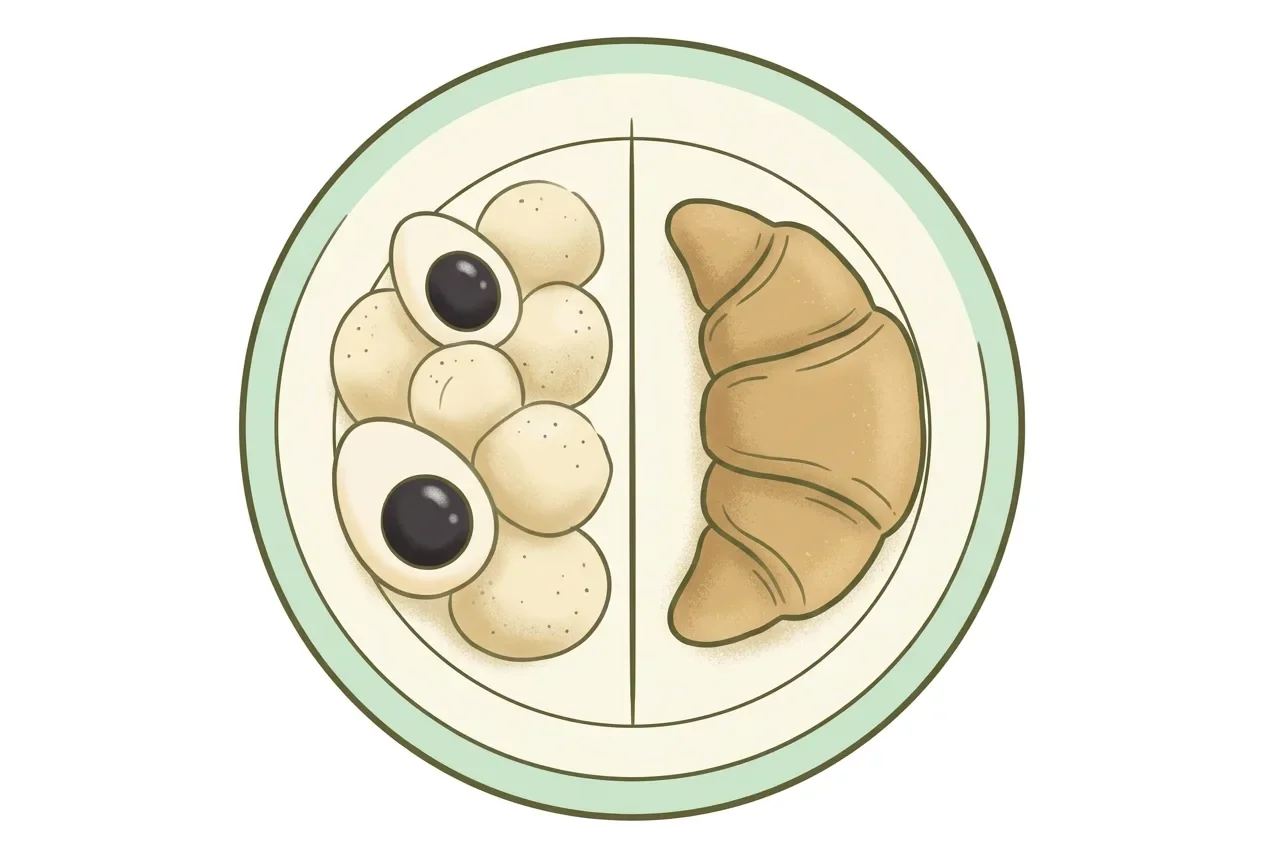
Boiled potatoes scored 323%, more than three times as filling as white bread at the same calories. Oranges scored 202%, apples 197%, boiled eggs 150%, and white rice 138%. A croissant, the least filling of the 38 foods, scored just 47%.
These differences appear at identical calorie counts. Two meals with the same number listed can leave you very differently hungry an hour later, depending on what made up that number.
Yes, and the effect has been isolated from diet itself. In a crossover trial, 12 healthy young men slept 4 hours a night for two nights, then 10 hours a night for two nights, with calorie intake and activity controlled throughout (Spiegel et al., Annals of Internal Medicine 2004, DOI 10.7326/0003-4819-141-11-200412070-00008).
After the short-sleep nights, leptin was 18% lower and ghrelin was 28% higher than after the long-sleep nights, with hunger and appetite ratings rising to match. This happened without any change in what participants ate or how much they moved.
That means a short night can push hunger signals in the same direction as a deficit itself, on top of it, not instead of it. Sleep is not a footnote here, it is a lever with its own measured size.
Worked example: not a measured trial, an illustration of the arithmetic behind it. Say two breakfasts each run 400 kcal.
| Breakfast | Composition (illustrative) | Satiety index basis |
|---|---|---|
| A | Croissant and coffee | Croissant scored 47% on Holt's index |
| B | Boiled potatoes and two eggs | Potatoes scored 323%, eggs 150% |
Both breakfasts cost the same 400 kcal. But breakfast B combines two of the highest-scoring foods on Holt's test, while breakfast A leans on the lowest-scoring food tested. If the same ranking held at these portions, breakfast B would be expected to hold hunger off for longer, at no extra calorie cost.
If you cook a version of breakfast B at home, you can add up its ingredients to check the calories per serving of the finished dish before you compare it against a bought alternative.
This is the comparison worth running on your own meals, not the theoretical one above. Each meal logged in Avocalo carries its photo and its protein, so you can compare the mornings that held you against the ones that did not, using your own data instead of guessing.
Avocalo cannot measure your hormones or tell you whether a meal will hold you full. What it can do is let you photograph a meal and get an estimate of its calories, protein, carbohydrate and fat, which you then review and edit before saving.
Logged consistently, that record lets you look back and compare: did the higher-protein breakfast keep you fuller longer than the pastry did, at similar calories? The app does not compute a satiety score or set a hunger target, and it gives no medical advice. It is a way to see your own pattern, not a verdict on it. Log a meal with its photo and protein to start building that record.
No. Hunger reflects hormonal shifts documented after weight loss, not the rate of fat loss itself. The Sumithran data shows these shifts persist regardless of how much weight has been regained or kept off, so hunger alone tells you little about what the scale is doing.
Carbohydrate-heavy meals can empty from the stomach faster and prompt an earlier ghrelin rebound than mixed meals with protein and fat. A separate guide on carbs and quick hunger covers the gastric-emptying mechanism in detail.
The Sumithran trial found the hormonal shifts still present a year after weight loss, not fading with time on their own. That does not mean hunger is fixed forever, but what changes week to week is more likely tied to food choice and sleep than to simple time passing.
The brief's sources do not measure daily timing patterns directly, so this is not something the cited studies can confirm or rule out. If a hunger pattern feels constant or distressing regardless of what or when you eat, that is worth raising with a healthcare professional rather than working around alone.
Published by Petros IT Solutions SRL. See our editorial policy for how sources and figures were checked. Found an error? Write to [email protected].