Counting calories
Does Skipping Breakfast Slow Your Metabolism?
Does skipping breakfast slow metabolism? RCT data show resting metabolic rate barely changes. See the trial numbers and a worked example.
Guides
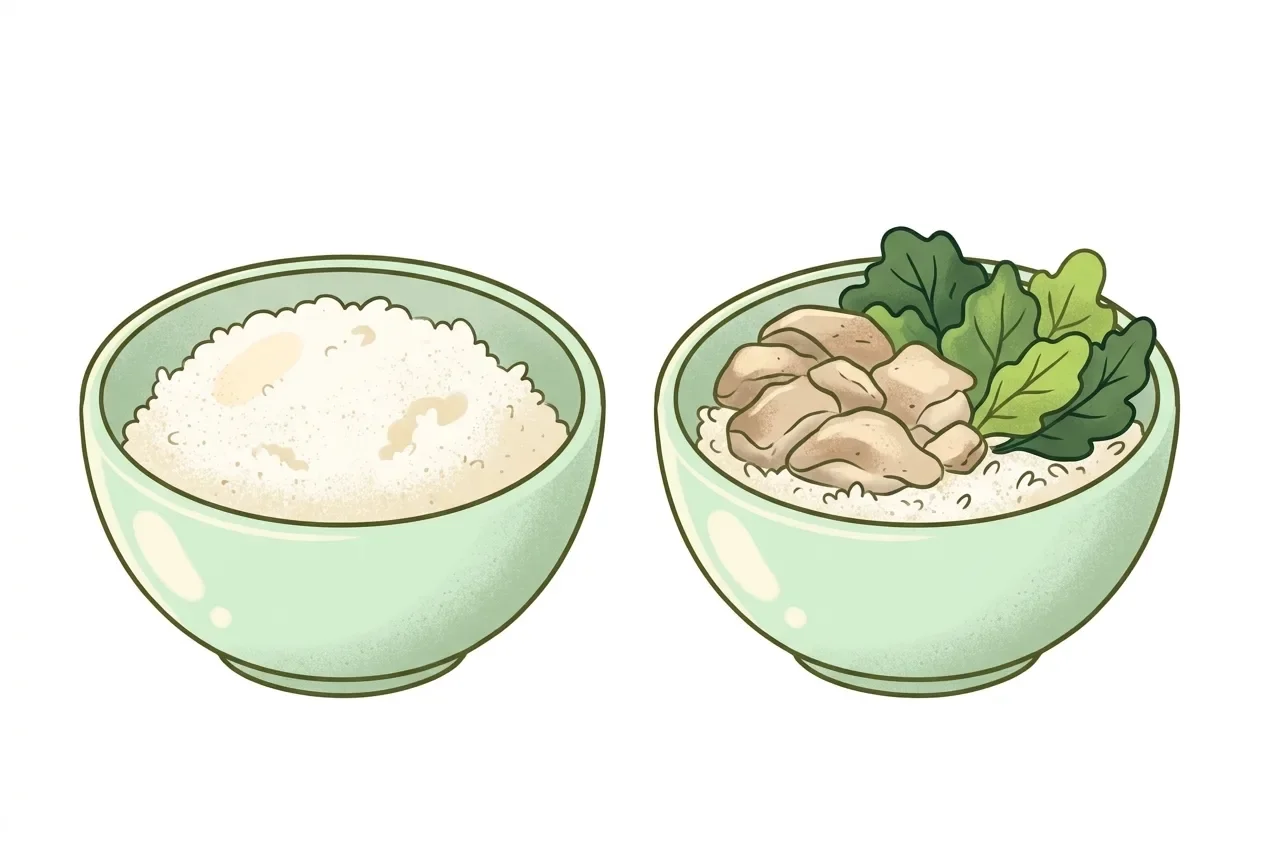
A meal that is mostly carbohydrate leaves your stomach faster and sends hunger hormones rebounding within a few hours. A meal with protein and fat lingers longer and keeps that rebound from happening. The sourced timing points to roughly two hours, not one, but the mechanism behind that quick return is the same either way: digestive speed, not willpower or portion size.
The obvious explanation is that you simply ate too little. But two meals with the same calories can behave completely differently in your stomach.
A meal built mostly from refined carbohydrate empties from the stomach faster than one with protein or fat mixed in. Once it's gone, blood sugar drops back down. The hormone that signals hunger doesn't just return to normal, it can rise above where it started.
An MRI study tracked gastric emptying in 15 healthy adults. The half-emptying time, the point where half the meal has left the stomach, was 132.35 ± 33.38 minutes for a high-carbohydrate meal. It was 157.57 ± 37.12 minutes for a high-protein meal, and 187.84 ± 41.17 minutes for a high-fat meal (Farivar et al.). The carb meal cleared significantly faster than both.
That's roughly two hours for carbs, versus over three hours for fat, in the same study, in the same people.
The Farivar study used three specific meals. The high-carb condition was vegetable fried rice (440.9 ± 30.5 kcal). The high-protein condition was roasted chicken with salad (725.7 ± 26.2 kcal). The high-fat condition was currywurst with fries (1212 to 1344 kcal), tested in 15 healthy adults (Farivar et al.).
The carb meal's half-emptying time was about 55 minutes shorter than the fat meal's. That difference was confirmed statistically (p<0.001). Against the protein meal the gap was smaller but still significant (p=0.010).
A separate trial isolated protein's role directly. Researchers had the same participants drink two different test drinks on separate visit days. One drink held protein only (70g protein, 280 kcal). The other swapped some of that protein for carbohydrate and fat (14g protein, 28g dextrose, 12.4g olive oil, 280 kcal).
The protein-only drink took 58 ± 31 minutes to half-empty. The carb-and-fat drink took just 23 ± 8 minutes. Its peak blood glucose reached 7.9 ± 0.6 mmol/L, versus 5.7 ± 0.4 mmol/L for the protein-only drink (study on carbohydrate and fat substitution, Nutrients 2018). Removing protein more than doubled the emptying speed in the same participants, tested on separate visits.
The timing of when your stomach empties lines up with when a specific hormone, ghrelin, starts climbing again.
Ghrelin rises before meals and falls after you eat. A study measuring it over six hours found that carbohydrate suppressed ghrelin more than protein or fat in the first three hours after eating, though protein suppressed it more strongly across the full six-hour window (Foster-Schubert et al., 2008).
But in the following three hours, carbohydrate alone produced something protein and fat did not: a marked rebound. Ghrelin climbed back above the level it was at before the meal. Protein and fat kept it suppressed for longer without that bounce.
This pattern matches what the emptying-time data above would predict. A carb-heavy lunch suppresses hunger hardest in the first stretch. The rebound just arrives sooner, and higher, than it would after a meal with protein in it.
Fat has the strongest effect on gastric emptying of the three macronutrients tested in the Farivar study. Its half-emptying time ran nearly an hour longer than the carbohydrate meal's (Farivar et al.).
This isn't because fat is more filling in some abstract sense. It's a physical effect: fat slows how quickly the stomach releases its contents into the small intestine, so the whole digestive process stretches out.
The practical result is that a meal with fat in it, even a modest amount, keeps you from feeling empty as quickly as a meal without it. Combined with protein's similar effect, a meal with both tends to hold off the ghrelin rebound far longer than carbohydrate alone.
The two lunches below are illustrative, built to match the calorie ranges from the cited meals, not a new measurement. The gastric-emptying and ghrelin timings are the sourced figures.
| Lunch | Composition | Approx. calories | Half-emptying time | Ghrelin pattern |
|---|---|---|---|---|
| Carb-only (illustrative) | Vegetable fried rice, similar to the study meal | ~440 kcal | 132 min (sourced) | Suppressed 0 to 3 hrs, rebounds above baseline 3 to 6 hrs |
| Mixed (illustrative) | Chicken, salad, olive oil dressing | ~440 kcal | 157 min for the protein component (sourced), plus further slowing from the added fat (illustrative combination) | Suppressed longer, no rebound expected in the 3 to 6 hr window based on how protein and fat behaved individually in that study |
Someone eating the carb-only lunch at 1pm reaches the halfway point of gastric emptying by roughly 3:12pm, which lands close to the 3pm slump many readers notice. The study's own range, ±33 minutes across 15 subjects, means this varies from person to person.
The mixed lunch, matched for calories but built with protein and fat, empties more slowly. Based on how protein and fat behaved individually in the Foster-Schubert data, its ghrelin curve would not be expected to show the same rebound in that 3-to-6-hour window (Foster-Schubert et al.), though that study tested single macronutrients, not this combined meal.
The two lunches can carry identical calories and still produce a different afternoon. That's the mechanism, not a flaw in either person's counting.
If you count a carb-only lunch as "enough" because the calorie number matches your usual lunch, you may still feel hungry sooner than after a mixed meal at the same calorie count.
That's not because the count was wrong. It's because gastric emptying and ghrelin rebound both move faster after carbohydrate alone, per the mechanisms above.
Equal-calorie foods can also differ in how filling they feel, separate from the emptying-speed mechanism above. The original satiety-index study compared 1000 kJ portions of 38 foods against white bread as a reference, and found that protein-rich and high-fat foods produced fullness ratings their glucose response alone would not predict (Holt et al.). Two meals with the same calorie count can differ for more than one reason.
A reader trying to count accurately benefits from logging the actual mix of a meal, not just its total calories, since two meals with the same total can behave differently for hours afterward. For a homemade lunch built from separate ingredients, our guide on logging a homemade mixed meal walks through adding up a recipe and splitting it into servings.
Once you know a recipe's total calories, the free recipe-portion calculator works out calories per serving, per 100g, or for a weighed portion.
The pattern is easiest to spot by comparing two similar days. A mostly-carbohydrate lunch, bread, rice or pasta without much else, may leave you hungry within a couple of hours. A lunch with meat, eggs, beans or added fat tends to hold you longer. Both patterns line up with the emptying and ghrelin data above.
A useful check is the clock, not the scale. Track roughly when hunger returns after different lunches over a week or two, and compare the timing rather than guessing at portions.
The roughly 55-minute emptying-time gap and the 3-to-6-hour ghrelin rebound window, described above, suggest a rough range to expect. If a carb-heavy lunch consistently wears off two to three hours sooner than a mixed one, that's the pattern to notice. It isn't a sign anything went wrong with your counting.
Avocalo can't measure your gastric emptying or your ghrelin levels. What it can do is let you photograph a meal so an AI vision model estimates its foods, portions, calories and macros, protein, carbohydrate and fat, for you to review and edit before saving.
Seeing the macro split next to a meal, alongside how long it kept you full, is one way to start noticing your own version of the pattern above. The app doesn't know your hunger timing, only what it can identify from the photo. If you want to compare your own carb-heavy and mixed meals this way, you can download Avocalo and log a few lunches to see the macro split for yourself.
No. Carbohydrate isn't the problem, pairing is. The gastric-emptying and ghrelin data above describe carbohydrate eaten alone, not carbohydrate in general. Rice, bread and fruit eaten alongside protein or fat follow a slower, steadier pattern, per the same mechanisms.
Not necessarily. A blood sugar crash after a carb-heavy meal is a normal rise and fall in glucose. Reactive hypoglycemia is different: it's a specific, more pronounced drop that some people experience. The sources above describe the general glucose and ghrelin pattern, not a clinical diagnosis, so a marked or repeated crash is worth discussing with a doctor.
It changes the timeline. Removing protein from a drink more than doubled its emptying speed and raised its glucose peak in one trial. Adding protein back would be expected to slow emptying and soften the peak in the same way, in reverse (study on carbohydrate and fat substitution).
Because gastric emptying and ghrelin timing are fairly consistent for a given meal composition. The Farivar study's half-emptying time for the high-carb meal was 132.35 ± 33.38 minutes across participants. That's a narrow enough window that a similar meal eaten at a similar time tends to empty on a similar schedule (Farivar et al.).
The cited studies tested whole meal categories, fried rice, chicken and salad, currywurst, not bread against fruit specifically. No cited figure separates those two foods. The general mechanism, carbohydrate alone emptying faster than a mixed meal, is the sourced part; comparing specific carb foods against each other would need a separate study.
Published by Petros IT Solutions SRL. Corrections: [email protected].