Counting calories
How to Know a Calorie Deficit Is Working
Hunger and single weigh-ins mislead. See the sourced weekly-average method that shows if your calorie deficit is really working, tracking or not.
Guides
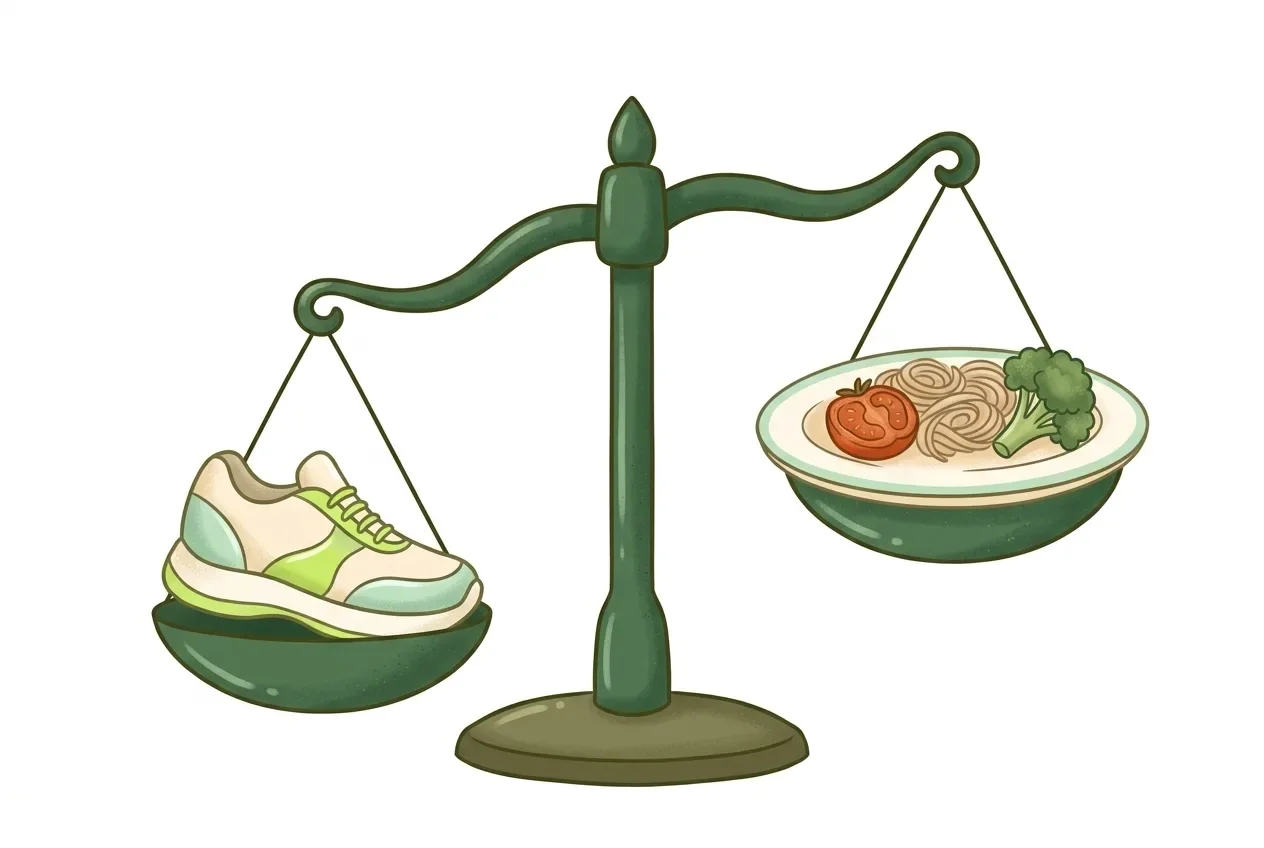
The workout on your wrist estimated 480 kcal, but that number carries a wide, honest margin of error. It also double-counts calories your daily estimate already contains. Neither eating it all back nor ignoring it is the mistake. The mistake is treating a rough estimate as exact. Keep one rule for a few weeks and let your weight trend tell you if it fits, rather than adjusting tonight's plate around a single shaky figure.
Wrist devices estimate energy expenditure from heart rate and motion. They do not directly measure the calories your body actually burned. Researchers at Stanford tested seven wrist devices against breath-gas analysis, the reference method for measuring energy expenditure. The devices included the Apple Watch, Fitbit Surge and Samsung Gear S2, tested across 60 volunteers (Shcherbina et al., Journal of Personalized Medicine, 2017).
Not one device came within 20% of the measured value. Across the seven devices, average error ranged from 27% for the best-performing device to 93% for the worst-performing one. Both figures are far past the researchers' own 10% threshold for acceptable accuracy (Stanford Medicine, 2017). That range describes how the seven tested devices performed on average, not a guaranteed error band for any single device or reading.
That is not a small rounding issue. Applying that error range to a device reporting 480 kcal illustrates how far a true figure could plausibly sit from what the display shows, depending on which device it is. App-based estimates that skip a wrist sensor and use a MET table instead carry the same basic problem. They describe an average body at a fixed intensity, not the reader's actual output.
If this is the first time you have looked closely at how a calorie figure gets built at all, how to count calories accurately covers the broader method this exercise-calorie question sits inside.
Most workout-calorie figures are what exercise scientists call gross energy cost. That is the total calories burned during the activity, including the calories your body would have burned anyway just sitting still. The MET system that underlies most app and device estimates is defined this way: one MET equals the oxygen cost of sitting quietly at rest (Ainsworth et al., Compendium of Physical Activities, 2011).
A daily calorie estimate already includes your resting metabolic rate for every hour of the day, workout hour included. So if the watch's 480 kcal is a gross figure, part of it is calories you were always going to burn resting. That part is not extra calories from the exercise itself. Add the full 480 back to a day whose estimate already contains those resting calories, and you count some of them twice.
This is reasoning from the MET definition itself, not a quoted line from any single paper. But it explains why two people using the same 480 kcal figure could land on two different numbers to log. One treats it as gross; the other nets out the resting cost first.
Not necessarily, and not for everyone. A study tracked 332 adults across five populations using doubly labeled water, a precise method for measuring total energy expenditure. It found that total daily calorie burn did not rise in strict proportion to activity level across the whole range (Pontzer et al., Current Biology, 2016).
At the higher end of activity, total expenditure plateaued after adjusting for body size and composition. That study's authors describe this as a pattern some bodies in the studied cohort showed: compensating for a hard workout by moving a little less the rest of the day, so the day's total burn rises by less than the workout's estimated calories alone would suggest.
This does not mean exercise burns nothing. It means the number on your watch describes the workout in isolation. It does not capture what happens to your whole day's expenditure once your body adjusts around it. That gap is invisible on any single day. It only shows up over weeks, which is why the trend matters more than any one workout's figure.
The device-accuracy problem does not go away for longer or harder sessions, but the stakes of getting it wrong do change. Applying the same 27% and 93% average error figures to a smaller workout estimate, illustratively 100 kcal for a short walk, produces a narrower spread in absolute kcal than applying them to a 480 kcal run. Applied to a much larger estimate, illustratively 800 kcal for a long hike, the same percentages open up a spread of several hundred kcal.
Longer, more intense sessions also make the resting-calorie double count larger in absolute terms, since more hours are involved. Neither of these facts points to a specific rule to follow. They just mean the honest range around any single workout estimate is wider the longer and harder that workout is. That is one more reason to lean on a multi-week trend rather than any one day's number, however big it looks.
Pick one rule, either one, and apply it consistently for a few weeks. Then look at your weight over that time, not your food log, to see whether that rule fits your body and your goal.
A single weigh-in moves for reasons that have nothing to do with fat. Looking at weigh-ins across several weeks, rather than any one morning, reflects a change in energy balance over time better than any single day can.
If the scale moves faster or slower than expected after a few weeks on one rule, that tells you more than any individual workout's kcal estimate. It reflects what actually happened to your weight, not what a device guessed about one hour.
The 480 kcal in this table is the reader's own watch figure from the search behind this article, assuming the run took about 45 minutes. The resting-calorie subtraction uses an illustrative round number to make the arithmetic easy to follow, not a measured figure for any specific person.
| Scenario | Calculation | Result |
|---|---|---|
| Watch's gross estimate | reported directly | 480 kcal |
| Best-device average error (27%) | 480 × 0.27 | ±130 kcal, so 350 to 610 kcal |
| Worst-device average error (93%) | 480 × 0.93 | ±446 kcal, so 34 to 926 kcal |
| Illustrative resting calories for the 45-minute run | (illustrative) 75 kcal/hour resting rate × 0.75 hour | about 56 kcal already counted in the daily estimate |
| Net figure after removing resting overlap | 480 − 56 (illustrative subtraction) | about 424 kcal |
Two readers using the same watch reading could reasonably log two different numbers. One might log 480 kcal, if their app treats the figure as pure additional burn. The other might log roughly 424 kcal, if it subtracts the resting-calorie overlap first. Neither is wrong on its face; the two conventions simply answer slightly different questions.
Applying the study's best-device and worst-device average error figures to this reader's 480 kcal reading, the illustrated span runs from roughly 34 kcal to over 900 kcal. That is the real size of the number a reader is being asked to trust, even though no single device is guaranteed to fall at either end.
Avocalo logs food, weight and activity in one place. It tracks weight and shows statistics over 7 days, 30 days and 3 months. Meals can be logged by photo. An AI vision model estimates the foods, portions and calories for you to review and edit. You can also search its food database, built from Open Food Facts, USDA FoodData Central and national food-composition tables.
If you cook meals at home and want a per-serving figure to log manually instead of a photo estimate, Avocalo's free recipe calorie calculator adds up a recipe's ingredients and splits the cooked dish into servings, entirely in your browser.
Avocalo has no measured accuracy figure of its own, and it was not one of the devices studied in the research cited here. So it makes no claim to have solved the workout-calorie estimate itself. You can download Avocalo to start building the log this decision runs on.
Not necessarily. App-based estimates typically use a MET table, which assumes an average body moving at a fixed pace, rather than measuring your heart rate directly. The Stanford-run device study tested wrist sensors specifically, not phone-only MET estimates, so no comparable error figure exists for those apps in this research.
That is a personal choice this article does not make for you. What matters more than whether you log it is picking one consistent approach and watching your weight over several weeks, since that reflects what actually happened, not what a device guessed.
Whether an app adds a workout's estimated calories back to your daily total by default depends on that app's own settings, which this article does not evaluate. Whether that default fits your body is exactly what your own multi-week weight pattern, not the app's default, is positioned to tell you.
The device and MET-based estimation problems described here apply broadly to how workout calories get estimated, not to one activity type. The brief behind this article did not include activity-specific error figures for strength training versus cardio, so no separate claim is made here.
The article recommends a few weeks, long enough for a weight pattern to reflect something real rather than normal day-to-day noise. A single day's number, on the scale or on the watch, is not enough data to judge a rule by.
For how Avocalo sources and checks the figures in its guides, see the editorial policy. To report an error in this article, contact [email protected].
Published by Petros IT Solutions SRL.