Counting calories
Should You Eat Back Your Exercise Calories?
Should you eat back exercise calories? See the 27-93% average device error and the double-count that makes the burn number unreliable.
Guides
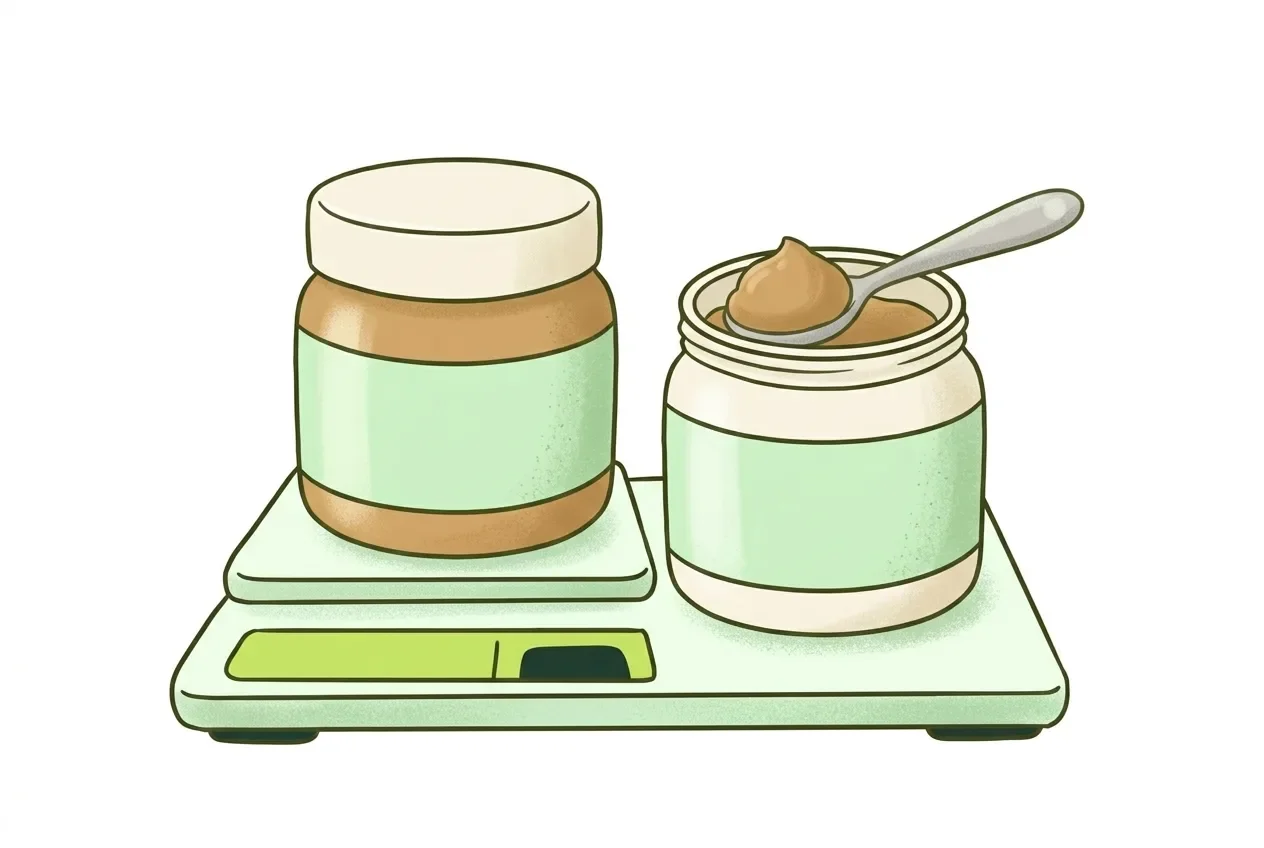
Put an empty bowl on the scale, press tare, then add food and log the grams shown. That is the whole method for how to use a food scale. Nothing has to sit on the scale alone. Tare zeroes the display, so the bowl's own weight never counts. The number you log is grams. Grams times the food's calories per 100 g gives you the calorie count.
No. This is the part that trips up almost everyone unboxing a new scale.
A scale reads the total weight of whatever sits on it right now. Zero it with an empty bowl first, and the display already ignores the bowl. Add rice to that bowl, and the number you see is rice alone, not rice plus bowl.
That is what the tare button does. Placing an empty container on the scale and pressing tare resets the display to zero, according to the RENPHO Smart Nutrition Scale manual. The scale then measures only what is added afterward.
So the food never has to leave the container to be weighed correctly. One bowl, one scale.
Tare zeroes the display at whatever point you press it. Nothing stops you from pressing it again once a food is already in the bowl. Here is the sequence for a plate with three foods:
This is not a separate feature. It is the same zeroing action from the last section, used once per food. Each reading shows the new food only, because the last tare press erased everything before it.
You only carry the grams forward. Look up each food's calories per 100 g and multiply, covered below. A three-ingredient plate becomes three tare presses and three numbers, not a pile of separate weighings.
Peanut butter, oil and honey cannot be tared into a bowl the same way. You do not know how much you are about to take before you take it. The fix is to weigh in reverse.
Put the whole jar on the scale and note its weight. Take your spoonful. Put the jar back on the scale and note the new, lower weight. The difference is exactly what left the jar, because nothing else changed.
This sidesteps the spoon-shape problem. A spoon's shape does not tell you what is on it. The drop in the jar's weight does. The same trick works for a bottle of oil or a squeeze bottle of honey: weigh before, weigh after, subtract.
You do not need to tare for this method. You can if you would rather read the drop as a positive number. Either way, only the food that left the container gets measured, and it is measured precisely.
A worked example, using USDA's own figures for this exact food. USDA FoodData Central lists smooth, salted peanut butter at 597 kcal per 100 g. The same record gives its household measure as one tablespoon equals 32 g.
| Amount | Grams | Calories |
|---|---|---|
| One level tablespoon (USDA measure) | 32 g | 191 kcal |
| A heaped spoon from the jar (illustrative) | 45 g | 269 kcal |
Both the 32 g tablespoon and the 597 kcal figure come from the same USDA record. The 45 g heaped spoon is illustrative, not measured. It shows what a generous scoop can look like next to USDA's own level measure.
The arithmetic: 32 g x 597 / 100 = 190.7 kcal, rounded to 191. For the illustrative heaped spoon: 45 g x 597 / 100 = 269 kcal. That is a 78 kcal gap from one extra scoop, with no change to the food itself. This is why the jar-and-scale method above matters. It replaces a guess about spoon shape with a number the scale already gave you.
Household measures miss more often than they hit. There is a study behind that claim.
Gibson et al. (2016), in the Journal of Nutritional Science, tested 67 people estimating pre-weighed portions with household measures, across several food types including a spread food. Among the geometrically shaped foods tested this way, only 29% of estimates landed within 25% of the true weighed value. Just 8% landed within 10%.
In that tested group, roughly seven in ten household-measure guesses missed by more than a quarter. A scale reading does not carry that uncertainty, because it is not a guess about how a spoon or cup is packed.
This does not mean every spoonful in every kitchen is wrong by that much. It describes the specific foods and conditions Gibson's team tested. It does show that cup and spoon geometry, how loosely or tightly something is packed, is a source of error a scale removes.
Weighing raw chicken and then looking up a cooked-chicken figure mixes two different numbers the same way. Cooking changes weight without changing total calories, so the per-100g figure shifts. See the raw-versus-cooked weighing math worked out step by step.
A few habits undo everything above:
For liquids like alcoholic drinks, where labels often give calories by volume, the drink calorie calculator works from volume and strength instead of a scale reading.
Avocalo's manual logging searches a food database built from Open Food Facts, USDA FoodData Central and national food-composition tables. It remembers recent and frequent items.
Type the weighed grams in and pick the match. The app cannot weigh anything itself. It cannot know what is in a jar before you weigh it. The scale does the physical measuring, the app does the lookup. Get Avocalo from the app stores to log the weighed food there.
Some scales label the same function "zero" instead of "tare". Check your scale's manual. Any button that resets the display to 0 with something already on the platform is the function this article describes, whatever it is called.
Liquids can be weighed the same way if your recipe or label gives calories by weight. Many drink labels give calories by volume instead, which is why alcoholic drinks are usually handled by strength and volume rather than a scale.
This article sets no rule for that, since it depends on personal habits. The numbers above show that dense, jarred foods like peanut butter carry a large gap between a guess and a weighed reading, because a small gram difference multiplies into a large calorie one at 597 kcal per 100 g.
Either works, since the arithmetic is the same once you stay consistent within one calculation. Grams divide evenly against the per-100g nutrition figures used in the worked example above, which is why it uses them.
No, because tare zeroes out whatever container you use before adding food. A heavier bowl and a lighter one give the same food-only reading once each has been tared separately.
Published by Petros IT Solutions SRL.