Portions without a scale
How Much Protein in Canned Tuna vs Fresh
Canned tuna has 19.4-23.6g protein per 100g drained, close to fresh. See the USDA figures and why draining changes the math.
Guides
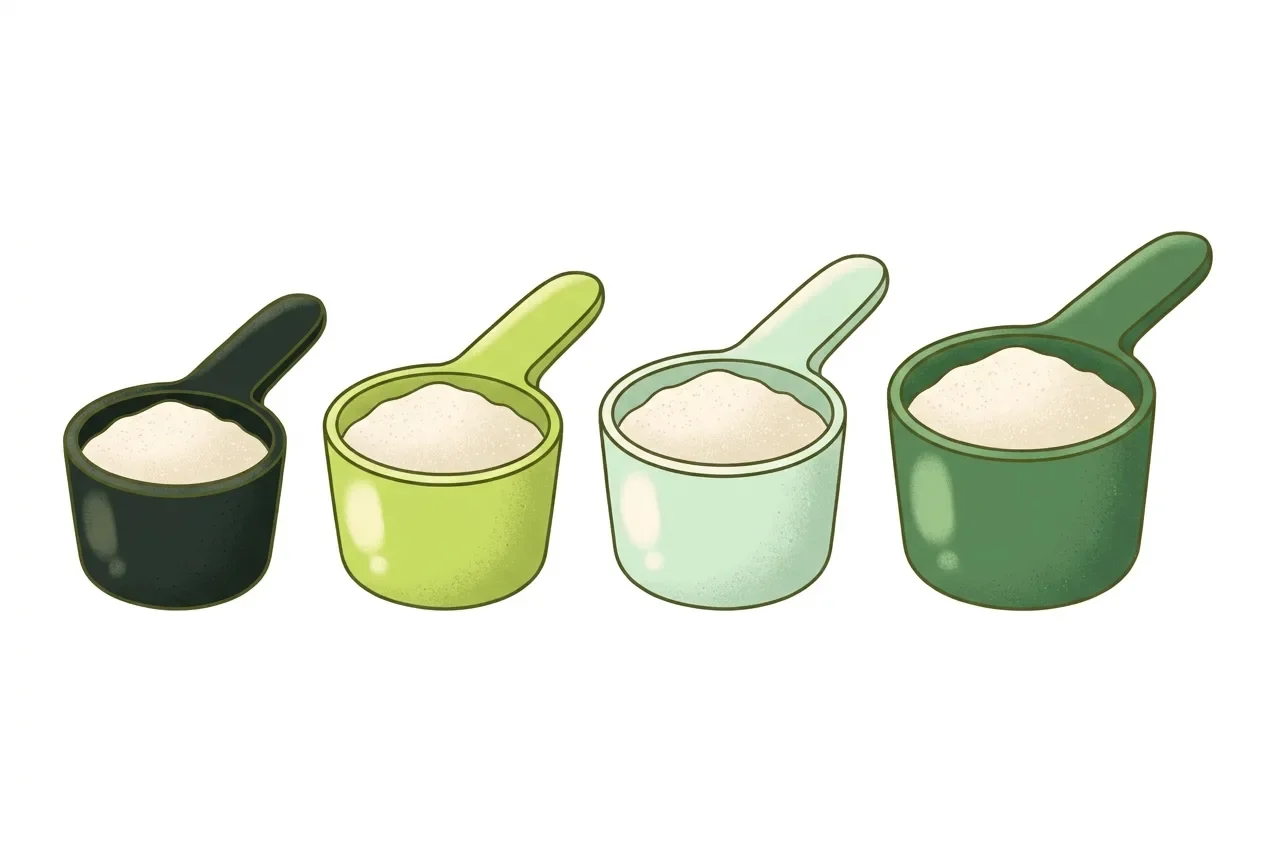
A scoop typically holds 23 to 25g protein, but the powder weight around that protein varies by brand. A scoop is not a standard unit. It is whatever plastic scoop the manufacturer chose to include, and it only means what the label says it means.
Four brand labels show the range directly. Optimum Nutrition's Gold Standard 100% Whey lists 1 scoop at 24g protein (Optimum Nutrition). Dymatize ISO100 Gourmet Vanilla lists 1 scoop, 30g of powder, at 25g protein and 110 calories (Dymatize).
Myprotein's Impact Whey Isolate lists 1 scoop at 29g powder for 25g protein and 110 calories (Myprotein). GymBeam's True Whey lists 1 portion at 30g powder for up to 23g protein, depending on flavor (GymBeam).
The four labels above show each brand pairing its protein grams with a different weight of powder. That means the rest of each scoop is carbohydrate, fat or flavoring, and that ratio shifts from label to label.
That is why two 30g scoops do not match: Dymatize's 30g scoop gives 25g protein, while GymBeam's 30g scoop gives up to 23g protein, depending on flavor. And it is why two 25g-protein products differ in weight: Dymatize needs 30g of powder to reach 25g protein, Myprotein needs only 29g.
The label is the only place this ratio is confirmed for a specific product. Look at the nutrition panel on your own tub, not a general guide. It lists the scoop size in grams and the protein grams for that same scoop.
Two regulators require this. In the US, the FDA's labeling rule requires the nutrition panel to state a serving size in a common household measure, such as a cup, spoon or scoop, under the regulation's catch-all for household packaging equipment, next to its metric gram weight, and to declare the nutrient amounts for that same serving (FDA, 21 CFR 101.9).
In the EU, Directive 2002/46/EC requires supplement labels to state the recommended daily portion and the nutrient quantity per that portion, in numerical form (EUR-Lex). This is why brands sold on either side of the Atlantic, from Optimum Nutrition to GymBeam, print an exact portion size and protein figure on the tub.
So whatever brand sits in your kitchen, its own label already has the answer. No cross-brand estimate can replace it.
Only if you know the powder's density, and the four labels above show that density is not fixed across brands. A borrowed spoon or cup will not reliably match another product's scoop.
The safest substitute is a kitchen scale. Weigh out the gram figure printed on your label. For example, use the 29g Myprotein scoop or the 30g Dymatize scoop as your target weight. You then get the same protein result the label promises, without needing the scoop at all.
If the scoop is gone and the label is unreadable too, the four brand figures above are named examples for that specific product, not a universal fallback. The safest move in that case is to search the product name online and find the same label again.
Once you know your scoop's actual protein count from its label, you can apply the same careful habit to a whole dish. How to count calories in homemade food walks through weighing and totaling ingredients step by step.
When you're ready, you can log the shake with Avocalo alongside the rest of your meals.
Yes, a packed scoop holds more powder by weight than a level one, even though it is the same scoop. Labels are written for the level fill the manufacturer tested, so packing the scoop pushes your actual protein intake above the number printed on the tub.
Not necessarily by design, but the labels above show isolates (Dymatize, Myprotein) reaching 25g protein at 29 to 30g powder, while GymBeam's whey reaches up to 23g protein at the same 30g. Compare the label's protein-per-scoop figure directly rather than assuming one powder type behaves like another.
Flavoring and sweetener add extra weight that is not protein, and brands adjust each flavor's recipe slightly. Always check the specific flavor's own label rather than assuming it matches another flavor from the same product line.
This article cites official product labels for four whey protein brands. See the pages for Optimum Nutrition Gold Standard 100% Whey, Dymatize ISO100, and Myprotein Impact Whey Isolate, plus GymBeam True Whey. It also cites the US FDA's serving size labeling rule, 21 CFR 101.9 and the EU's Directive 2002/46/EC on supplement labeling. Published by Petros IT Solutions SRL. Corrections: [email protected].