Portions without a scale
How Much Protein Is in a Scoop of Protein Powder?
A scoop holds about 23-25g protein, but scoop weight varies by brand. Real labels compared side by side, so you can check your own tub.
Guides
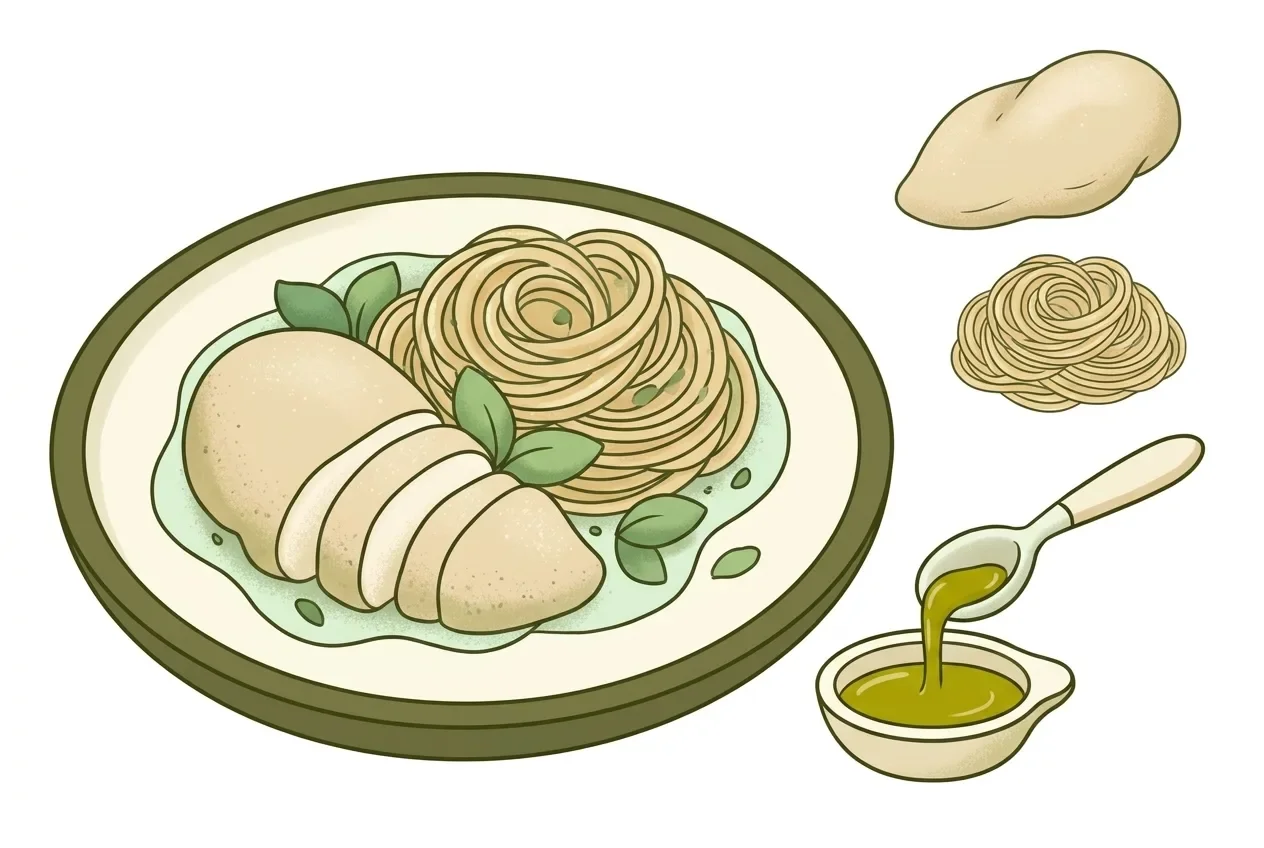
To count calories when eating out, build the plate from its parts, not from its name. Size the protein and the starch against something you already know the weight of, then add the fat you cannot see, since that fat is usually what separates a restaurant plate from the same dish at home.
A consistent estimate logged every time beats a precise number you never log because the menu left you nothing to work with.
Typing "pasta, 1 serving" into a food search treats every plate called pasta as the same plate. It is not. A team from Tufts University bought 364 meals from 123 independent restaurants in Boston, San Francisco and Little Rock, Arkansas, and measured them in a lab. The average came to 1,205 kcal per meal, but individual dishes varied widely even within the same cuisine (Urban et al., 2016).
A dish name is a category, not a measurement. Two restaurants' "grilled chicken caesar" can differ by hundreds of calories depending on how much oil hit the pan and how much dressing hit the bowl. The name tells you what's roughly on the plate. It says nothing about how much fat carried it there.
Start with the parts you can estimate by eye, because they are the most stable across kitchens.
Compare the protein portion to something sized and weighed before: your own bowl at home, or a deck of cards for a rough visual anchor. A chicken breast, fish fillet or piece of steak that fills roughly a palm's worth of space is a reasonable starting point for an adult portion.
Do the same for the starch. Pasta, rice or potatoes piled to about a cupped handful gives you a second anchor point. If the plate arrived with a visibly larger mound than what you'd serve yourself, size it up accordingly rather than defaulting to a "standard serving."
These two components are usually the most predictable part of the plate. A grilled chicken breast is grilled chicken breast wherever it's cooked; the variation mostly hides elsewhere.
Once you have a rough weight for the protein and the starch, you have the skeleton of the estimate. The next step is the part that actually moves the number.
This is where restaurant plates and home plates diverge, and it is the step most guides mention without ever putting a number on it.
Olive oil carries 884 kcal per 100 g, according to USDA FoodData Central (FDC 171413). A tablespoon poured into a pan, a finishing drizzle, or oil the pasta was tossed in can add more energy to the plate than the protein sitting on top of it.
Dressings vary even more by brand. USDA FoodData Central branded-food entries for caesar dressing range from about 110 kcal per 100 g for a low-calorie version (FDC 169877) to over 500 kcal per 100 g for a regular one (FDC 169055). A restaurant's house dressing could sit anywhere in that range, and you have no way to know which end it's closer to just by looking.
Treat any sauce, dressing, pan fat or visible sheen on the plate as its own line item, not as a garnish. If the dish looks glossy, oil is the reason, and it belongs in the total.
The portion sizes below are illustrative, meant to show the arithmetic, not a measurement of an actual restaurant plate. Only the per-100 g energy figures are sourced.
Say you're estimating a grilled chicken and pasta dish. You judge the chicken at roughly 150 g, comparable to a chicken breast you've weighed before, and the pasta at roughly 200 g cooked. You notice a light sheen of oil, which you estimate at one tablespoon (about 14 g).
| Component | Illustrative amount | kcal per 100 g (sourced) | Estimated kcal |
|---|---|---|---|
| Grilled chicken breast | 150 g | 151 kcal (USDA FDC 171534) | 227 kcal |
| Cooked pasta | 200 g | 158 kcal (illustrative figure for this example) | 316 kcal |
| Olive oil | 14 g | 884 kcal (USDA FDC 171413) | 124 kcal |
| Total | 667 kcal |
The chicken math is simple: 150 g at 151 kcal per 100 g is 1.5 × 151, or about 227 kcal. The oil is the part worth noticing: 14 g at 884 kcal per 100 g is 0.14 × 884, or about 124 kcal, nearly as much as the chicken itself from a single tablespoon.
If you'd missed the oil entirely, the estimate would drop by almost a fifth. The protein and starch are the frame; the fat is where the real uncertainty sits.
Where a menu number does exist, it describes a standard portion, not necessarily the plate served to you. Under the FDA's menu labelling rule, a restaurant only needs a "reasonable basis" for its stated figure, drawn from a nutrient database, a cookbook, a lab analysis, or other reasonable means (21 CFR 101.11).
The same Tufts group tested how close those stated numbers come to reality. Across 269 items from 42 chain and quick-serve restaurants, measured energy averaged just 10 kcal higher than the stated value, a difference too small to be statistically significant (Urban et al., JAMA 2011).
On average, menus are close. Individually, they can swing. The same study found 19% of items, 50 out of 269, measured at least 100 kcal above their stated value. A menu number is accurate for the standard version of the dish. Your plate might not be the standard version.
The Tufts sampling of independent restaurants also found the average meal at 1,205 kcal, and meals from American, Chinese and Italian cuisine, the highest-calorie group in the study, averaged 1,495 kcal (Urban et al., 2016). The same study found 92% of the 364 sampled meals exceeded recommended single-meal energy needs.
These are averages across a wide sample, not a prediction for any one plate. They explain why building from parts matters: a dish's name alone won't tell you where in that range yours falls.
Guessing high on every entry defeats the purpose of logging, because it stops reflecting what you actually ate. The goal of the parts method is a number tied to the plate in front of you, not a padded estimate meant to cover every possible version of the dish.
If you're unsure whether the oil was one tablespoon or two, log your best estimate and adjust next time you order something similar. A rough number tied to what you saw is more useful over weeks than a consistently inflated one.
Consistency is what makes restaurant logging useful, more than precision on any single plate. Pick the same anchors each time: a remembered bowl size, a card-deck comparison, a tablespoon for visible oil. Reusing the same reference points means your estimates drift together rather than randomly, so a week of restaurant meals stays comparable to a week of home-cooked ones.
A photo of the plate is the fastest way to get a first-pass list of its parts. Avocalo's photo logging identifies the foods and estimates portions and macros from the image, and you review and edit that result before saving it. The parts method in this article is what tells you what to edit: add the oil the photo can't see, adjust the portion if it looks larger than what you'd serve at home.
A photo estimate reads the image; it does not weigh the food or look it up in a nutrition database. It cannot know how much oil is in the pan sauce, how much butter finished the dish, or exactly how large the portion is compared with a restaurant's standard size. That's why the review step matters.
Avocalo lets you edit the AI's first pass before saving, which is where the fat and portion adjustments from this method belong. For a closer look at how photo-based estimates perform and where they tend to miss, see how accurate photo-based calorie estimates tend to be. If you want to size the invisible oil or dressing more precisely, the cooking-oil calorie calculator does the same conversion this article walks through by hand. You can download Avocalo to try photo logging on your next plate.
There's no single figure, because the dressing alone ranges from about 110 to over 500 kcal per 100 g depending on the brand or recipe used (USDA FDC 169877, USDA FDC 169055). Add the chicken or croutons, and the total depends heavily on how much dressing was poured, not just what's listed as "caesar."
The Tufts sampling found American, Chinese and Italian cuisines averaged 1,495 kcal per meal, notably higher than the overall 1,205 kcal average across all cuisines sampled (Urban et al., 2016). Cuisines built around sauces and oil-based cooking carry more of the hidden fat this article's oil step is meant to catch.
A consistent estimate logged every time gives you a record you can compare week to week, which a skipped entry never does. The parts method exists to make that rough estimate reasoned rather than a total guess.
A photo gives a fast first pass at what's on the plate, but it can't see the oil in a sauce or know if your portion is larger than standard. The method in this article is what you apply to edit that first pass before saving it.
Spotted an error? Write to [email protected].