Raw vs cooked weight
Weigh Food Raw or Cooked?
Weigh food raw or cooked based on your app's entry. See the USDA math showing why raw and cooked weights differ, worked out step by step.
Guides
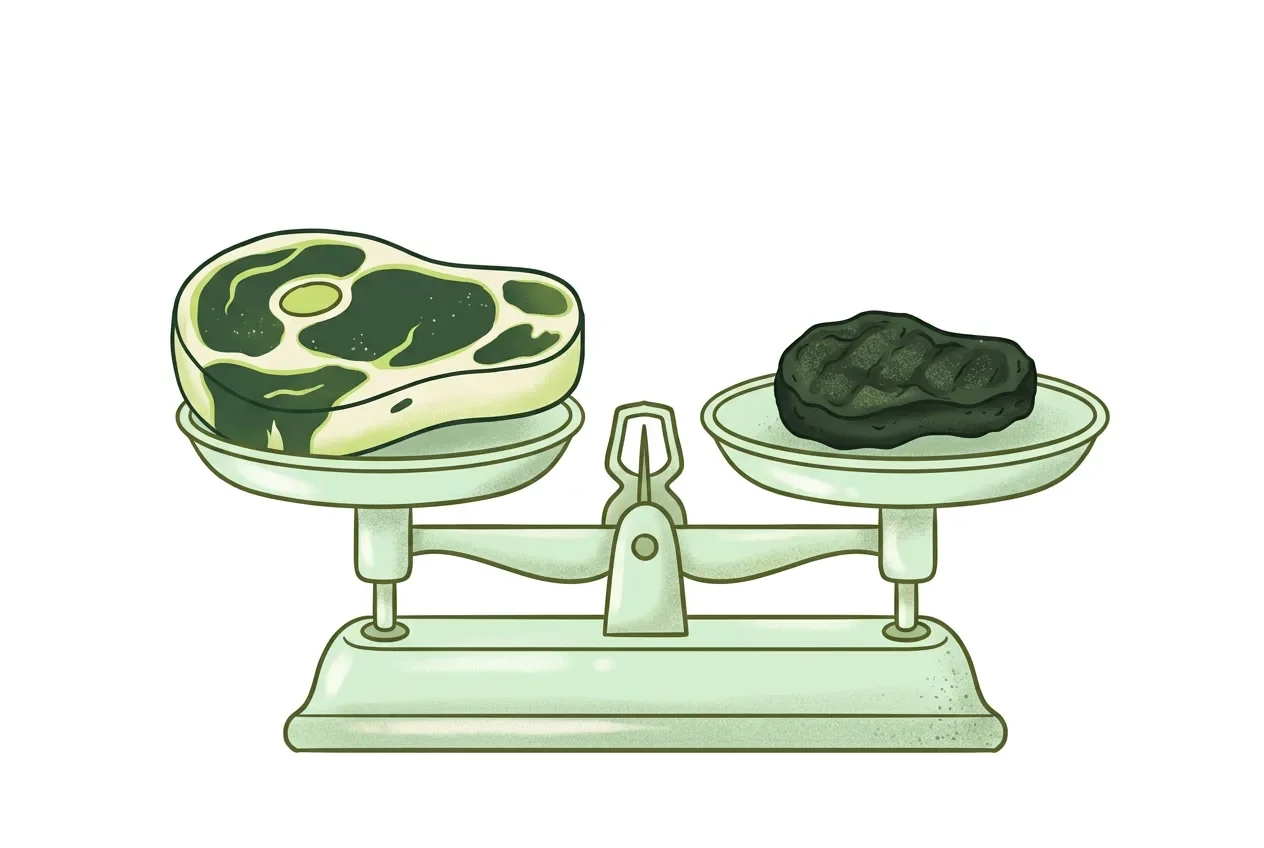
Cooking does not destroy protein in meat. What changes is water. A steak loses moisture as it cooks, so the same protein sits in less mass, and the cooked label shows more protein per 100 grams than the raw one. The total protein in the whole piece barely moves.
No. Heat unfolds, or denatures, the protein's shape, but it does not break the amino acid chains apart or remove them from the meat. The protein stays in the pan, on the plate, in the steak.
What heat does remove is water. A raw beef fillet steak is about 72.13 g moisture per 100 g, according to a 2022 study in the International Journal of Environmental Research and Public Health (Borela et al., PMC8744971). As that water cooks off, the steak shrinks, and the protein that was always there becomes a bigger share of a smaller piece.
This is why a nutrition label for cooked meat looks more impressive than one for raw meat of the same cut. Nothing was added. Water left, and everything else got more concentrated.
Protein per 100 g is a concentration, not a total. Shrink the denominator and the number goes up even if the numerator stays fixed.
The same study measured raw beef fillet steak at 22.90 g protein per 100 g (± 0.42). Cooked well-done in a pan with oil, that figure rose to 34.19 g per 100 g (± 0.90), a study measured directly, not a universal constant for all beef.
That is not 11 extra grams of protein appearing from nowhere. It is the same protein, measured against a lighter, water-reduced piece of meat. A scale would show the cooked steak weighs less than it did raw, even though it still holds nearly all its original protein.
Once you see the mechanism, the two numbers stop looking like a contradiction. They are two different denominators describing one steak.
The amount of water lost depends on the cooking method, not just the presence of heat. Borela et al. tracked this with a cooking factor index, the cooked weight divided by the raw weight, for beef fillet steak cooked well-done three ways.
Pan-frying with oil left the steak at 0.60 of its raw weight, the heaviest loss of the three methods measured. Pan-frying without oil left it at 0.72. Air frying left it at 0.71, close to the dry pan method.
| Method (well-done) | Cooking factor (cooked ÷ raw weight) | Protein per 100 g cooked |
|---|---|---|
| Pan-fried with oil | 0.60 | 34.19 g |
| Pan-fried without oil | 0.72 | 28.19 g |
| Air fryer | 0.71 | 29.67 g |
Source: Borela et al. 2022, PMC8744971.
The method with the most weight loss, oil pan-frying, produced the highest protein-per-100g reading. That is the water-loss mechanism at work, not a sign that oil adds protein or that the method 'concentrates' nutrition in a way worth chasing.
A reader logging a home-cooked steak now knows why the method matters for the label reading, even if the meat itself started identical.
This example uses an illustrative starting weight of 200 g raw fillet steak, since the study reports concentrations and ratios, not one fixed portion size. The protein and cooking-factor figures are Borela et al.'s measured results.
Start with 200 g of raw fillet steak. At 22.90 g protein per 100 g, that piece holds 45.8 g of protein before it touches heat.
Cook it well-done, pan-fried with oil, and the cooking factor of 0.60 means it now weighs 120 g. At 34.19 g protein per 100 g, that 120 g portion holds 41.0 g of protein.
| Stage | Weight | Protein per 100 g | Total protein |
|---|---|---|---|
| Raw | 200 g | 22.90 g | 45.8 g |
| Cooked (oil pan-fry) | 120 g | 34.19 g | 41.0 g |
The per-100g number rose by nearly 50%. The total protein in the piece dropped by about 5 g, not because protein was destroyed, but because some small losses happen alongside the larger water loss, and because 22.90 and 34.19 are independently measured averages with their own margins, not two points on one perfectly conserved curve.
If you know a recipe's total calories and want to split a cooked dish like this into servings, Avocalo's free recipe-portion calculator does that arithmetic once you have the cooked weight in front of you.
The headline stands: the steak did not gain protein by cooking, and it did not lose most of what it started with either. The label number moved because the scale number moved.
Match the weight you put on the scale to the entry you use. If you weigh the steak after cooking, use a cooked-meat protein figure. If you weigh it raw before it goes in the pan, use the raw figure.
Mixing them is the actual source of counting errors here, not cooking itself. Logging a 120 g cooked portion against a raw-meat protein-per-100g number overstates the protein in that plate, because the raw figure assumes more water is still present than actually is.
The fix is simple once you know which state you weighed. Weigh the steak at the point you plan to log it, then look up or estimate protein for that same state, not the other one.
Not in any way worth planning around. The total protein in a piece of meat starts fixed by the raw cut and stays close to that figure through cooking, whichever method you choose.
What the method changes is how much water leaves, which changes the weight of what lands on your plate and therefore the per-100g reading you would use if you logged the cooked weight. A method that removes more water, like oil pan-frying in this study, produces a smaller, denser-reading piece of meat, not a piece with meaningfully more protein packed into it from an eating standpoint.
Choosing a cooking method for its effect on a protein count is chasing a labeling artifact, not a real gain.
Avocalo is a photo-based calorie and macro tracker. You photograph a meal, and an AI vision model estimates calories, protein, carbohydrates and fat from what it sees in the image. You review and edit the estimate before saving it.
That estimate reads the cooked meal in front of you, the steak as it actually sits on the plate, not a raw weight you'd have to remember or reconstruct. It does not look up your food in a nutrition database or weigh it, and it can't know about hidden oil or sauces, so treat the result as an estimate to check, not a lab reading.
If you'd rather not do the raw-to-cooked arithmetic by hand each time, you can download Avocalo and photograph the finished dish instead.
The mechanism, water loss concentrating protein, applies broadly, but the exact numbers do not transfer. Borela et al. measured fillet steak specifically; a cut with more connective tissue or fat, like a chuck roast, will lose water at different rates and needs its own measurement rather than borrowing fillet steak's figures.
No. High heat denatures protein, changing its shape and texture, but it does not remove amino acids from the meat. The browning you see at high heat (the Maillard reaction) changes surface flavor compounds, not the underlying protein quantity.
They are usually measuring different states of the meat, one raw and one cooked, or two different cooking methods with different water loss. Check whether each label specifies raw or cooked weight before comparing them directly.
Resting can redistribute juices within the meat, but the figures in this article come from Borela et al.'s measurements taken at their stated cooking endpoint, not a separate resting stage. The study does not report a distinct post-rest weight or protein figure.
Published by Petros IT Solutions SRL. Spotted an error? Write to [email protected].