Raw vs cooked weight
Does Cooking Change Protein in Fish?
Does cooking change protein in fish? No, it concentrates it by removing water. See the USDA math and digestibility study behind the number.
Guides
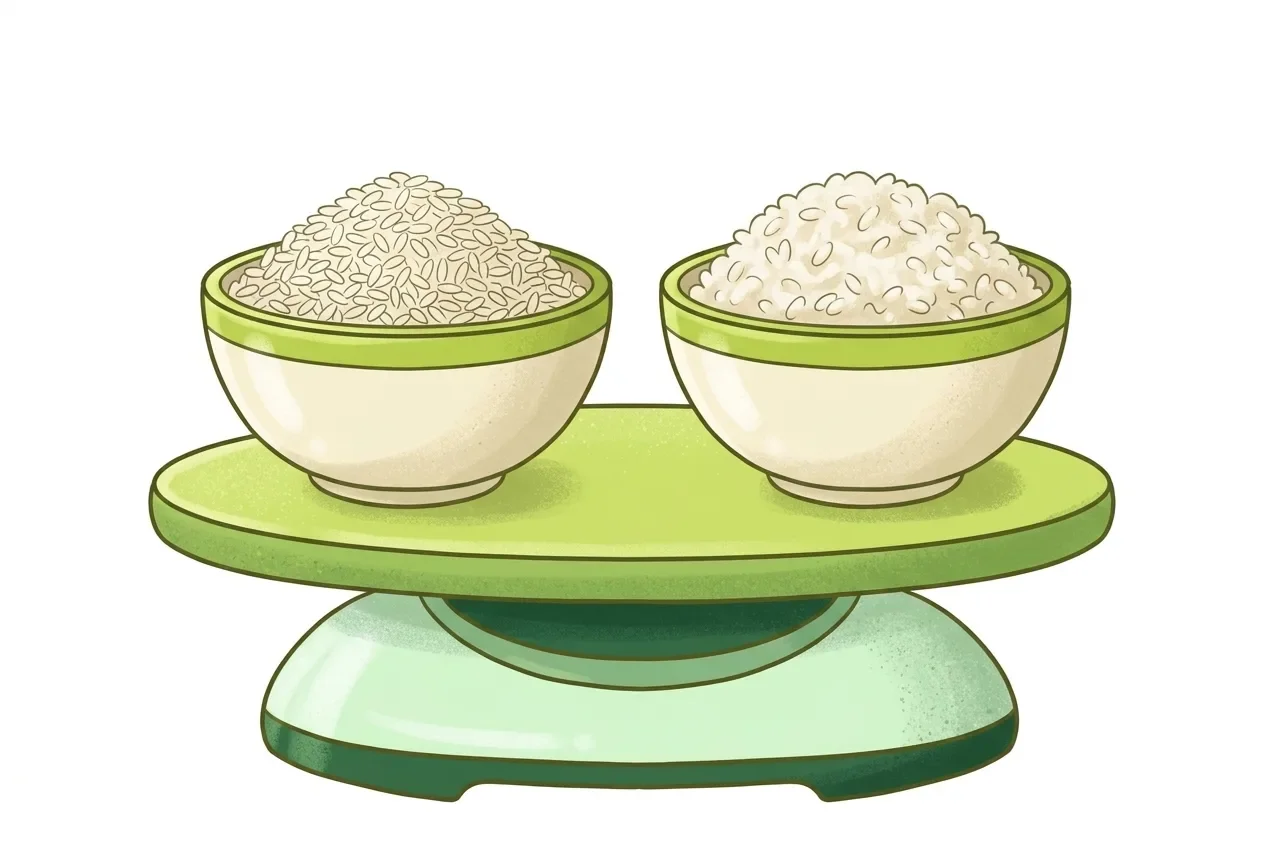
Weigh it either way, as long as you log it against the matching database entry. Rice keeps the same calories from the moment it's dry to the moment it's cooked, because cooking only adds water. A raw entry and a cooked entry describe the same food at two different points, not two different foods.
USDA's own records show why the numbers look so different. Raw white long-grain rice runs 365 kcal per 100 g, while the cooked version of the same rice comes in at 130 kcal per 100 g (FoodData Central, fdcId 168877; fdcId 168878).
Nothing was destroyed. The rice absorbed water, so the same calories now sit inside a heavier pile of food. Weighing raw skips the guesswork about how much water your batch absorbed; weighing cooked matches what's actually in front of you. Either works, provided the entry you tap in your app is in the same state as the food on your scale.
The obvious instinct is to assume cooking changes rice's calorie content. It doesn't. Rice is mostly starch, and starch's energy value doesn't change when it absorbs water during cooking.
What changes is the denominator. A 100 g scoop of dry rice is almost entirely rice. A 100 g scoop of cooked rice is roughly a third rice and two thirds water, because the grains have swollen. Divide the same total calories by a bigger weight and the number per 100 g drops.
USDA's two records confirm this directly. Raw rice sits at 365 kcal per 100 g. Cooked rice sits at 130 kcal per 100 g. The site's general explainer covers this rule in more depth using the general rule for weighing any food raw or cooked. Rice is one example of that rule, not an exception to it.
Once you accept that the calories are fixed at the dry weight, the practical question becomes: how much heavier does the rice get, and what happens if you log it against the wrong entry.
For white long-grain rice, Avocalo's raw-to-cooked converter puts the yield at 280%, derived from the paired USDA raw and cooked entries above (raw-to-cooked weight converter, rice). So 100 g of dry rice becomes about 280 g once cooked by absorption. That's the method where the rice takes up all the water in the pot, rather than being boiled in excess water and drained.
Different rice types absorb water differently, so their yields differ too. That's fine, since matching your weighed state to the matching entry is what matters, not hitting one universal ratio.
Illustrative example, using the sourced 365 kcal raw and 130 kcal cooked figures above: say you cook 100 g of dry white rice, which becomes about 280 g cooked at the 280% yield. The true calorie count is 365 kcal, fixed at the dry weight, whichever way you weigh it.
| Scenario | What you weigh | Entry you log against | Result |
|---|---|---|---|
| Correct, raw | 100 g dry | Raw entry (365 kcal/100g) | 365 kcal |
| Correct, cooked | 280 g cooked | Cooked entry (130 kcal/100g) | 365 kcal |
| Mismatch A | 280 g cooked | Raw entry (365 kcal/100g) | 1,022 kcal, off by 657 kcal |
| Mismatch B | 100 g dry | Cooked entry (130 kcal/100g) | 130 kcal, off by 235 kcal |
Logging the cooked weight against the raw entry roughly triples the true figure. Logging the dry weight against the cooked entry cuts it to about a third. Both mistakes come from the same root cause: the weight and the entry describing different states of the same food.
Most rice isn't cooked one portion at a time, so the practical question is how to split a shared pot fairly.
Weigh the empty pot first, then weigh it again once the rice is cooked and off the heat. Subtract the two to get the true cooked weight of just the rice. From there, divide by the number of servings you're splitting it into, or weigh out the portion you're actually eating.
Avocalo's recipe-portion calculator is built for exactly this step. It takes a cooked dish's total weight and a number of servings, or a specific portion weight, and returns calories per serving. Once you have that per-serving weight, log it against the cooked rice entry in your app, since that's the state you weighed it in.
Brown rice absorbs more water than white rice during cooking, which is why its yield percentage is higher. Avocalo's converter puts brown long-grain rice at about 296.7% of its dry weight cooked, compared to 280% for white long-grain rice.
These figures come from USDA's own brown-rice pair: raw brown long-grain rice against its cooked counterpart (FoodData Central, fdcId 169703; fdcId 169704). This is a separate pair of records from the white-rice figures above, not the same entries scaled up.
Brown rice, cooked, comes in at 123 kcal per 100 g on that record, a little lower than white rice's 130 kcal per 100 g cooked. So a higher water yield doesn't mean the same calories per 100 g; brown rice cooked is its own figure, not white rice's number carried over. Expect roughly 297 g of cooked brown rice for every 100 g started dry, and log it against the brown rice entry, raw or cooked, that matches the state you weighed.
A few habits undermine the arithmetic even when the underlying rule is right.
Avocalo's manual food search holds separate raw and cooked rice entries, built from sources including USDA FoodData Central. Once you know which weight you took, you can pick the matching entry directly.
Its photo logging works differently. Point the camera at a plated meal and the AI vision model estimates the foods, portions and calories from the image itself. It doesn't weigh anything or match against a database entry.
That's useful for a quick estimate, but it doesn't replace weighing rice on a scale when you want the entry-matching accuracy this article describes. You can download Avocalo to use either method.
Rinsing removes surface starch before cooking begins, but the water absorbed during cooking is what determines the final yield. The 280% and 296.7% figures on Avocalo's converter assume standard absorption cooking; a rinsed or soaked batch may land somewhat differently, so weighing your own cooked result is the reliable check.
Neither is inherently more accurate; both give the same true calorie count once matched to the right entry. Weighing dry avoids guessing the cooking yield, while weighing cooked matches what's actually on the plate. Pick whichever fits how you cook, and log it against the entry in that same state.
They're not disagreeing, they're describing different states of the same food. Raw white rice sits at 365 kcal per 100 g and cooked rice at 130 kcal per 100 g in USDA's records. The difference is roughly threefold, explained entirely by the water absorbed during cooking, not by any change in the rice itself.
Yes. Absorption cooking, where all the water is taken up by the rice, gives a different final weight than boiling in excess water and draining it off afterward. The 280% figure for white long-grain rice on Avocalo's converter is tied specifically to the USDA record pair behind it, not to every possible method.
This article was written by the Avocalo Editorial Team for Avocalo, published by Petros IT Solutions SRL. Spotted an error? Write to [email protected].