Raw vs cooked weight
Does Cooking Change Protein Content in Meat?
Cooking doesn't destroy protein in meat, it concentrates it. See the exact study numbers and the arithmetic behind the label.
Guides
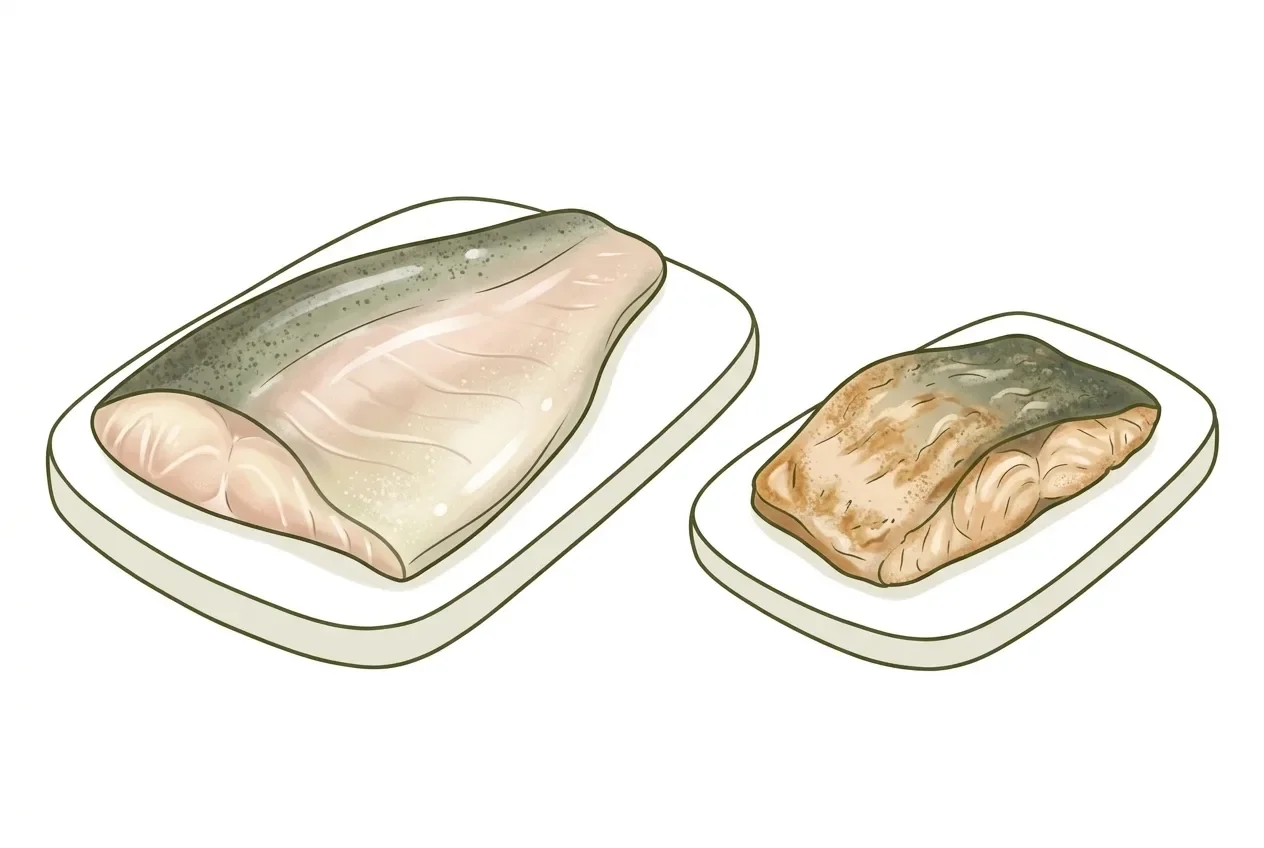
The obvious method is to compare two per-100g labels and assume cooking added protein. That gives the wrong answer.
A 100g portion of raw fish and a 100g portion of cooked fish are not the same piece of fish. The raw portion contains more water. Once you cook it, that water evaporates, so the same amount of protein now sits inside fewer total grams. The percentage looks higher, but nothing was added.
This is a weight problem, not a protein problem. To see the real effect, you need to track total grams of protein in the whole fillet, not just the ratio on one label.
Water. Fish muscle holds a large share of water before cooking, and heat pushes a portion of it out through evaporation and drip loss.
Farmed Atlantic salmon, raw, contains 20.4g of protein per 100g, according to USDA FoodData Central (fdcId 175167). That same record lists 64.9g of water per 100g, the water this article's mechanism concerns.
None of that protein evaporates during cooking. Only water does. So as a fillet loses weight, the protein that remains gets packed into a smaller mass, and its percentage per 100g climbs even though the total grams of protein in the fillet do not.
No single cooking method adds or destroys protein grams. What changes by method is how digestible that protein becomes.
A 2025 peer-reviewed study in the journal Foods measured protein digestibility, not protein amount, in sardines and sprats cooked by different methods. Raw sardines digested at 67.4%. Steamed and baked sardines rose to roughly 82.6 to 82.8%. Fried sardines reached 92.4%.
Sprats followed a similar pattern: 76.0% raw, about 82.5% steamed or baked, and 89.5% fried.
These are absorption percentages, not weight or grams. The study did not measure total protein grams before and after cooking, so it cannot tell you whether frying versus steaming changes the number on a nutrition label. It only tells you that heat can make the protein already present easier for the body to break down and absorb, in the two species this study tested.
Every figure in this section past the raw record is illustrative, built to show the arithmetic, because no verified USDA record for cooked salmon protein, water or fat was available for this article. Only the raw protein and water figures below are sourced.
Start with the one confirmed record: 100g of raw farmed Atlantic salmon holds 20.4g protein and 64.9g water, per USDA FoodData Central.
Imagine a 200g raw fillet, an illustrative starting weight. It contains twice that protein amount: 40.8g, since the figure per 100g simply doubles for 200g.
Suppose cooking drives off 20% of that fillet's total weight in water, an illustrative loss chosen only to keep the arithmetic simple. Real water loss varies by fish, cut and cooking method, a point the pitfalls below cover. The fillet now weighs 160g.
| State | Total weight | Total protein | Protein per 100g |
|---|---|---|---|
| Raw fillet | 200g (illustrative) | 40.8g (from sourced 20.4g/100g) | 20.4g (sourced, fdcId 175167) |
| Cooked fillet | 160g (illustrative loss) | 40.8g (unchanged) | 25.5g (illustrative) |
The total protein, 40.8g, never changes between the two rows. Only the denominator shrinks, from 200g to 160g, which is why 40.8 ÷ 160 × 100 gives 25.5g per 100g cooked, higher than the 20.4g raw figure. This is the arithmetic behind the water-loss effect: divide the same protein by a smaller cooked weight, and the ratio rises even though nothing was added.
Avocalo lets you log a meal two ways. You can photograph the cooked fish and let an AI vision model estimate the foods, portions, calories and macros from the image, which you then review and edit before saving.
Or you can search Avocalo's food database, built from Open Food Facts, USDA FoodData Central and national food-composition tables, and pick the entry that matches the state you actually weighed, raw or cooked.
Neither method weighs the fish for you or knows about hidden butter or oil. If you already know a cooked dish's total calories and want to split it into servings or a per-100g figure once you have logged the cooked weight, try the free recipe-portion calculator, which does that math from numbers you supply.
To log a fish meal by photo or by searching the food database, download Avocalo.
No, extended cooking does not destroy protein grams in fish. Heat denatures the protein's folded structure, changing its shape, but this is not the same as removing it, and the total protein amount in the fillet stays constant regardless of how long it cooks.
No, the 2025 Foods study found the opposite pattern in sardines and sprats. Raw fish digested at 67.4 to 76.0%, while steamed, baked and fried versions all digested at higher percentages, up to 92.4% for fried sardines.
The mechanism, water leaving during cooking while protein stays fixed, is the same principle behind any water-containing food losing moisture as it cooks, but this article's sourced figures cover only farmed Atlantic salmon. A shellfish-specific claim would need its own verified raw and cooked records.
They are likely reading different states of the same fish, or pulling from different database entries. A cooked-weight entry and a raw-weight entry for the same fillet will show different per-100g protein numbers even though the fish itself did not change, which is the mechanism this article explains.
The underlying question of should you weigh food raw or cooked applies to any food you log, fish included.
Avocalo is published by Petros IT Solutions SRL. See the editorial policy for how figures are checked and sourced. Report a correction to [email protected].