Intermittent fasting
Should You Count Calories on Intermittent Fasting?
Should you count calories while intermittent fasting? Two trials show the window alone rarely explains weight loss; here's how to check yours.
Guides
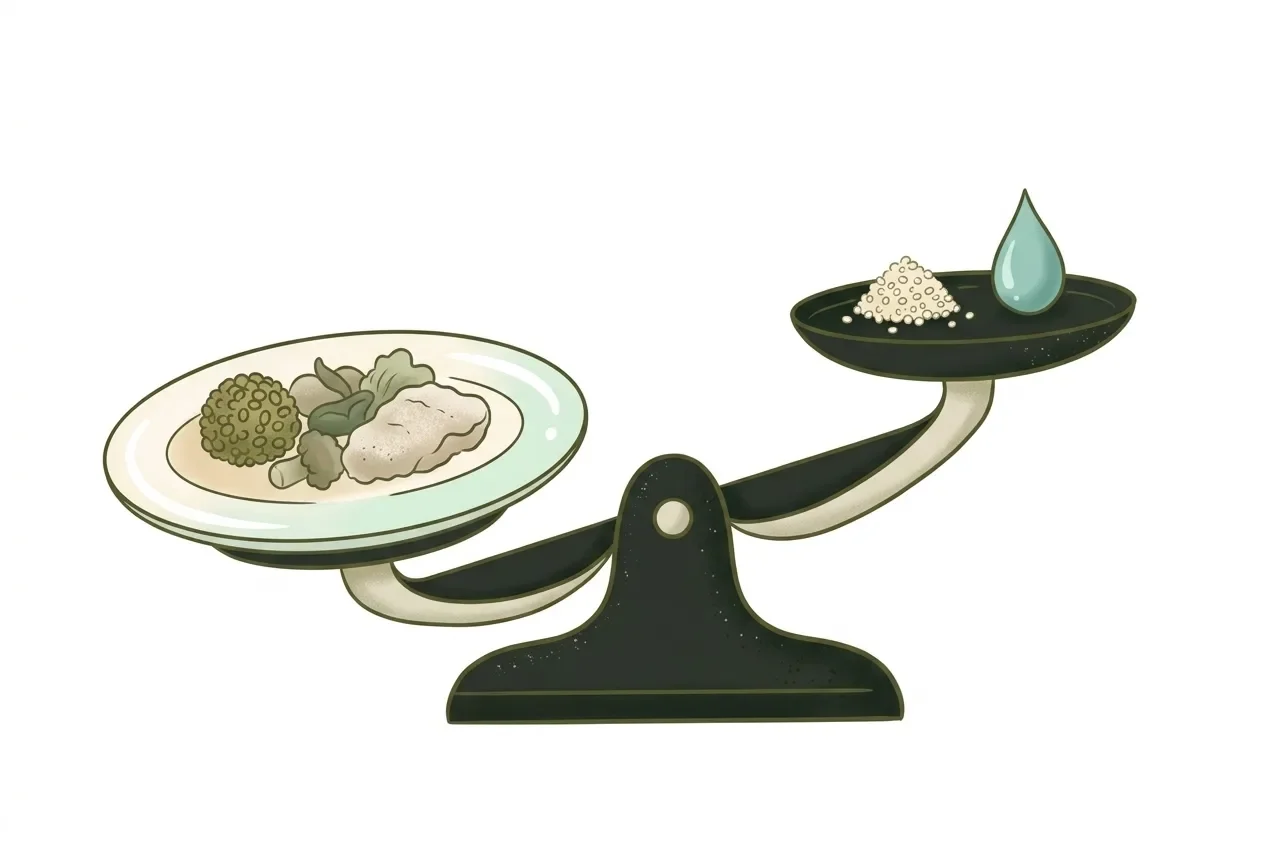
If you're gaining weight on intermittent fasting despite the timer being perfect, the window isn't enforcing a deficit on its own. Something else is filling the gap. A fasting window controls when you eat. It does not control how much.
If the meals inside your eating window got bigger or denser than what you used to eat across a whole day, the shorter window never produced a deficit.
A fasting schedule alone does not create a calorie deficit. The kilo you're seeing over three weeks is most likely water tied to glycogen, not fat. That's consistent with what the TREAT and Liu 2022 trials found.
No. The TREAT trial randomized adults with overweight or obesity to an 8-hour eating window (noon to 8pm) or to three meals spread across the day. After the study, the time-restricted group lost 0.94 kg on average. The control group lost 0.68 kg. That gap, 0.26 kg, was not statistically significant, P=.63 (Lowe et al., JAMA Internal Medicine, 2020).
The trial also measured estimated energy intake between groups. It found no statistically significant difference. That means compressing meals into a window did not, on its own, cut what people ate. The clock restricts timing. It does not restrict quantity unless you also restrict quantity.
Yes, and the trial data point toward this as a likely reason the scale went up. When people eat fewer, larger meals, the size and density of each meal can rise to fill the space.
A separate 2022 trial tested a related question directly. It combined an 8-hour window with a set calorie restriction, in a group of adults with overweight or obesity as well. That group lost 8.0 kg at 12 months, versus 6.3 kg for calorie restriction alone (Liu et al., New England Journal of Medicine, 2022).
The difference, 1.8 kg, was not statistically significant (95% CI -4.0 to 0.4, P=.11). Adding the window on top of an already-controlled calorie target added no reliable extra loss.
Both trials studied adults with overweight or obesity, so the exact numbers may not transfer to every body type or starting weight. But the mechanism they tested, whether a shorter window forces fewer calories on its own, applies regardless of who is fasting. If the window alone barely helps when calories are already fixed, it will not fix itself when the window is the only rule you're following.
Likely, yes, especially in the first three weeks of a new pattern. When you eat less often, the meals you do eat can be larger. A larger meal refills muscle glycogen more than a string of smaller ones would.
Glycogen does not sit in the muscle dry. It holds water. A 1970 study using muscle biopsies found that stored glycogen carries roughly 3 to 4 grams of water for every gram of glycogen (Olsson & Saltin, Acta Physiologica Scandinavica, 1970). That ratio was measured during a carbohydrate refeed after depletion. As an inference, this is a plausible parallel to what happens when a bigger dinner replaces three smaller meals, not a finding the study itself tested.
The 200 to 400 gram glycogen swing below is an illustrative figure. It is not a measurement of your body. It represents a plausible range for someone whose eating window now holds noticeably more carbohydrate-dense food than their old routine did.
| Extra glycogen stored | Water bound at 3g per gram | Water bound at 4g per gram |
|---|---|---|
| 200 g | 600 g | 800 g |
| 300 g | 900 g | 1,200 g |
| 400 g | 1,200 g | 1,600 g |
The arithmetic is just multiplication. At the low end of the ratio, 300 extra grams of glycogen binds 300 × 3, which is 900 grams of water. At the high end of the ratio, the same 300 grams binds 300 × 4, which is 1,200 grams.
Either way, that's close to or over a full kilogram. It is water weight tied to carbohydrate storage, not new fat tissue. This is why a kilo over three weeks, with nothing else changed, doesn't prove the fasting window failed. It may simply mean your body is holding more glycogen and its attached water than it was three weeks ago.
The trial data suggest three weeks may be too soon to judge. Even the 12-week TREAT trial only reported a statistically significant weight loss within the time-restricted group at the 12-week endpoint; the trial did not publish earlier timepoints to show whether that significance arrived sooner (Lowe et al., 2020). Both the water-binding effect above and normal day-to-day fluid shifts add noise. A single weigh-in cannot separate that noise from an actual trend.
The window itself doesn't tell you what went into it. The clock alone can't show the difference between two people on the same 16:8 schedule who eat different amounts. If your goal was a deficit, the eating window was never the mechanism. What filled it was.
That's true whether or not you're fasting. The three-step method for counting calories accurately covers weighing food and matching entries to how it was cooked, the steps that actually reveal what a meal contains, window or no window.
If you cook your own meals inside the window, Avocalo's recipe calorie calculator can turn a recipe's total calories into a per-serving or per-portion figure once you know the total and the weight of what you ate, so a bigger portion shows up as a number rather than a guess.
No, and it's worth being clear about what a photo log can and can't do. Avocalo lets you photograph a meal. An AI vision model then estimates the foods, portions, calories and macros in the image, which you review and edit before saving. It does not calculate a personalized deficit or tell you whether your window is working.
What it can do is show you, meal by meal, what actually went into your eating window this week. That log is sourced from what you photographed rather than from memory. If a bigger dinner has quietly replaced three smaller meals, a week of logged photos can make that pattern visible in a way a single scale reading cannot. You can download Avocalo to try this for your own eating window.
Yes, a small gain in the first weeks is common. It usually reflects glycogen and water shifting as your body adjusts to a new meal pattern, not new fat. The TREAT trial's own weight changes were reported at the 12-week endpoint, so early fluctuation before that point is expected.
The TREAT trial found no statistically significant difference in estimated energy expenditure between the time-restricted group and the control group. Both groups ate the same total pattern, just spread differently across the day. The window did not measurably change energy burned in that trial.
The Liu 2022 trial found no significant extra weight loss from adding an 8-hour window on top of calorie restriction that was already in place. Any reason to keep the window would rest on personal preference or convenience, not on a proven metabolic advantage shown in these studies.
You can't tell from the scale alone, since both water and food add weight the same way. Comparing what you actually ate in the window this week against a prior week, meal by meal, is the more direct way to check.
This article was written by the Avocalo Editorial Team and published by Petros IT Solutions SRL. Report a correction to [email protected].