Intermittent fasting
Does Creamer Break a Fast? The Calorie Math
Does creamer break a fast? See the real kcal in milk, creamer and lemon water, sourced to USDA data, and why the 50-calorie rule has no study behind it.
Guides
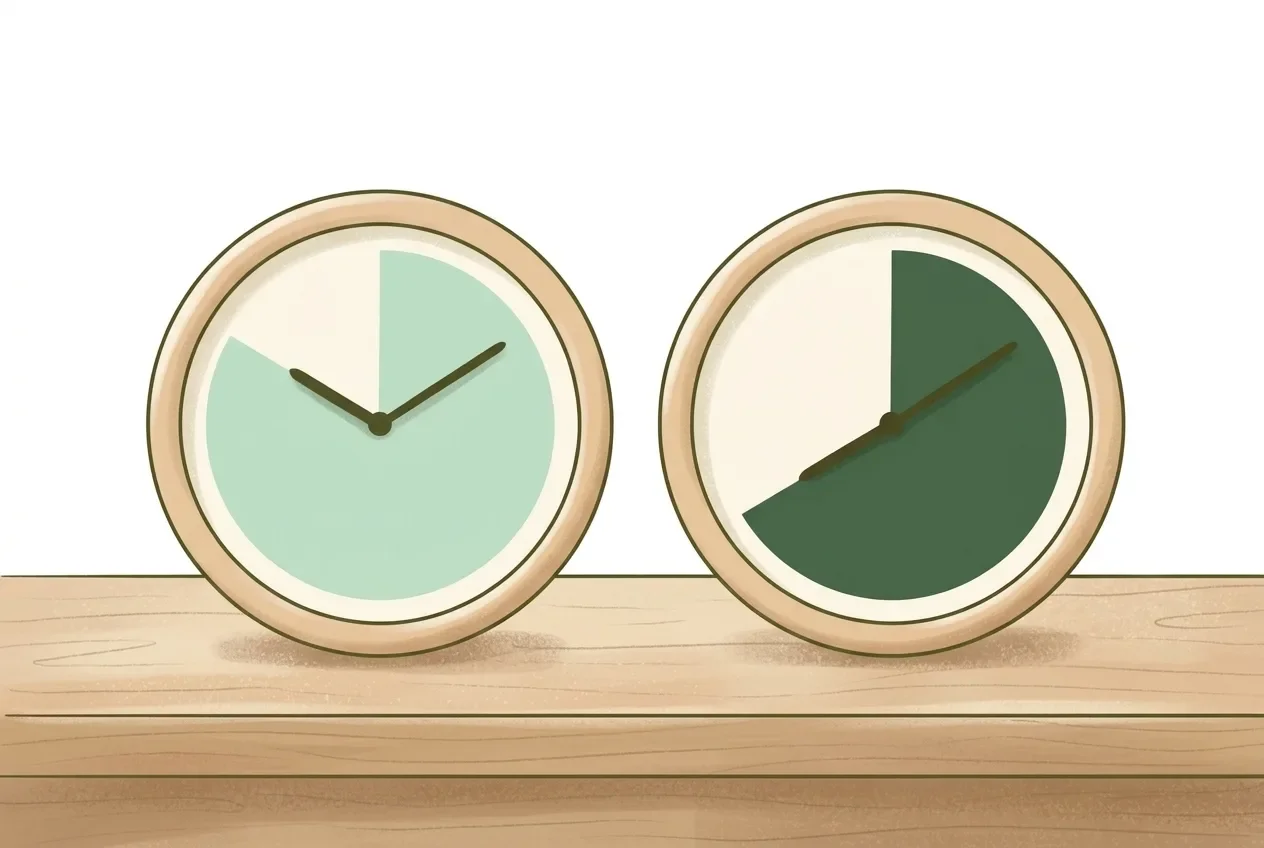
Both are daily eating windows named for hours fasted to hours eaten. 14:10 means you eat across any 10-hour stretch and fast the other 14; 16:8 narrows that eating stretch to 8 hours. The whole difference is two hours moved from the eating side to the fasting side.
Nothing else about the rule changes. You still choose which two hours to give up, breakfast, a late dinner, or a snack. The trial evidence below is what tells you whether those two hours are worth losing.
It depends which trial you read, and the honest answer is that they disagree. The only study that put the two windows head to head found 16:8 won; two other trials found window length barely mattered at all.
In a 2024 randomised trial of adults with obesity and type 2 diabetes, people fasted 3 days a week for 3 months on either 16:8 or 14:10. The 16:8 group lost 3.18 kg (4.02% of body weight); the 14:10 group lost 2.5 kg (3.15%); both beat a control group's 0.4 kg, and 16:8 lost significantly more than 14:10 (p<0.001) (Journal of Diabetes Investigation, 2024). The table below lines up all three trials.
But that trial fasted people only 3 days a week, in a group managing diabetes. That protocol differs from daily fasting in a general population, which is how most searchers picture running either window.
Two other trials point the other way. Cienfuegos and colleagues randomised adults with obesity to a 4-hour or a 6-hour daily eating window for 8 weeks. Both lost about 3% of body weight, with no meaningful difference between them (Cell Metabolism, 2020).
The TREAT trial compared 16:8 against eating at any time across 12 weeks. The 16:8 group lost 0.94 kg, the control group 0.68 kg, a gap of 0.26 kg that wasn't statistically significant (JAMA Internal Medicine, 2020). On its own, 16:8 barely beat no window at all.
The three trials tested different populations, different protocols and different comparisons, which is why their numbers don't agree.
| Trial | Population | Protocol | Result |
|---|---|---|---|
| Cienfuegos, Cell Metabolism 2020 | Adults with obesity | Daily, 4h vs 6h window, 8 weeks | Both ~3% weight loss, no significant difference |
| TREAT, JAMA Internal Medicine 2020 | Adults with obesity | Daily 16:8 vs unrestricted eating, 12 weeks | 16:8 -0.94 kg vs control -0.68 kg, not significant |
| Journal of Diabetes Investigation 2024 | Adults with obesity and type 2 diabetes | 3 days/week, 16:8 vs 14:10, 3 months | 16:8 -3.18 kg vs 14:10 -2.5 kg, significant (p<0.001) |
Only the 2024 trial compared the two windows directly and found a real gap. It did so in a specific medical population, fasting a partial week, not daily.
The fairest comparison for someone fasting daily, Cienfuegos, found no difference between a 4-hour and a 6-hour window. The trial that did find a difference tested a 3-day-a-week schedule in people with type 2 diabetes.
That design doesn't match how most people run 14:10 or 16:8 at home, fasting every day. So the disagreement between trials is largely a disagreement between what was tested, not proof that one window is inherently stronger.
The following figures are illustrative, to show the arithmetic; they are not a prediction for any individual. A fasting window changes weight only through what it does to your food intake, so start there.
In the Cienfuegos trial, both the 4-hour and 6-hour groups spontaneously cut about 550 kcal a day, without counting calories, and lost the same weight (Cell Metabolism, 2020).
Say a reader normally eats 2,400 kcal a day. If both a 14:10 window and a 16:8 window pushed that same 550 kcal drop, both would land around 1,850 kcal. That's true whether the cut came from a missed breakfast or a missed evening snack.
The two extra hours of fasting in 16:8 don't add a second mechanism. They just narrow the clock further, and the clock only removes calories on days it's actually kept.
A 14:10 window followed every day removes more food, over a month, than a 16:8 window followed four days out of seven. That is the arithmetic behind the article's central point: the window matters less than whether you keep it.
No trial fetched for this article measured a 16-hour threshold for anything, so no specific hour count can be stated as fact here. Guides that claim autophagy switches on exactly at hour 16 aren't citing a measurement.
None of the sources behind this article support that number. What the trials do show is a weight and intake effect from both 14 and 16-hour windows, at different magnitudes depending on the study.
If a specific biological switch exists at a specific hour, it isn't in the evidence this article can check. Treat that claim as unverified rather than settled.
Start from the two hours you'd actually lose. Both windows are legitimate protocols; the 2-hour gap between them is not the difference between a real fast and a fake one.
If skipping breakfast is easy for you, 16:8 costs you little, and the 2024 trial gives it a slight edge in the population it tested. If breakfast is the one meal you protect, 14:10 lost nearly as much weight in that same trial, and matched 16:8 exactly on weight loss in the Cienfuegos trial's more general population.
The window you keep every day beats the stricter one you keep four days a week. Pick the one you can run on a Tuesday, not just a Monday.
The same logic applies: a narrower window is a stricter version of the same rule, and it only helps if you actually keep it. None of the trials cited here tested 20:4 or one meal a day directly, so no separate weight-loss figure can be given for either.
No trial in this article's sources measured an autophagy threshold at 16 hours or any other specific hour. That claim appears widely online but wasn't verified against a primary source here, so treat it as unconfirmed rather than settled science.
Nothing in the cited trials tested switching, but the evidence points toward consistency mattering more than the exact hour count. Since both windows produced similar drops in intake when kept daily, alternating them likely just averages the effect, not cancels it.
The trials cited here measured window length, not food quality within it, so they can't answer what you eat directly. But since both windows worked mainly by cutting spontaneous intake, what fills that shorter eating period likely still matters for how much intake actually drops.
It can be, since it cut intake and body weight by amounts close to 16:8 in the Cienfuegos trial's general-population design. A longer window is not automatically the more effective one, so starting at 14:10 isn't a lesser version of fasting.
Not based on these trials: both the Cienfuegos and TREAT trials measured spontaneous drops in intake without any calorie counting. That said, tracking what you actually eat is the only way to know whether your own window is doing anything, rather than assuming it from the trial averages.
Avocalo's fasting timer supports 16:8, 14:10, 20:4 and one meal a day, so you can set up whichever window this article settles you on. The app also logs meals from a photo, tracks calories and macros, and shows 7-day, 30-day and 3-month trends.
None of that tells you whether autophagy switched on, and the app makes no claim to. What it can show is whether your own intake actually dropped on the days you kept the window, which is the same thing the cited trials measured.
If you're deciding between windows, running one for two weeks and checking does skipping breakfast slow your metabolism alongside your own weight trend and plateau checker readout is closer to what the RCTs actually did than picking a winner from a headline percentage. Get the timer from Avocalo's download page.
Published by Petros IT Solutions SRL. Spotted an error? Write to [email protected].