Portions without a scale
How to Estimate Protein in Meat Without a Scale
How to estimate protein in meat without a scale: size the piece by hand, then apply the right protein figure for its state.
Guides
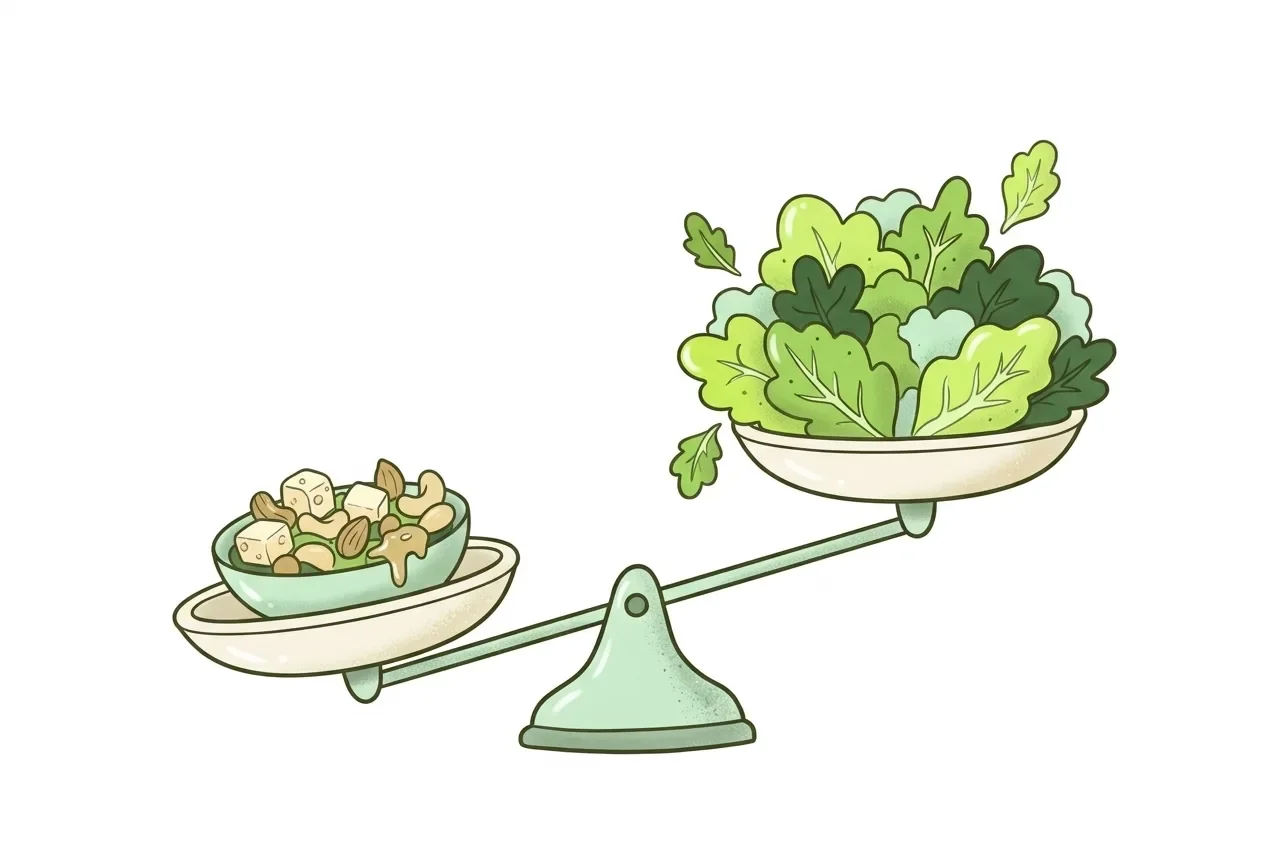
To count calories in a salad, weigh the dense parts and let the leaves be a rough guess. Lettuce barely matters: it holds so little energy that even a wrong guess costs you almost nothing. Dressing, cheese, nuts and oil are a different story. A few tablespoons of any of them can outweigh a whole bowl of leaves in calories, so those are the ingredients worth putting on a scale.
A photo shows volume well. It shows a big pile of lettuce and a modest scoop of feta. What it cannot show is the coating of oil clinging to every leaf once the salad is tossed, or how much dressing pooled at the bottom of the bowl.
This is a documented weak point, not a guess. A published study of image-based nutrition apps looked at how these tools handle mixed dishes. It found that ingredients not clearly separated, with volume that is hard to judge, are a recurring source of logging error (JMIR mHealth and uHealth, 2021). A salad is exactly that: several ingredients folded together so the camera sees one blended mass. The leaves are rarely the problem. The dressing is.
For the same reason, a photo estimate of any homemade dish tends to miss the ingredients stirred through it. It is more likely to catch the ones sitting visibly on top, as the worked example for homemade food shows for a full cooked dish.
Energy density is the reason. Some salad ingredients pack far more calories per gram than others, and the range is wide enough that eyeballing volume alone misleads you.
Romaine lettuce is 17 kcal per 100 g, iceberg 14 kcal per 100 g (USDA FoodData Central). Olive oil is 884 kcal per 100 g (USDA FoodData Central), a roughly 50-fold gap. That single fact explains most of what goes wrong when a salad is logged as "salad."
Once you know which ingredients sit at the dense end, you know where to spend your attention. Weigh those. Guess at the rest.
Bottled Italian dressing runs 240 kcal per 100 g (USDA FoodData Central), French dressing 457 kcal per 100 g (USDA FoodData Central), and a mayonnaise-type dressing 680 kcal per 100 g (USDA FoodData Central). A homemade vinaigrette usually sits somewhere near the oil end of that range, since oil is most of its volume.
If you make your own dressing, it is really a small recipe: oil, acid, maybe mustard or honey, mixed in a known ratio. Weigh the oil, the vinegar and any extras once, add up the calories, and divide by however many servings the batch makes. The recipe-portion calculator does exactly that: enter the ingredients and their weights and it returns calories per serving.
Do that once for your usual dressing and you have a number you can reuse every time you make the same batch again.
Here is one salad, weighed. The lettuce and dense toppings use sourced USDA figures; the finished bowl's total weight is an illustrative example to keep the arithmetic simple.
| Ingredient | Weight | kcal per 100 g | Calories |
|---|---|---|---|
| Romaine lettuce | 300 g | 17 | 51 |
| Feta cheese | 40 g | 264 | 106 |
| Walnuts | 20 g | 654 | 131 |
| Italian dressing | 30 g | 240 | 72 |
Sources: lettuce from USDA FoodData Central, dressing from USDA FoodData Central, feta from USDA FoodData Central, walnuts from USDA FoodData Central.
Add the four figures: 51 + 106 + 131 + 72 = 360 kcal. Notice that 90 g of feta, walnuts and dressing together contribute 309 kcal, while 300 g of lettuce, more than three times the weight, contributes just 51. The three dense ingredients decide the total, not the pile of leaves underneath them. Weigh those three and the lettuce weight barely changes the answer.
The same logic carries over. A sandwich's bread and lettuce are moderate and forgiving to estimate. Butter, mayonnaise, cheese and any fatty spread are where the calories concentrate, the same as dressing in a salad.
Weigh the spread and the cheese separately from the bread and vegetables. A tablespoon of mayonnaise-type dressing alone can add close to 100 kcal, based on the 680 kcal per 100 g figure above (USDA FoodData Central). Treat any sauce or spread as its own line item, the way you would treat dressing.
A photo estimate reads the image: it identifies the foods it can see and estimates portions, calories and macros from that image. It does not weigh anything and cannot see oil coating or dressing pooled beneath the leaves. For a broader look at where photo estimates tend to run high or low, see how accurate photo calorie estimates are.
For a salad, that means the model can read the volume of lettuce reasonably well but has no way to know how much dressing, cheese or nuts are mixed through it. The honest move is to review the estimate after taking the photo and add the dressing, cheese and nuts by weight, using the grams from your own kitchen scale or a label.
You can edit any saved estimate in the app before it counts. Download Avocalo to log the photo, then adjust the dense ingredients with the numbers this article walks through.
No. At 14 to 17 kcal per 100 g, lettuce contributes so little that even a rough guess of its weight changes the total by only a few calories. Spend your attention on the dressing, cheese and nuts instead.
Neither is automatically worse; both run high per 100 g. Bottled Italian dressing is 240 kcal per 100 g, French dressing 457, and mayonnaise-type dressing 680, all from USDA data, so the recipe's ratio of oil to other ingredients decides more than the dressing's style.
This depends on the dressing's thickness and how full the spoon is, so there is no single figure to give here. Weighing your usual serving once on a kitchen scale tells you your own answer, which you can then reuse.
Tossing coats every leaf, so more dressing tends to be eaten than when it sits on the side and some stays in the bowl. Weighing the dressing before you pour it, rather than guessing after tossing, avoids this difference entirely.
Treat it as a small homemade recipe. Weigh the oil, vinegar and any extras, add the calories from a USDA record or the recipe-portion calculator, and divide by the number of servings the batch makes.
This article was written by the Avocalo Editorial Team for Petros IT Solutions SRL. See the editorial policy for how sources and figures are checked. Report an error to [email protected].