Portions without a scale
How to Count Calories When Eating Out
How to count calories when eating out with no menu numbers: size the protein and starch by eye, then add the hidden oil or dressing.
Guides
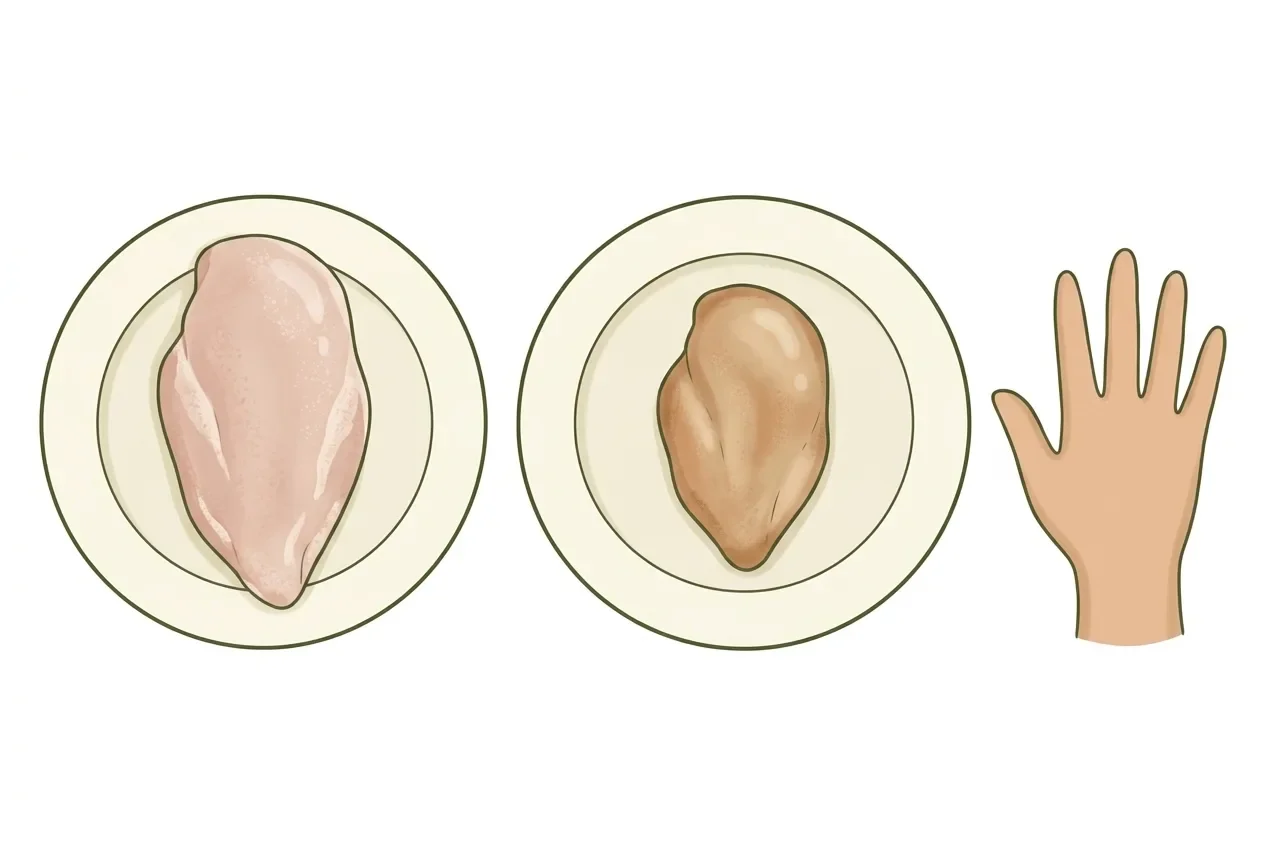
To estimate protein in meat without a scale, size the piece by hand, then apply the right protein-per-100g figure for its state. A palm-sized, finger-thick piece of cooked chicken breast holds roughly 26 to 37 grams of protein. The one costly mistake: reading a cooked piece against a raw database entry, which undercounts by about a quarter.
Start with the weight. As an illustrative range, a palm-sized, finger-thick piece of cooked chicken might run about 85 to 120 g, depending on hand size.
USDA's roasted chicken breast entry lists 31.0 g of protein per 100 g (FDC 171477). At 85 g that's about 26 g of protein; at 120 g, about 37 g. So a palm-sized piece of cooked chicken holds roughly 26 to 37 g of protein, the two ends of that weight range run through the same protein figure.
Cooking drives off water, so the same piece of meat has less mass but the same protein. That concentrates the protein-per-100-g figure without adding any protein.
USDA's numbers show the gap directly. Raw skinless chicken breast holds 22.5 g of protein per 100 g (FDC 171077); roasted, the same cut holds 31.0 g per 100 g (FDC 171477). Roasted chicken breast also keeps about 72.5% of its raw weight, a figure derived from those two USDA protein values rather than a directly measured USDA yield, as shown on Avocalo's chicken breast raw to cooked weight converter.
So a 150 g raw piece cooks down to roughly 109 g, and both weigh out to about the same 34 g of protein. The state changes what number a scale shows. It doesn't change what's on the plate.
Logging a cooked piece against a raw entry is the costly error. A 100 g cooked piece actually holds 31 g of protein; mistakenly logged as 100 g raw, it would show 22.5 g, about 27% low. Matching the weight's state to the entry's state is what keeps the number honest, as the site's raw or cooked weighing guide works through in more depth.
A 2016 study in the Journal of Nutritional Science found that for foods shaped like a simple prism or cylinder, finger-width hand measures put 80% of estimates within 25% of true weight, against 29% for household measures like cups and spoons (Gibson et al., PMC4976119).
Meat cuts don't fit that shape, and the same study measured them separately. It named beef steak, chicken breast and fish fillet specifically as foods where estimation error ran over 50% at both portion sizes tested, for both the hand and household methods. Irregular shapes are harder to size by eye than a food that fits a simple geometric form.
Treat 26 to 37 g as a bracket to log within, not a number to defend to the gram. The raw-to-cooked gap holds across meats too, though the exact numbers shift.
Pan-fried boneless pork chop runs from 21.6 g protein per 100 g raw to 29.4 g cooked, per USDA data cited on Avocalo's pork chop converter. Pan-broiled 85/15 ground beef goes from 18.6 g raw to 24.6 g cooked, per USDA figures in the site's raw or cooked weighing guide. Same mechanism, different starting points: matching weight state to protein figure matters more than the cut itself.
If a deli pack, labelled tray or menu lists a weight, use it. That's a free calibration point against the hand estimate, and it beats guessing entirely.
Without one, the palm-sized range above is the honest fallback. For a rough weight check afterward, Avocalo's chicken breast raw to cooked weight converter linked above converts a guessed weight between raw and cooked. A photo through the Avocalo app gives a second estimate of calories and macros from the meal photo itself, from an AI model reading the image, to compare against the hand guess.
Both are rough visual anchors for a similar weight range, not interchangeable measurements with a fixed conversion. Use whichever object is in view and treat the result as an estimate.
Log it as cooked, since that's the state you're eating. Use a cooked figure like USDA's roasted value, 31.0 g per 100 g, rather than a raw one, to avoid the undercount described above.
Ground meat and stew lose their shape, so a palm-sized comparison is less reliable than for a whole cut like a breast or chop. A package weight is a better starting point here.
USDA FoodData Central, raw chicken breast and roasted chicken breast. Gibson et al., "Accuracy of hands v. household measures as portion size estimation aids," Journal of Nutritional Science, 2016, PMC4976119. Published by Petros IT Solutions SRL. Questions or corrections: [email protected].