Homemade recipes
How to Count Calories in Homemade Soup
Turn one pot of homemade soup into a per-bowl calorie figure: weigh the pot once, sum the ingredients, and divide, worked example included.
Guides
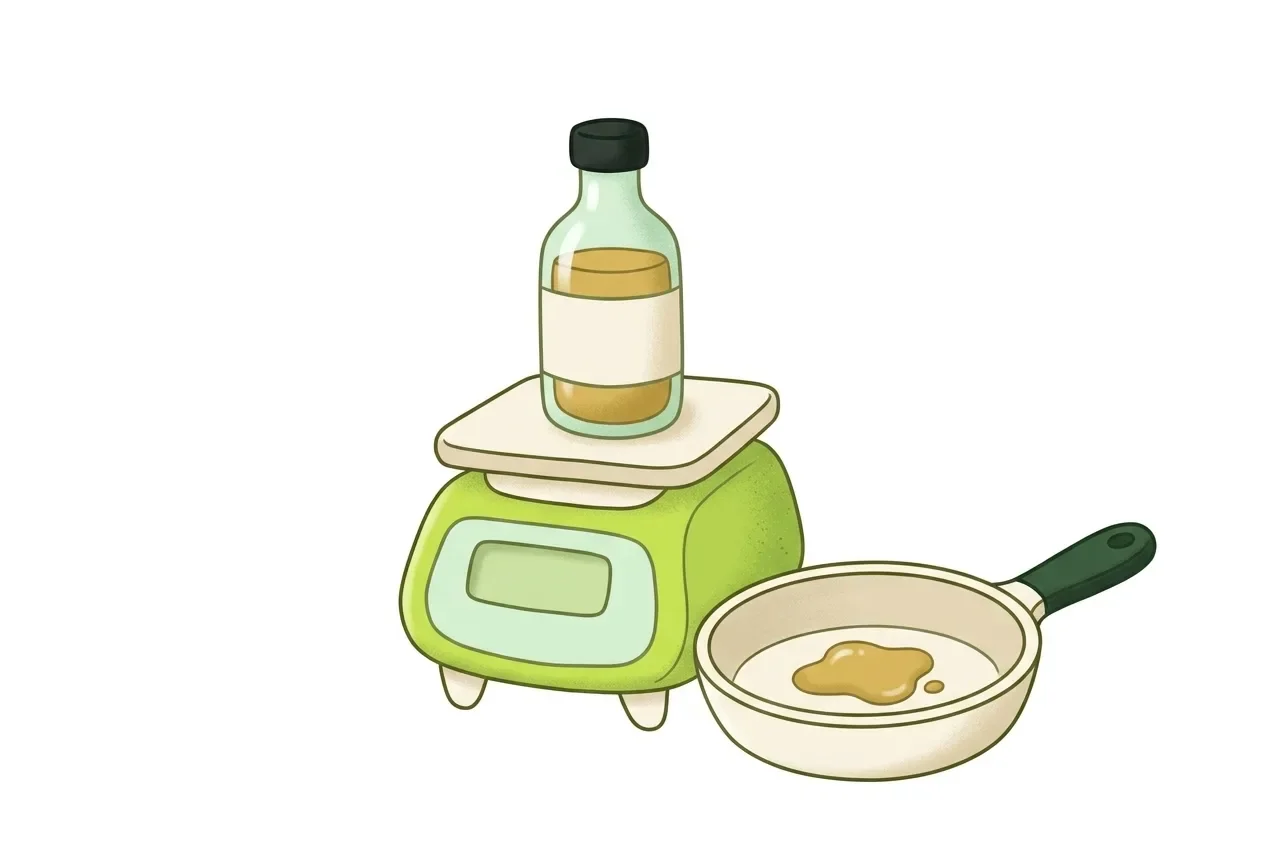
How many calories does cooking oil add to food? A level tablespoon of any cooking oil is about 120 kcal, since oil runs 884 kcal per 100 g and a tablespoon weighs 13.5 g. What lands on the plate is only part of that. A sauté keeps nearly all the oil you poured. A shallow-fried, blotted cutlet keeps a fraction. The fix is to weigh the bottle before and after cooking, then subtract what's left in the pan.
A tablespoon of oil looks the same whether it ends up on the plate or stays behind. That's the problem. The calories are fixed by weight, but the weight that reaches the food is not fixed at all.
USDA's food-composition record for olive oil lists 884 kcal per 100 g. A level tablespoon of it weighs 13.5 g, so that spoon carries about 120 kcal (USDA FoodData Central). That figure never changes. What changes is how much of the spoon's contents the food actually absorbs.
A photo of a stir-fry can't show this. It sees glossy noodles or a browned cutlet, not the grams of fat that soaked in versus the grams left coating the pan. Guessing "a bit of oil" as 40 kcal or 400 kcal is really a guess about absorption, not about the oil itself.
Start with the number that doesn't move. Olive, sunflower and rapeseed oil run 884 kcal per 100 g, and a US tablespoon weighs 13.5 g, giving about 119 to 120 kcal per tablespoon (USDA FoodData Central, olive oil). That figure is the same whether the oil goes into a pan, a dressing or a marinade. A teaspoon, at a third of a tablespoon, comes to roughly 40 kcal.
Butter is different: 717 kcal per 100 g, and a tablespoon weighs slightly more, 14.2 g, for about 102 kcal (USDA FoodData Central, unsalted butter). Butter has water and milk solids that oil doesn't, so its energy per gram is lower even though the tablespoon is a bit heavier.
The food only gets the calories from the oil it actually absorbed, not the calories from everything poured into the pan. A recipe that calls for two tablespoons of oil doesn't put 240 kcal on the plate. It puts however many of those 240 kcal the food picked up, plus whatever visibly clings to the finished dish.
For a sauce-based sauté, scraped onto the plate with a spatula, nearly all of it goes with the food. For a shallow-fried piece lifted out and blotted, most of it stays behind. The gap between those two scenarios is the entire reason a stir-fry logged from a photo can be off by hundreds of calories.
Absorption depends on the food and the oil, not on a single universal rate. A peer-reviewed review of frying oils has the numbers. French fries fried in canola oil pick up about 12% of their weight as oil. The same fries fried in soybean or corn oil pick up 23% to 24% (Mahmud et al., Heliyon, 2023).
The same review lists fat-content increases across deep-fried foods. French fries rise from about 0.2% fat raw to as much as 14% after frying. Potato chips can reach 40% fat. Chicken drumsticks go from about 2% to 18%, and whiting fillets from about 1% to 10.5% (Mahmud et al., 2023).
Those numbers only apply to deep-frying, and only to the specific food and oil tested. They can't be pasted onto a home sauté, where the oil never fully submerges the food and most of it ends up scraped onto the plate rather than absorbed into the food's structure.
The mechanism is about moisture, not about time in the pan. Research on deep-fat frying describes oil moving into food largely as it cools. It replaces water that evaporated out during cooking, filling the space that steam left behind (Bouchon, Advances in Food and Nutrition Research, 2009).
That explains why breaded, high-moisture foods absorb far more oil than a food with little surface area to lose water from. A breaded cutlet or a thin-cut chip has lots of surface area for water to escape and oil to replace it. A seared steak does not.
A stir-fry or sauce-based sauté never goes through that deep cooling-and-refilling cycle the way submerged frying does. The oil mostly stays as a coating, and coatings get scraped onto the plate along with the food. That's why the split between "kept the oil" and "lost the oil" tracks the cooking method more than the ingredient list.
Weigh the oil bottle on a kitchen scale before you start cooking, note the grams, then weigh it again once you've finished pouring. The difference is exactly how much oil left the bottle, no guessing required.
If a shallow-fried piece gets lifted out and blotted, you can also weigh what's left in the pan once it's cooled and scraped onto a plate. Subtract that from what left the bottle, and what remains is the oil the food kept.
For a sauté or stir-fry scraped straight onto the plate with nothing left behind, the full amount that left the bottle is the amount to log. This method sidesteps the entire absorption-percentage debate. A reader doesn't need a published rate for their exact dish, only two weighings and subtraction.
The oil amounts below are illustrative, chosen to divide cleanly; the kcal-per-gram figure is sourced.
Suppose a stir-fry starts with a bottle at 940 g. After cooking, the bottle weighs 920 g, so 20 g of oil left the bottle. The pan is wiped and scraped onto the plate, leaving nothing measurable behind.
| Step | Weight | Oil accounted for |
|---|---|---|
| Bottle before cooking | 940 g | n/a |
| Bottle after cooking | 920 g | 20 g poured |
| Oil left in pan | 0 g | 0 g stayed behind |
| Oil eaten with the dish | n/a | 20 g |
At 884 kcal per 100 g (USDA FoodData Central), 20 g of oil is 20 ÷ 100 × 884, about 177 kcal. That's the number to add to the stir-fry's log entry, on top of whatever the vegetables and protein contribute.
Now compare a shallow-fried cutlet from the same 940 g bottle, poured down to 900 g, so 40 g left the bottle. Say 15 g stays in the pan and on the paper towel after lifting the cutlet out. The food keeps 25 g, or about 221 kcal. That's more than the stir-fry's 177 kcal, even though the stir-fry poured less oil to start with.
A photo of a finished dish can't show how much oil is in it. Avocalo's photo logging uses an AI vision model to estimate the foods, portions, calories and macros from the image, and the user reviews and edits that estimate before saving it. It doesn't weigh food and can't detect hidden oil.
That review step is where the bottle-weighing method fits: work out the oil's calories by hand, then add that figure when editing the estimate. For the arithmetic itself, the site's cooking oil calorie calculator takes the amount that went in the pan, what was left afterward, and the number of portions, and divides it the same way this article does. Once the oil is sorted, the sibling guide on how to count calories in homemade food covers the rest of the recipe, ingredient by ingredient.
The app is free to download, with a subscription and a free trial. Get it from Avocalo.
Yes, essentially. USDA lists olive oil at 884 kcal per 100 g, and sunflower and rapeseed oil share that same figure, since all three are close to pure fat by weight. The type of oil changes flavor and fatty-acid profile, not the calories per gram.
The sourced figure, 884 kcal per 100 g, comes from USDA's record for olive oil labeled "salad or cooking," covering the oil as commonly sold. Refining changes flavor compounds and smoke point far more than it changes the fat content, so any difference in calories per 100 g is likely small.
It's the second one. A spray dispenses less oil per use than pouring from a bottle, but each gram of that oil still carries the same 884 kcal per 100 g. Weighing the bottle before and after several sprays shows the real amount, same as with poured oil.
The sourced review reports absorption rates by food and oil type, such as fries at 12% in canola versus 23% to 24% in soybean oil, but it doesn't report a figure for reused oil specifically. Without a sourced number for that scenario, the safest approach is still to weigh the bottle and the pan directly.
The kcal-per-gram math is identical either way, since oil is 884 kcal per 100 g regardless of method. What differs is how much oil the food keeps: a stir-fry scraped onto the plate keeps nearly all of it, while deep-fried food loses a measurable share back into the fryer, so the weighing step matters more for frying.
This article is published by Petros IT Solutions SRL. Read the editorial policy for how figures are sourced and checked, or send corrections to [email protected].