Homemade recipes
How Many Calories Does Cooking Oil Add to Food?
How many calories does cooking oil add to food? About 120 kcal per tablespoon, but only the oil the food absorbs counts. See the math.
Guides
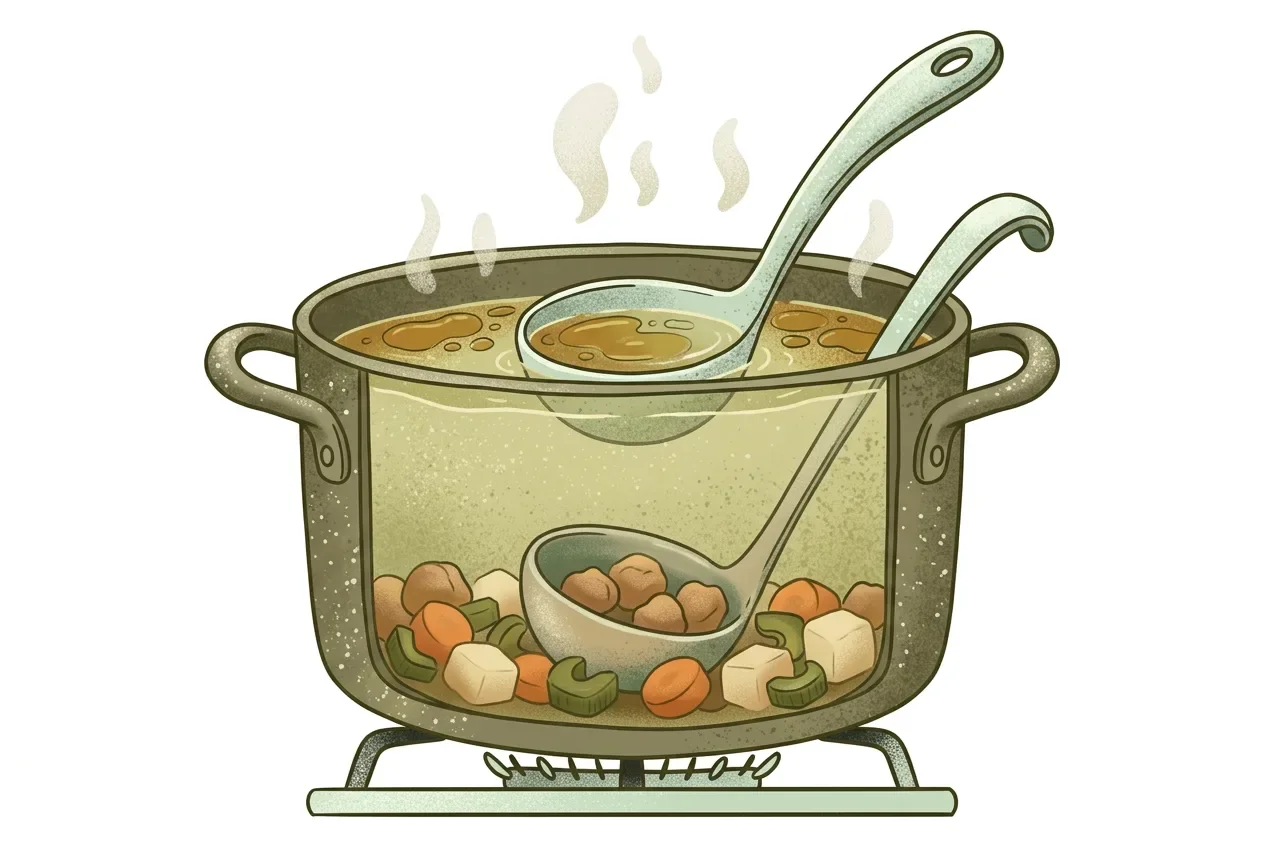
How do you count calories in homemade soup when the pot has no listed serving size? You add up every ingredient that went in, then weigh the finished pot once. Dividing that total by the pot's weight gives calories per gram, and any bowl becomes that figure times its own weight on a scale. Nobody needs to guess how many "servings" a pot holds.
A soup recipe rarely comes with a serving count that matches your pot. A bag of vegetables, a cut of meat, a splash of oil, none of it tells you how many bowls the finished pot will fill.
The fix skips servings entirely. Sum the calories of every raw ingredient before it goes in, using each one's weight and its calories per 100 g. That total never changes once cooking starts, because heat does not add or remove energy from the food itself.
Then weigh the finished pot, or weigh it empty first and subtract. Total recipe calories divided by cooked weight in grams, times 100, gives calories per 100 g of the finished soup. Avocalo's recipe-portion calculator does this exact division once you have both numbers.
Soup adds two wrinkles a plain dish does not have: water leaves as steam while it simmers, and fat separates from the rest once it settles in the bowl. A reader who wants the general ingredient-sum method for any homemade dish can see it worked through in the guide to counting calories in homemade food, but a pot of soup needs the extra steps below.
From there, any bowl is just its weight on a kitchen scale multiplied by that per-100 g figure. The pot's total serving count never has to be decided in advance.
No. Water carries no calories, whether it stays in the pot or leaves as steam.
This matters because a soup shrinks while it simmers. Water evaporates and steam carries it off, but every calorie from the meat, vegetables and oil stays behind. The pot's total calorie count is fixed the moment the last ingredient goes in.
What changes is the concentration. As water leaves, the same fixed total is packed into a smaller weight of soup, so the calories per 100 g creep upward the longer the pot simmers uncovered. A two-hour simmer with the lid off concentrates the soup more than a twenty-minute one with the lid on, even with identical ingredients.
This is why weighing the pot after cooking, not before, is the step that actually matters for a per-100 g figure. The ingredient sum tells you the total. The finished weight tells you how concentrated that total became.
Both, but for different jobs. The raw ingredients give the total calorie count. The finished pot gives the weight to divide that total by.
Weigh each raw ingredient as it goes in: the chicken before it hits the pot, the potatoes after peeling, the oil by the tablespoon. If the sauté oil is a meaningful part of the recipe, the cooking oil calorie calculator can isolate exactly how much it adds before it goes into the pot total. Look up each ingredient's calories per 100 g from a food-composition source and multiply by its weight. Sum all of them for the pot's total.
Separately, weigh the pot once it is cooked. Either weigh the empty pot first and subtract from the full weight, or pour the finished soup into a container on a scale. This cooked weight is smaller than the sum of the raw ingredient weights, because water left as steam.
Once you have both numbers, calories per 100 g of the finished soup follows directly: total calories divided by cooked weight, times 100. That single figure is reusable for any bowl, any day, as long as the recipe does not change.
The exact grams below are illustrative, chosen to divide cleanly, not measured from a real pot. The per-100 g calorie figures for each ingredient are sourced from USDA FoodData Central.
| Ingredient | Raw weight (illustrative) | kcal per 100 g (sourced) | Calories |
|---|---|---|---|
| Chicken thigh, raw skinless | 500 g | 121 | 605 |
| Potato, raw | 400 g | 77 | 308 |
| Carrot, raw | 200 g | 41 | 82 |
| Onion, raw | 200 g | 40 | 80 |
| Olive oil | 25 g | 884 | 221 |
| Water | 2,000 g | 0 | 0 |
| Total | 3,325 g raw | 1,296 kcal |
The chicken thigh figure comes from USDA's raw chicken thigh record. That same record shows a roasted yield of 79.4% of raw weight. This is why cooked chicken looks more concentrated per 100 g than raw chicken, even though its total calories barely move.
Suppose this pot simmers down to 2,800 g once cooked, an illustrative finished weight. Using the recipe-portion calculator's formula: 1,296 kcal ÷ 2,800 g × 100 = 46.3 kcal per 100 g.
A 350 g bowl from that pot works out to roughly 162 kcal (350 g × 0.463 kcal/g). A 450 g bowl comes to about 208 kcal. The same pot, two different bowl sizes, two different totals, all traceable back to one ingredient sum.
Not exactly. Soup is not uniform once it settles. Oil and rendered fat rise, so a ladle skimmed from the surface picks up more of the sauté oil's 884 kcal per 100 g than the pot's average suggests. A ladle from the bottom picks up more meat and potato, which sank as the soup cooled slightly.
An average ladle, one that goes straight down through all the layers, lands closest to the pot's true per-100 g figure. A ladle taken entirely from the top or entirely from the bottom will drift from that average in opposite directions.
This is not a flaw in the ingredient-sum method. It is a reminder that the per-100 g figure is a pot average, and any single ladle can sit slightly above or below it depending on where it came from.
The time of day does not change what is in the bowl. What changes the calorie count is what went into the pot: the sauté oil, whether smântână (sour cream) was stirred in, and the cut of meat used.
All three of those are already counted in the ingredient sum described above. A ciorbă made with a lean cut and no added fat sits at one per-100 g figure. The same recipe with extra oil or a generous spoon of sour cream sits higher, because those ingredients carry their own calories regardless of when the bowl is eaten.
The ingredient sum answers "how much does this ciorbă add" without needing to answer "is evening a bad time," because the pot's calories are fixed the moment cooking finishes.
Once you have a per-100 g figure from the ingredient sum, a bowl becomes a manual weight entry. Avocalo's photo logging estimates calories and macros from a picture of a meal, using an AI vision model that reads the image, and the user reviews and edits the result before saving. It does not weigh food or look the dish up in a database.
For a soup with a known per-100 g figure, a weighed bowl beats a photo guess. A photo cannot see how much oil or sour cream is hiding under the surface, but a kitchen scale can weigh what is actually in the bowl. You can log a weighed bowl in Avocalo once you have that number.
Either works, as long as you get the cooked soup's weight alone. Weighing the empty pot first and subtracting from the full weight avoids needing a separate container. Pouring the soup into a bowl on a scale works just as well if the pot itself is hard to weigh.
The total calories stay the same, since water adds none, but the finished weight changes. Recalculate the per-100 g figure using the new finished weight, not the one you expected before adding water.
Yes, if you discard it rather than stir it back in. The fat that rises to the surface is real oil or rendered fat, and removing it lowers both the pot's total calories and its weight, though only by however much fat you actually scoop out.
Yes, unless the soup loses more water while reheating. Reheating alone does not add or remove calories, but if it simmers uncovered and more steam escapes, the pot's weight drops and the per-100 g figure needs to be recalculated.
This article was written by the Avocalo Editorial Team for Avocalo, published by Petros IT Solutions SRL. Read the editorial policy for how sources and calculations are checked. Spot an error? Write to [email protected].