Intermittent fasting
Can You Drink Protein Shakes While Fasting?
Can you drink protein shakes while fasting? No: a whey scoop is 130 kcal and 24g protein, a meal that belongs in the eating window.
Guides
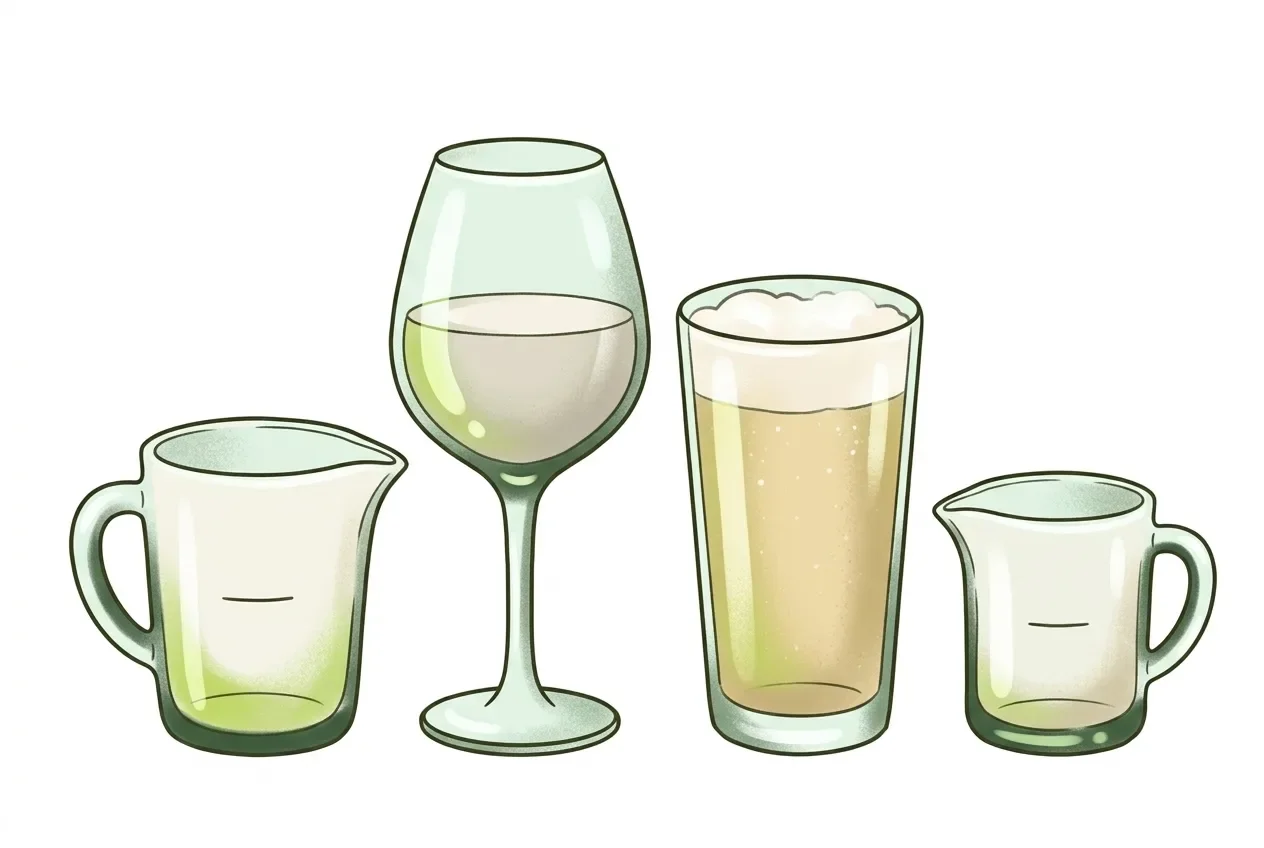
To track alcohol macros, log the drink by hand using its volume and % ABV, not a photo. Alcohol is a fourth energy source at 7 kcal per gram, and calorie apps built around carbs, fat and protein often have no column for it, so a drink's calories get filed under carbs, fat or nowhere. The fix: calculate the alcohol calories yourself and enter them as a manual food.
This isn't a bug. Food labels in the EU are required to declare energy using a fixed set of conversion factors (Regulation (EU) No 1169/2011, Annex XIV), where alcohol converts at 7 kcal/g against 4 kcal/g for carbohydrate and 9 kcal/g for fat. A camera sees liquid in a glass, not its strength. That's why a drink needs the label read and entered by hand.
Every alcoholic drink's label carries the number you need: % ABV, the share of the volume that is pure ethanol. Multiply volume by that percentage to get millilitres of ethanol, then convert to grams, then to calories.
Three constants are fixed. Ethanol has a density of 0.789 g per millilitre, a figure used across NIAAA-style standard-drink calculations. Alcohol supplies 7 kcal per gram, the conversion factor set out in EU food-labelling law (Regulation (EU) No 1169/2011, Annex XIV). So the formula is:
volume (ml) × %ABV × 0.789 g/ml × 7 kcal/g = alcohol calories
Add whatever carbohydrate the drink carries, at 4 kcal per gram, and you have the drink's full calorie count. This works for beer, wine, spirits or a cocktail, as long as you know the volume and the ABV on the bottle.
A "glass of wine" isn't one size. The US standard drink is defined as 14 g of pure alcohol. NIAAA sets that at 12 fl oz of ~5% beer, 5 fl oz of ~12% wine, or 1.5 fl oz of ~40% spirits (NIAAA, Rethinking Drinking). The UK unit is smaller: 10 mL, or 8 g, of pure alcohol (NHS).
Neither matches what actually lands in a glass at home. Kerr and colleagues documented that home-poured drinks vary in ethanol content compared with these standard-drink assumptions (Kerr et al., Alcoholism: Clinical and Experimental Research, 2005). A generous restaurant pour or a taller glass at home can carry more ethanol than the reference volume.
That's why a single "a glass of wine is X calories" rule breaks down. Measuring your own pour, rather than trusting a fixed serving size, keeps the arithmetic honest. If you're weighing other parts of a meal by hand too, how to count calories accurately covers the same measure-don't-assume method beyond drinks.
Yes, and it adds them separately from the alcohol. A spirit itself typically carries no carbohydrate. USDA's record for 80-proof distilled spirits shows 0 g carbohydrate per 100 g (USDA FoodData Central, fdcId 174815). Tonic, cola, juice or a sweet liqueur adds sugar on top of the ethanol's calories, at 4 kcal per gram of that sugar.
Beer and wine already carry their own carbohydrate before any mixer. USDA's table wine entry shows about 2.6 g carbohydrate per 100 g alongside its alcohol (fdcId 174837), and regular beer about 3.6 g per 100 g (fdcId 168746). A sweeter wine or a flavoured beer sits higher again. To log a mixed drink correctly, calculate the spirit's alcohol calories first. Then add the mixer's calories from its own label or a food database entry, as a separate line rather than folding it into one guess.
One input below is illustrative, marked as such: the exact pour sizes (150 mL wine, 500 mL beer, 40 mL spirit) are common serving sizes, not a measurement of any specific glass. The per-100 g figures are USDA's.
| Drink (illustrative pour) | Strength | Alcohol calories | Carb calories | Total |
|---|---|---|---|---|
| Wine, 150 mL | 13% ABV | 150 × 0.13 × 0.789 × 7 ≈ 108 kcal | ~16 kcal (2.6 g/100g × 150 mL = 3.9 g × 4 kcal/g) | ~124 kcal |
| Beer, 500 mL | 5% ABV | 500 × 0.05 × 0.789 × 7 ≈ 138 kcal | ~72 kcal (3.6 g/100g × 500 mL = 18 g × 4 kcal/g) | ~210 kcal |
| Spirit, 40 mL | 40% ABV | 40 × 0.40 × 0.789 × 7 ≈ 88 kcal | 0 kcal | ~88 kcal |
Walk through the wine row. 150 mL of 13% wine holds 150 × 0.13 = 19.5 mL of pure ethanol. At 0.789 g/mL, that's about 15.4 g of alcohol. At 7 kcal/g, that's roughly 108 kcal, before the glass's own carbohydrate.
That carbohydrate adds up too: 150 mL at 2.6 g per 100 g is 3.9 g, or about 16 kcal at 4 kcal/g (USDA fdcId 174837). Together, the wine's alcohol and carbohydrate come to roughly 124 kcal.
The spirit row uses the same three steps: 40 mL × 40% = 16 mL of ethanol, × 0.789 = 12.6 g, × 7 kcal/g ≈ 88 kcal (USDA fdcId 174815). Because 80-proof spirits carry no carbohydrate, that figure is close to the drink's full total, before any mixer.
There's no clean answer, because alcohol isn't a macronutrient at all. Some apps let a drink be logged as a separate alcohol entry, since the app's macro totals still need somewhere to put the calories. Anecdotally, some users report routing it through a carbs or fat quick-add field instead when their app has no alcohol category, though that is a workaround rather than a documented standard.
The calorie total matters more than which macro column absorbs it. If your app has no alcohol field, put the drink's calories under carbs, since carbohydrate and alcohol are both quickly used for energy. Accept that your carb grams for the day will read high. What you're protecting is the day's total energy, not a precise split between carbs and fat, since a macro breakdown built around carbs, fat and protein was never designed to hold a fourth energy source.
Start from the label: volume and % ABV. Run the formula, volume × %ABV × 0.789 × 7. Add any carbohydrate the drink or its mixer carries. Enter that combined number as a manual food entry rather than trying to catch it with a photo.
Avocalo's photo logging reads what a meal looks like in an image. It cannot see a bottle's ABV printed on the label, so a drink is one of the clearer cases for manual entry over a photo. The app's manual log lets you search a food database built from Open Food Facts, USDA FoodData Central and national food-composition tables, or reuse a drink logged before.
If you'd rather skip the arithmetic, the drink calorie calculator runs the same formula. It uses the volume, the strength on the label and the carbohydrate in the glass, and you can carry the result into the app's manual entry. Log it in Avocalo once you have the number.
Alcohol carries calories, at 7 kcal per gram (EU Regulation 1169/2011, Annex XIV), so a drink during a fasting window adds energy the same way food does. Whether that counts as "breaking" a fast depends on the fasting method and the reader's own rules, which is a broader question than this article's calorie arithmetic covers.
Soda water itself carries no calories, but the spirit in the glass does. A vodka soda's calories come entirely from the vodka's ethanol, roughly 88 kcal for a 40 mL, 40% ABV shot (USDA fdcId 174815), not from the mixer.
Usually yes, because it combines higher alcohol content with more residual sugar. Both parts of the formula, the ethanol calories and the carbohydrate calories, run higher than a dry table wine's roughly 2.6 g carbohydrate per 100 g (USDA fdcId 174837).
It depends on the specific beer. A "light" label often means fewer carbohydrate grams, but the calorie total still depends on strength, since a regular beer's alcohol alone contributes about 138 kcal per 500 mL in the table above, on top of roughly 72 kcal from carbohydrate (USDA fdcId 168746).
Because ABV, not volume, drives most of the difference. A 150 mL glass at 13% ABV carries more alcohol calories than the same 150 mL at 9% ABV, since the formula multiplies volume by strength before converting to calories.
Read more on the Avocalo Editorial Team's page and the site's editorial policy. Spot an error? Write to [email protected].
Published by Petros IT Solutions SRL.