Raw vs cooked weight
Do You Weigh Rice Cooked or Uncooked?
Weigh rice raw or cooked, either works, as long as it matches the database entry. See the USDA figures and the exact calorie error if it doesn't.
Guides
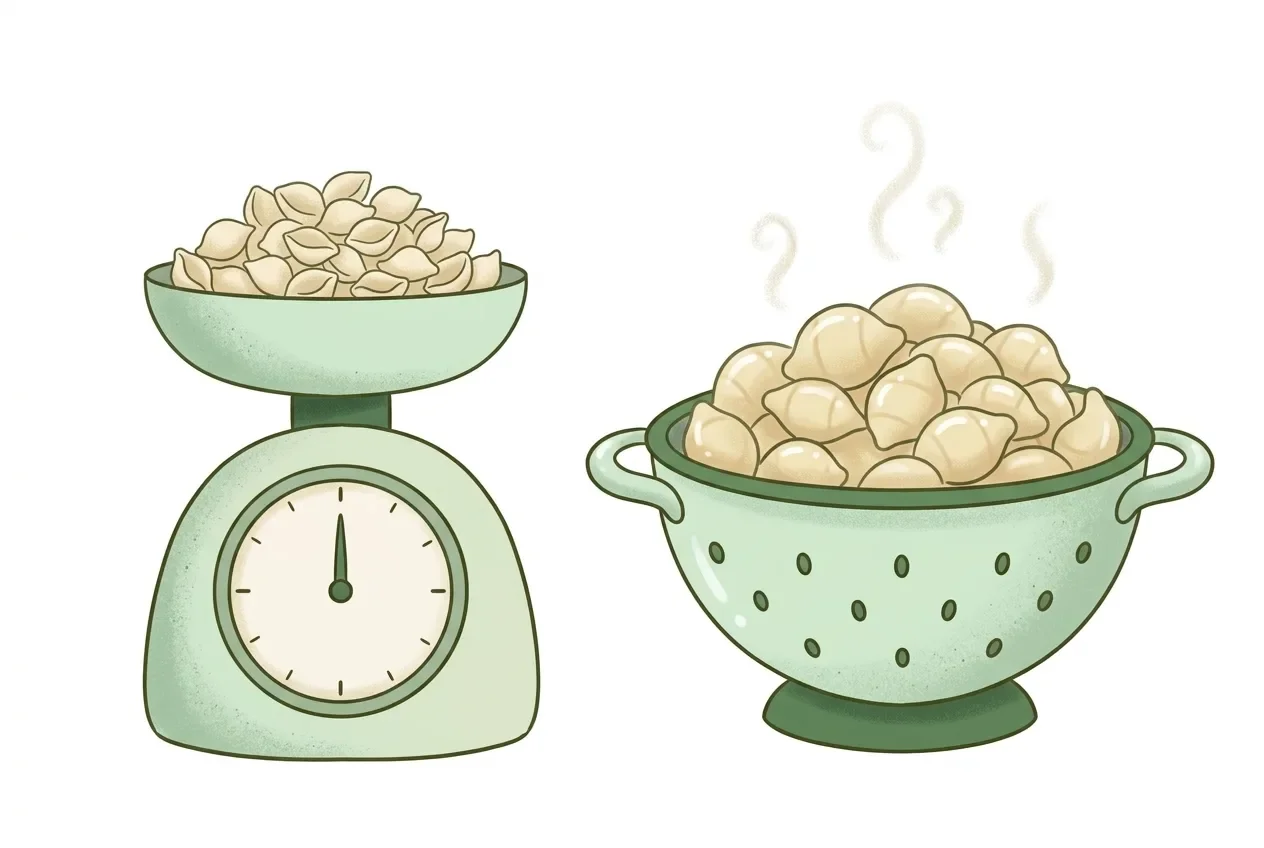
When comparing cooked pasta weight vs dry, weigh pasta dry, before it goes in the water. Dry pasta is a fixed thing: a packet's printed calories, usually around 371 kcal per 100 g for enriched white pasta, always describes the same dry product. Cooked pasta is dry pasta plus however much water your pot let in, and that amount is not fixed. Weighing dry and matching that weight to the packet's own figure removes the one variable the app can't see: how long you boiled it.
Cooked pasta shows fewer calories per 100 g because it is mostly water by weight, and water has no calories. USDA's record for cooked enriched pasta lists 158 kcal per 100 g, against 371 kcal per 100 g dry (FoodData Central 169736, 169737).
That is not pasta losing energy. The same 100 g of dry pasta, once boiled, becomes roughly 238 g of cooked pasta. Its calories are simply spread across more grams.
The water content confirms it. Dry pasta holds 9.90 g of water per 100 g. Cooked pasta holds 62.1 g, a gain of 52.2 g of water per 100 g of the cooked product (FoodData Central 169737). A "cooked pasta" database entry is only ever as accurate as the water content it assumes, and that depends on how long the pasta actually boiled.
Avocalo's raw-to-cooked converter, built from the same USDA pairs above, puts the yield of white pasta at 237.9%: 100 g dry becomes about 238 g cooked. Whole-wheat pasta yields slightly more, 240.3% (the pasta raw-to-cooked weight converter).
These are derived figures, arithmetic from the dry and cooked USDA entries by dry matter. They are not a single direct measurement of one pot on one stove. Published research on pasta cooking confirms the mechanism behind them: water uptake rises with cooking time. The longer the pasta boils, the more it weighs and the lower its calories per 100 g fall (Journal of Food Engineering, 2010).
That is why no single multiplier fits every kitchen. A pot boiled two minutes past al dente will yield more water, and more grams, than the same pasta pulled right on time. The dry weight sidesteps that variability entirely, because the packet's kcal figure never changes with cooking time.
For the same reasoning applied to meat and rice, see the general rule for weighing food raw or cooked.
The 80 g portion below is illustrative, chosen to divide cleanly; the kcal and yield figures are sourced.
Say a packet of enriched white pasta states 371 kcal per 100 g, matching the USDA dry-pasta record. You weigh out 80 g dry.
| Step | Figure | Source |
|---|---|---|
| Dry weight | 80 g | illustrative |
| Dry kcal per 100 g | 371 kcal | USDA FDC 169736 |
| Calories in the 80 g portion | 80 × 3.71 = 296.8 kcal | derived |
| Cooked weight (237.9% yield) | 80 × 2.379 = 190.3 g | Avocalo pasta converter |
| Cooked kcal per 100 g (same 296.8 kcal spread over 190.3 g) | 156 kcal | derived |
That last figure, 156 kcal per 100 g cooked, lands close to USDA's own cooked-pasta record of 158 kcal per 100 g (FDC 169737). Both start from the same dry-to-cooked relationship.
The calories never changed between the two rows. Only the denominator did: 80 g of dry pasta and 190.3 g of cooked pasta describe the same food, at 296.8 kcal either way. Logging the dry weight against the packet's own dry-weight kcal skips the conversion altogether.
If the pasta is already drained and you never weighed it dry, USDA's cooked-pasta record is the closest sourced figure to use: 158 kcal per 100 g for white, 149 kcal per 100 g for whole-wheat. It assumes a cooking time you may not have matched exactly.
A generic "cooked pasta" entry in any database carries the same limitation, since it assumes some average doneness. The gap between a slightly underdone and a well-boiled pot is real. Water uptake keeps rising with time on the stove (Journal of Food Engineering, 2010). If dry weighing is possible next time, it removes this uncertainty for good.
Yes, because al dente pasta has absorbed less water than pasta boiled longer. The mechanism is the same published water-uptake pattern: yield rises with cooking time. Firmer pasta weighs less per 100 g dry-equivalent and carries slightly more calories per 100 g cooked than pasta boiled past that point (Journal of Food Engineering, 2010).
Avocalo's stated yields, 237.9% for white and 240.3% for whole-wheat, are single derived figures, not a range across doneness levels. Treat them as a reasonable middle point rather than an exact match for any specific pot.
The same principle holds. Dry whole-wheat pasta runs 352 kcal per 100 g, cooked whole-wheat pasta runs 149 kcal per 100 g (FDC 169738, FDC 168910). The dry figure is lower than white pasta's, the cooked gap is proportionally similar, and the yield, 240.3%, is close enough to white pasta's 237.9% that the same dry-weighing habit applies to both.
For a whole pot with sauce or other ingredients added, the total cooked weight of the finished dish matters more than any single pasta multiplier. The recipe-portion calculator lets you add each ingredient's weight, including the pasta's dry weight from the pack, weigh the finished pot, and split the total into servings. It returns calories per serving or per 100 g of the cooked dish.
Once you know which number matches your plate, download Avocalo to photograph the finished meal and review the estimate it gives before saving it.
Each app's "cooked pasta" entry assumes its own cooking time and resulting water content. Since yield rises the longer pasta boils, two entries built from different reference cooking times will show different kcal per 100 g, even for the same pasta shape.
No, salt does not carry calories, and any salt left on the pasta after draining is a negligible fraction of the dish's weight. The calorie figures for both dry and cooked pasta above are for pasta cooked without added salt, per the USDA cooked-pasta record (FDC 169737).
Rinsing removes surface starch and a small amount of water, not meaningful calories. The pasta's energy is bound in its carbohydrate and protein content, not on its rinsed-off surface, so the USDA cooked-pasta figures apply either way.
The brief's sourced figures cover dried, packaged pasta only; fresh pasta has a different starting water content and would yield a different ratio. Without a USDA record for fresh pasta's dry-to-cooked change, the safest approach is weighing it dry against whatever label it carries.
This article was published by Petros IT Solutions SRL. See the editorial policy for how it was researched, or send corrections to [email protected].