Protein
Does Collagen Count as Protein?
Does collagen count as protein? Yes on the label, only partly for muscle-building amino acids. The FDA rule and a real label's numbers, explained.
Guides
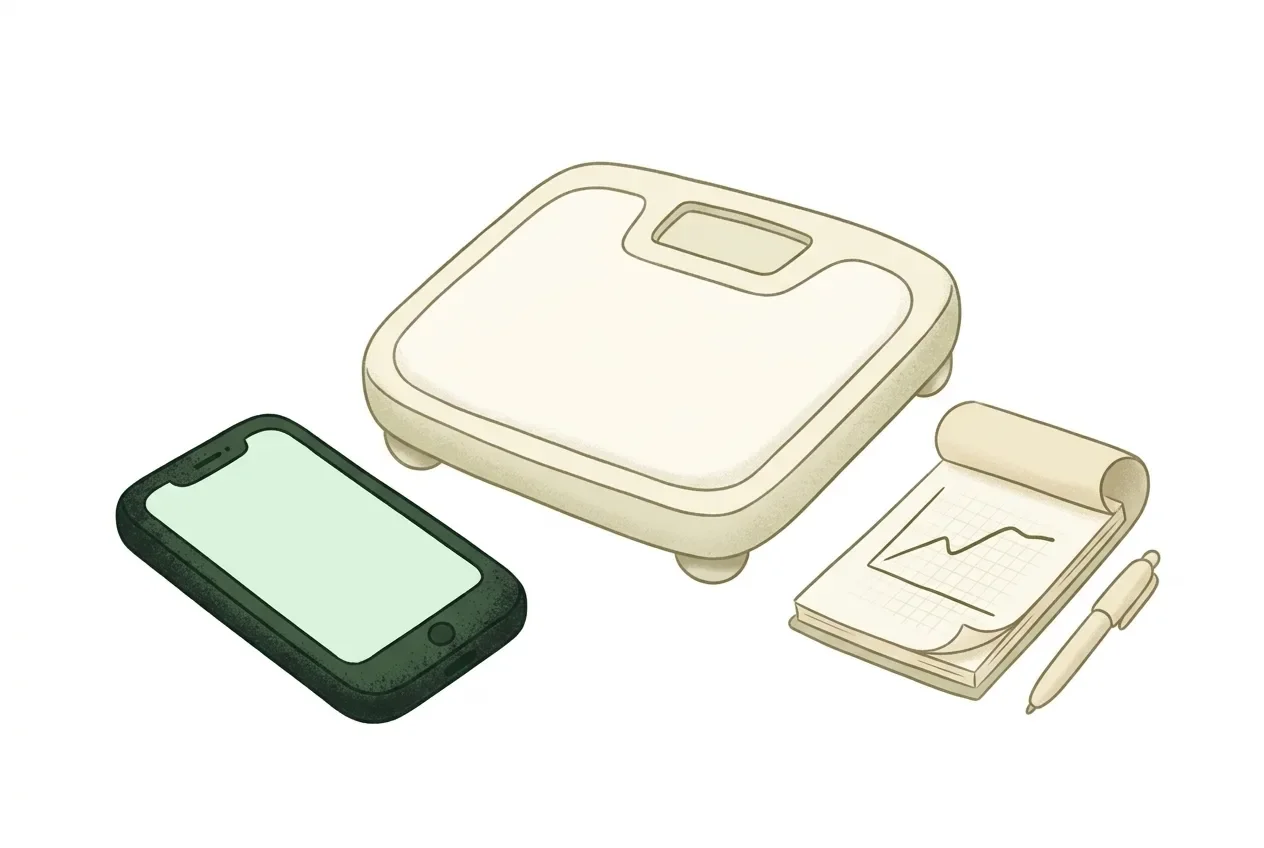
To stop counting calories without gaining weight back, swap daily food logging for a regular weigh-in and watch the trend, logging again only if it drifts. Frequent self-weighing is one of the habits shared by people who keep weight off for years, alongside diet and activity habits they often keep too. Wing and Phelan's 2005 review of the National Weight Control Registry found that most long-term maintainers weigh themselves often, and about half still count calories or fat grams in some form.
Food logging is not something the research says you must drop. It is something you can trade for a cheaper check, if you keep the check.
What happens when you stop counting calories is not usually an immediate slide back to the starting weight. It is a slow drift: a few days where portions creep up half-noticed, unmarked by any log because there isn't one anymore. Nothing about stopping food logging itself undoes the loss. The risk is losing the tool that notices the drift, whatever that tool is.
In short
- NWCR members whose self-weighing frequency dropped regained 4.0 kg at one year, versus 1.8 kg for those who kept weighing the same, versus 1.1 kg for those who weighed more often (Butryn et al., Obesity, 2007).
- Over a third of registry members weighed themselves daily at baseline (Butryn et al., 2007).
- Frequent self-weighing is one of the habits registry maintainers report, alongside diet and activity habits (Wing and Phelan, 2005).
That is why the exit plan below is not "stop everything." It swaps daily food logging for a cheaper, ongoing check that still catches a real drift while it is small, and keeps a way to go back to logging briefly if that check flags something.
A regular weigh-in can carry the job daily food logging was doing. Weight is a single number, quick to record. It reflects the week's calorie balance whether or not each meal was written down. This is the cheap check the maintenance research points to as one part of what maintainers do.
Weigh yourself several times a week after you stop tracking food, so you see a trend rather than one reading. In the registry data, people who kept weighing regularly after losing weight regained far less than those who let the habit lapse. Those who weighed more often regained 1.1 kg at one year, against 4.0 kg for those who weighed less (Butryn et al., 2007).
A single morning's number bounces with water and food in the gut. A trend line smooths that out and shows the direction that actually matters. This does not mean logging weight with the same intensity as food. It means picking a cadence you'll actually keep, several times a week is enough to build a trend, and sticking to it longer than the first weeks after you stop tracking meals.
Stopping mental tallying works the same way as stopping the app: replace it with the scale trend, not with more counting. Running a rough calorie count in your head all day is food logging without the log. It carries the same mental load without producing a number anyone can act on.
When a nagging thought about a meal shows up, the better response is not to estimate it silently. It's to notice whether the weekly trend has actually moved. If it hasn't, the mental math was solving a problem that wasn't there.
You catch regain early by watching the trend, not the daily number, and reacting to a real shift rather than a single high reading. A short stretch of higher numbers after a salty meal or a heavier week is normal noise. What matters is whether the smoothed trend keeps climbing over multiple weeks.
Avocalo's free weight trend calculator does exactly this. Paste in your weigh-ins and it shows the 7-day average, a smoothed trend line, and whether the weekly rate is still flat or has turned upward. It calls a real shift only once the range of likely rates sits clearly above zero, the same logic behind watching a pattern rather than one bad morning.
A single higher reading is often water rather than a trend break. A guide on why the scale can rise even while fat loss is still on track covers the usual culprits: salt and carbs, none of which mean the plan stopped working. For tips on weighing food accurately, see the guide on counting calories accurately.
A recalibration week is a short return to logging, used to find out what changed rather than to police every calorie. If the trend on the scale drifts upward for a few weeks running, logging food again for about a week is a fast way to see why. It's not a punishment or a return to daily counting forever, just a diagnostic.
During that week, the log itself does the noticing: a bigger serving of rice, a heavier pour of oil, an extra handful of something eaten standing up, all show up once weighed and written down again, the same way they did the first time. A week of logging is usually enough to find the change and correct it, after which the log can close again.
This is also the moment the app's frequent and recent items list earns its keep. A week of logging goes faster when meals you already ate regularly during your original tracking period are one tap away, instead of a fresh search each time.
The following body-weight figures are illustrative, invented to show how the arithmetic works, not measurements from any study.
Say someone stopped daily food logging three months ago and has been weighing in three times a week. Their smoothed trend sits at 70.0 kg for most of that stretch. Over the last three weeks it creeps to 70.4, 70.9, and 71.3 kg.
| Week | Smoothed trend (kg) | Change from prior week |
|---|---|---|
| Baseline (months 1 to 2) | 70.0 | none |
| Week 1 of drift | 70.4 | +0.4 |
| Week 2 of drift | 70.9 | +0.5 |
| Week 3 of drift | 71.3 | +0.4 |
Three consecutive weeks of roughly +0.4 to +0.5 kg is a pattern, not noise. This is the trigger for a recalibration week: log meals for seven days, look for the portion that quietly grew, and adjust. Once the trend flattens back out over the following weeks, the log closes again until the next drift.
Avocalo's core use is photographing meals to estimate calories and macros, which is what most people use during the active tracking phase. Once you stop logging daily, the app's weight tracker and its 7-day, 30-day and 3-month statistics become the tool that matters.
The app also keeps a list of recent and frequent items, which is what makes a short recalibration week faster than starting from scratch.
The app gives no calorie or macro target in these guides, and it does not diagnose regain. It only shows the numbers you log. For the occasional week of renewed logging, or for tracking weight and trends day to day, download Avocalo.
Not by itself. What the registry data show is an association between self-weighing frequency and regain. Members who weighed themselves less often after losing weight regained more, 4.0 kg at one year, than those who kept weighing regularly, 1.1 kg, per Butryn et al., 2007. The data point to keeping the scale check, not to keeping the food log specifically.
There's no fixed number of weeks in the research reviewed here. A practical marker is that you can commit to weighing in regularly once logging stops, and to a short recalibration week if the trend drifts. Readiness is about having the check in place, not about a set number of tracked weeks.
Treat a multi-week upward trend, not a single high reading, as the signal to log food again for about a week. This recalibration finds the portion or habit that changed, and the log can close again once the trend flattens.
Yes, it's a common worry, since the log has been the visible proof that the plan is working. The registry findings suggest a regular scale trend can also carry that job, which is why the exit plan pairs stopping logging with keeping a weigh-in habit.
Yes, that's the core of the approach described here: stop daily food logging and start regular self-weighing with a trend view. Keep a short recalibration week in reserve for whenever the trend drifts, rather than returning to daily logging by default.
This article was written by the Avocalo Editorial Team for Avocalo, published by Petros IT Solutions SRL. See the editorial policy for how it was researched. Spot an error? Write to [email protected].