Homemade recipes
How to Count Calories in Homemade Soup
Turn one pot of homemade soup into a per-bowl calorie figure: weigh the pot once, sum the ingredients, and divide, worked example included.
Guides
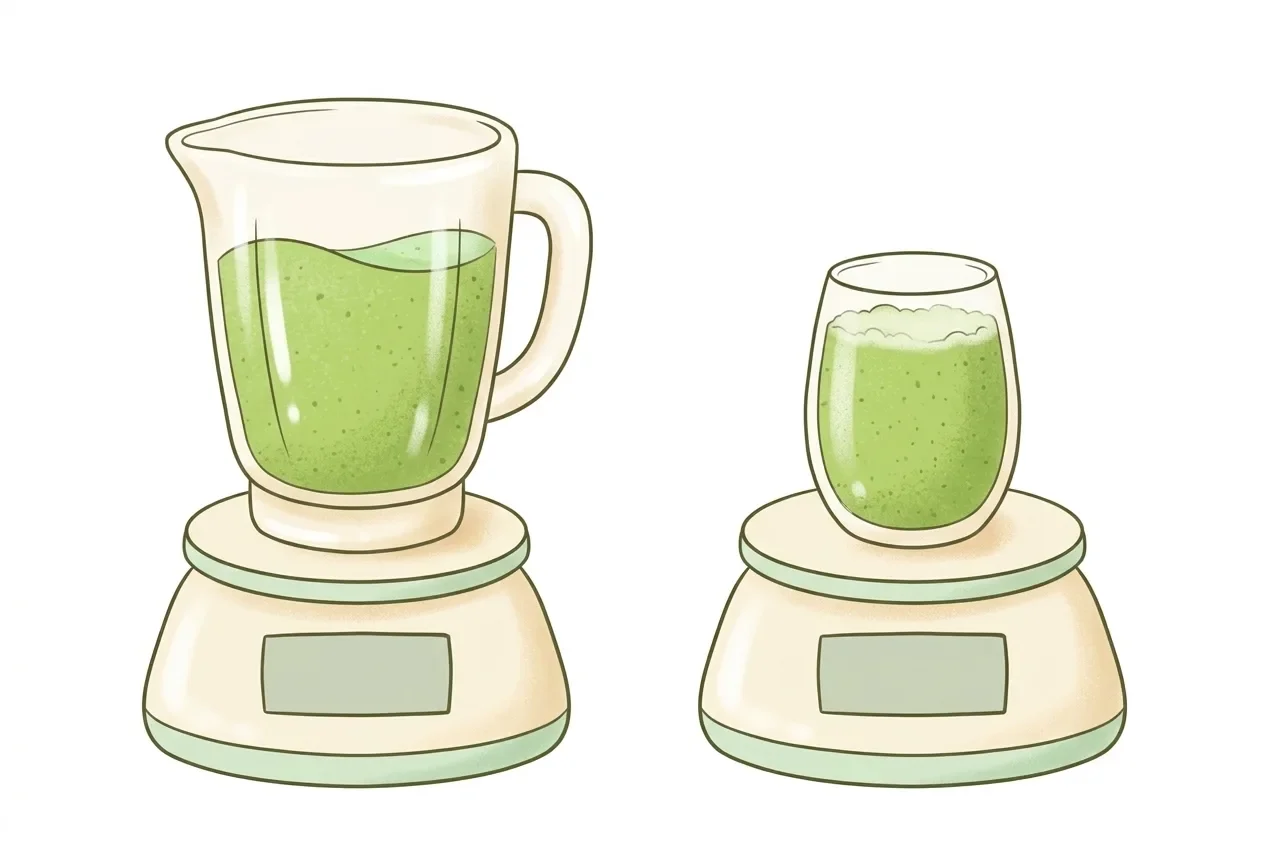
The calories in a smoothie equal the sum of every ingredient's calories as it goes into the blender, whatever you do to it afterward. Weigh each ingredient rather than eyeballing a cup, multiply by its calories per 100 g, and add the results. The blender changes texture and volume, not the number you just calculated.
This is the same method used for any homemade dish: sum the raw ingredients once, then work out portions from that fixed total. The site's guide on counting calories in homemade food walks through the identical approach for a cooked meal.
Weigh ingredients rather than measuring by cup or spoon. A cup of rolled oats or a spoon of peanut butter packs to different densities depending on how it's scooped, so volume measures introduce error a scale avoids. This matters most for dense, calorie-heavy add-ins like nut butters, which can rival the fruit's contribution despite looking like a minor extra.
No, ice and water add zero calories, so diluting a smoothie lowers its calories per 100 ml while leaving the total unchanged. Water has no meaningful energy content, and ice is just frozen water. Pour a 500 g smoothie into a 700 g one by adding 200 g of ice, and the calorie total from the ingredients stays exactly where it was.
What changes is concentration, not quantity. A thinner smoothie has fewer calories per ounce, but the same total calories overall, because ice and water contribute nothing to the sum. A blender jug marked at 600 ml might hold a thick 500 g smoothie or a watery 650 g one made from identical ingredients, and the total calories are the same either way.
Split by weight, not by glass or by a fraction eyeballed from the jug. Weigh the full batch once it's blended, weigh the glass you poured, and the glass's share of the total calories equals its share of the total weight.
Illustrative figures, not measured: say a blender holds 600 g of finished smoothie and a glass holds 350 g. That glass is 350/600 of the batch, or about 58%. Pouring "half the blender" by eye isn't the same as pouring half the weight, since froth and ice settle unevenly.
The site's recipe-portion calculator does this division. Add the ingredients or enter the total calories, then the batch's cooked weight and the glass's weight. It returns calories for the portion actually in your hand.
Milk and yogurt carry hidden calories in smoothies that a "just fruit and water" tally skips. Checking the carton's own nutrition label for the milk used is the most direct source for that ingredient, since a label is printed for the exact product in hand.
Once the total and the per-glass split are worked out, save the result so the arithmetic isn't repeated tomorrow. The Avocalo app can save a logged item as a reusable frequent item. A smoothie made the same way logs in one tap next time instead of being recalculated from scratch.
The Avocalo app doesn't weigh food or look up the recipe automatically. The ingredient sum and the portion split still happen first, using a scale and the calculator above. For the wider principle behind weighing over eyeballing, how to count calories accurately covers the method this smoothie approach is drawn from.
No. Blending rearranges food physically, breaking cell walls and mixing components, but it neither creates nor destroys energy. The calorie total of the blended mixture equals the sum of what went in, unchanged by how smooth or chunky the result is.
Frozen fruit is usually fresh fruit frozen shortly after picking. Its calorie content per 100 g stays close to the fresh equivalent, with any difference coming from water loss or gain during freezing. Weighing the frozen fruit as used still gives the most accurate total for that batch.
A volume measure like a cup or scoop can be converted using the household-measure weights some food databases list alongside gram values, but this carries more error than weighing directly. Reweighing the same ingredients on a scale next time removes that uncertainty for future batches.
This article's method follows the standard approach to homemade-recipe calorie counting: summing weighed ingredients once and dividing the fixed total by weight, not volume. The USDA FoodData Central records below are the correct record-level source for readers looking up their own ingredients. A milk carton's own nutrition declaration is the most direct source for that ingredient.
Published by Petros IT Solutions SRL. Spotted an error? Write to [email protected].