Hidden calories
Why Does Snacking at Night Make You Gain Weight?
Does snacking at night make you gain weight? Mostly not the hour: see why, with two trials and a worked weekly example you can reproduce.
Guides
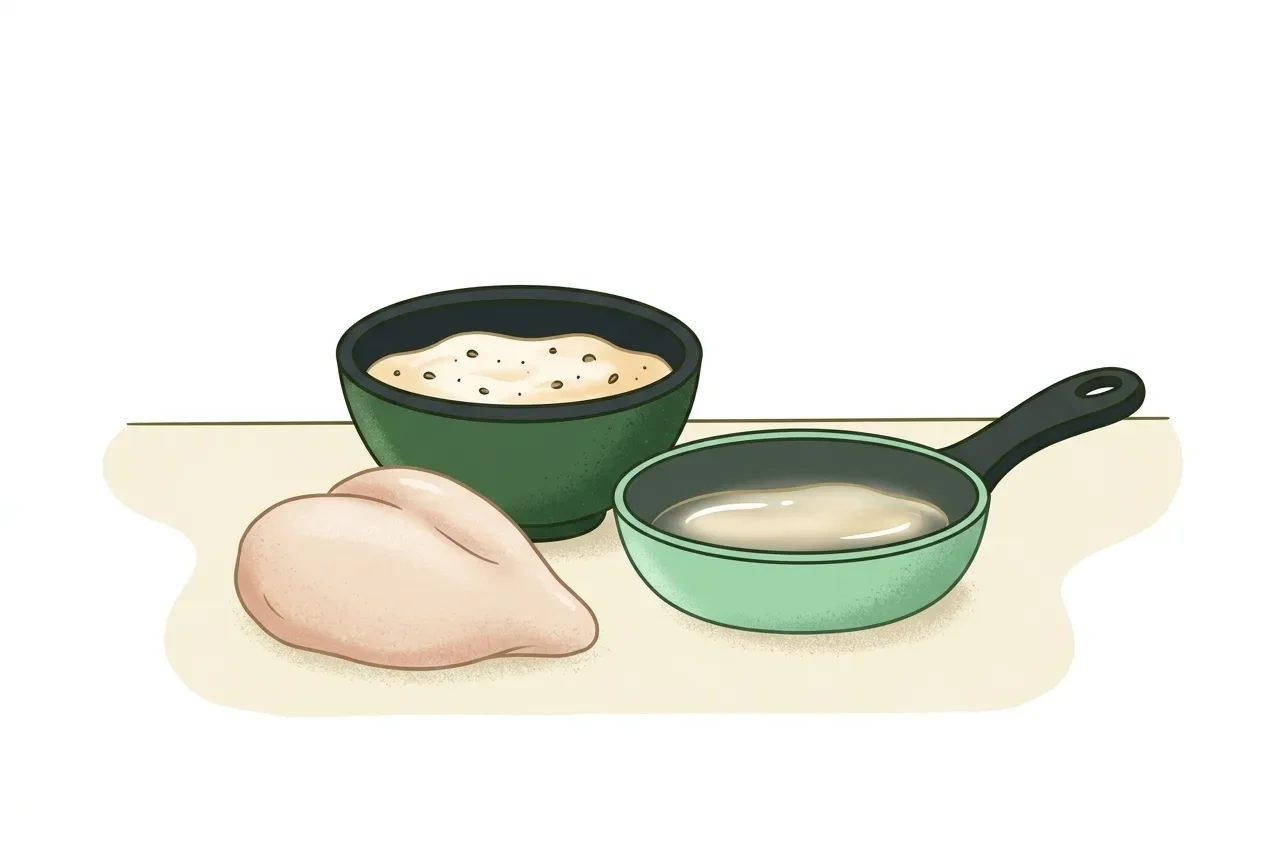
Hidden calories in sauces come down to the spoon, not the name on the bottle. A level tablespoon can hold anywhere from under 10 calories to about 120. Olive oil runs about 884 kcal per 100 g, roughly 120 kcal in a 13.5 g tablespoon, per USDA FoodData Central (fdc.nal.usda.gov). Regular mayonnaise is close behind at 680 kcal per 100 g, about 95 kcal per 14 g tablespoon (680 × 0.14 = 95.2) (fdc.nal.usda.gov).
Ranch dressing sits in the middle. It's 430 kcal per 100 g, about 65 kcal per 15 g tablespoon (430 × 0.15 = 64.5) (fdc.nal.usda.gov). A heavier fill weight would push this higher, since the figure scales directly with the tablespoon's weight. Ketchup and soy sauce are mostly water, salt and sugar rather than fat. They land far lower: ketchup at 101 kcal per 100 g, about 17 to 19 kcal a tablespoon (fdc.nal.usda.gov), and soy sauce at just 53 kcal per 100 g, under 10 kcal a tablespoon (fdc.nal.usda.gov).
That's more than a tenfold range in a single spoon-shaped unit: olive oil's roughly 120 kcal per tablespoon against soy sauce's under 10 kcal, about 12 times more. Weighing the chicken and rice to the gram, then guessing at the sauce, throws away most of the precision the rest of the log had.
Not if it's still in the pan. Oil that went into a hot pan has only two places to go. It ends up on the food, or it's left behind as a visible film once the food comes out.
If the pan is wiped clean, all the oil that went in reached the plate. If a spoonful is still pooled at the bottom, that portion never reached the food. It shouldn't be logged as eaten. There's no absorption estimate to apply here. The physical amount is right there to look at and weigh.
This is different from a sauce poured over food at the table, which is entirely eaten by definition. It's different again from a marinade, which the meat sits in rather than is cooked in.
Only the amount the food actually absorbs. That's a small fraction of the bowl, not a guessed-at third or half. A study on chicken breast immersed in a marinade for 15 hours at 4°C measured the meat's weight gain at 4.91%, plus or minus 0.21%, over the course of soaking (pmc.ncbi.nlm.nih.gov).
A separate paper on still marinating chicken parts found weight gain reaching about 12% after 8 hours. Most of the uptake happened in the first 4 hours (sciencedirect.com).
Both figures describe immersion marinating, where the meat sits in liquid without being pierced or injected. Neither is a rule for every marinade. Salt content, time and whether the surface is scored all change how much liquid gets pulled in. What both studies show is that far less than half the bowl ends up in the meat. It's closer to a twentieth, or at most an eighth, of the meat's own weight, not the marinade's.
The marinade left in the bowl after cooking was never eaten. It doesn't belong in the log at all.
Weigh the container before pouring and after, then read the label's energy per 100 g or per serving. A kitchen scale that measures to the gram turns "some mayo" into a real number in under a minute.
For a sauce made ahead, like a marinade or a salad dressing mixed at home, weigh the empty bowl, then the bowl with the sauce, then whatever's poured off or left behind after the meal. The difference is what was actually eaten.
For a bottled sauce, the label states kcal per 15 ml or per 100 g directly. A level tablespoon, about 15 ml for most sauces, reads straight off the label without any conversion.
For oil in a pan, the same logic applies. Weigh the bottle before cooking and after, or weigh what's left in the pan and subtract it from what went in. Either method replaces a guess with a measurement in about the same time the guess would have taken.
Table sauces built on tomato, vinegar or soy tend to be mostly water. They don't carry much energy per spoonful. The table below lines up the five sourced figures from USDA FoodData Central on the same per-tablespoon scale.
| Sauce or fat | kcal per 100 g | kcal per tablespoon (approx.) |
|---|---|---|
| Olive oil | 884 | 120 |
| Mayonnaise, regular | 680 | 95 |
| Ranch dressing, regular | 430 | 65 |
| Ketchup | 101 | 17-19 |
| Soy sauce (shoyu) | 53 | under 10 |
Source: USDA FoodData Central records linked above, each fetched at record level.
Olive oil's 884 kcal per 100 g is nearly seventeenfold soy sauce's 53 kcal per 100 g (884 ÷ 53 ≈ 16.7). The fat content, not the flavor or the "sauce" label, decides where a spoonful lands. Among these five, ketchup and soy sauce carry the least energy per spoonful; oils, mayonnaise and creamy dressings carry the most.
The starting weights below are illustrative, chosen so the arithmetic is easy to follow. The marinade uptake percentage applied to them is the sourced figure from the 15-hour immersion study.
Say a chicken breast weighing 200 g sits in 150 g of a honey-soy marinade overnight, then is cooked and the leftover marinade is poured away.
| Step | Weight |
|---|---|
| Chicken breast, raw, before marinating | 200 g |
| Marinade, poured into the bowl | 150 g |
| Chicken breast, after marinating, before cooking | 210 g |
| Marinade absorbed by the chicken | 10 g |
The 10 g gained matches the 4.91% uptake measured over 15 hours of immersion marinating in the cited study (pmc.ncbi.nlm.nih.gov). 200 g times 4.91% is about 9.8 g, rounding to 10 g.
Say the marinade itself runs 80 kcal per 100 g, an illustrative figure for a honey-soy mix. Then 10 g of it carries about 8 kcal, a small addition next to the chicken's own calories. The remaining 140 g of marinade in the bowl, poured down the sink, was never eaten. It isn't logged.
This complements the ingredient-by-ingredient method covered in the worked example for a whole homemade dish, which also shows how to convert a dish's total into calories per serving.
Avocalo's photo logging works from an AI vision model reading the image. It identifies the foods and estimates portions, calories and macros from what's visible in the photo. A photo can't see the oil left in a pan off-frame, the marinade a piece of chicken sat in overnight, or a sauce mixed invisibly through a dish.
That's exactly where editing the estimate before saving matters. Add the weighed spoon of oil or the marinade's small absorbed share by hand, using the method above. The app's manual logging also lets you search its food database, built from Open Food Facts, USDA FoodData Central and national food-composition tables, to log a sauce directly instead of estimating it from a photo.
For a pan of oil and several table sauces added to a dish, the cooking-oil calorie calculator divides the pan's fat between portions and adds up to 10 extras in one pass. Avocalo is free to download, with a subscription and free trial. Download Avocalo from the App Store or Google Play.
Not entirely, but close for typical use. USDA FoodData Central lists soy sauce (shoyu) at 53 kcal per 100 g, under 10 kcal per tablespoon (fdc.nal.usda.gov). A splash or two rarely changes a day's total, though its sodium content is separately worth noting on a label.
Yes. Injection and vacuum tumbling pull in far more liquid than plain immersion soaking. The cited immersion study measured 4.91% weight gain over 15 hours (pmc.ncbi.nlm.nih.gov); vacuum tumbling in the same study reached much higher uptake, so a marinade forced into the meat should be weighed separately rather than assumed similar.
Weigh it as it's added to the dish, at the point it reaches the plate. If a sauce is combined with other ingredients before serving, weighing the finished mixture and applying its label or a recipe total, as in the recipe-portion calculator, keeps every ingredient accounted for once.
It lowers the number but doesn't remove the need to measure it. A light dressing still has its own kcal per 100 g on the label, and a heaped spoonful of anything can run higher than the level tablespoon a package's stated serving assumes.
This article is published by Petros IT Solutions SRL. See the editorial policy for how Avocalo's guides are researched and checked. Spot an error? Write to [email protected].